
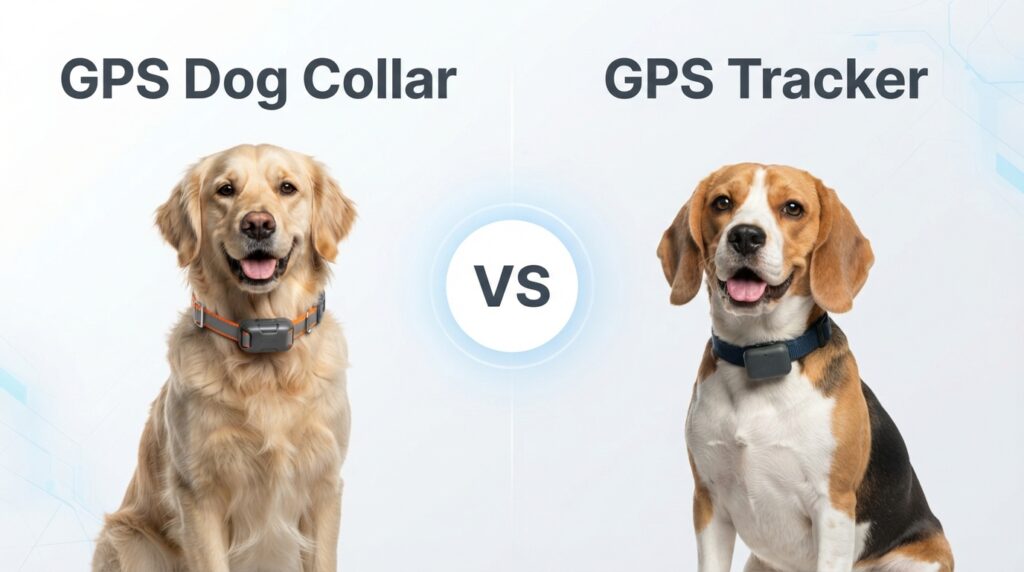
“GPS collar” and “GPS tracker” sound interchangeable, but the hardware and the day-to-day experience can be very different. Here’s the short version:
- Integrated GPS collar (smart collar): the GPS and cellular hardware are built into the collar itself.
- Clip-on GPS tracker: a small standalone device that attaches to a collar or harness you already own.
- Virtual-fence collar: a GPS collar that also alerts you, or in some designs prompts your dog, when your dog crosses a boundary you draw in an app.
- Bluetooth tracker: a short-range tag that relies on nearby phones to report its location. It is not live GPS tracking.
No single type wins for every dog. The right choice depends on your dog’s size, your escape risk, where you live and hike, and how you feel about monthly fees. This guide explains each format so you can choose with confidence.
This is an editorial guide based on manufacturer documentation and public technical sources. PetTrackerHub has not run hands-on tests for this article, and product specs, pricing, and coverage change, so check the manufacturer’s current page before buying.
GPS Dog Collar vs GPS Tracker: What’s the Difference?
Quick answer: A GPS dog collar is a wearable with location technology built in. A GPS dog tracker is a separate device that clips onto a collar. Both can use the same underlying technology, but the form factor changes fit, portability, battery size, and what happens when you replace a worn collar.
The confusion comes from marketing. Some brands call a clip-on device a “GPS collar” because the dog wears it on a collar. Others sell a true smart collar with the electronics sealed inside. Searches like “GPS dog collar vs dog tracker” and “GPS tracker vs GPS collar” are usually the same question: do I want the hardware built into the collar, or attached to it?
A second question sits underneath: how does the location reach me? That depends on whether the device uses cellular networks, Bluetooth, or radio, covered below.
What Is a GPS Dog Collar?
A GPS dog collar is a collar with a GPS receiver, battery, and usually a cellular radio inside the collar body or a fixed module on it. Owners often search for a “smart dog collar with GPS” or an “integrated GPS dog collar.”
Typical strengths
- One item to put on the dog, with no clip to loosen or lose
- Often designed around a specific strap for a secure, low-profile fit
- Many include extras such as safe-zone alerts, activity data, or a built-in light
Typical trade-offs
- If the collar wears out or the dog outgrows it, you may replace the electronics too, depending on the design
- Fit options and sizing can be narrower than with a universal clip-on
- You’re tied to the maker’s collar styles
Some integrated collars add a virtual fence, which we cover in its own section because it’s a different feature, not just a different shape.
What Is a GPS Dog Tracker?
A GPS dog tracker is a small standalone unit, usually with a built-in cellular connection, that attaches to a collar or harness. Owners searching “GPS tracker for dogs” typically mean this format.
Cellular clip-on trackers work in two steps. The device determines its position from satellites, then sends that position over a cellular network to a server and your app. Tractive’s Help Center says its trackers use LTE Cat-M1 as the primary connection with 2G as a fallback, and that cellular coverage is required. Their support pages also note the tracker doesn’t connect to exactly the same networks as your phone, so “it works wherever my phone works” is a rule of thumb, not a guarantee.
If you’re comparing cellular clip-ons, our guide to the best GPS trackers for dogs covers current options in more depth.
Integrated GPS Collar vs Clip-On GPS Tracker
This is the decision most readers actually face. Here’s how the two formats compare on the points that matter over months of ownership.
| Factor | Integrated GPS collar | Clip-on GPS tracker |
|---|---|---|
| Existing collar | Replaces it | Uses any compatible collar or harness |
| Portability | Tied to that collar | Easy to move between collars, harnesses, or dogs |
| Attachment security | Generally fixed; no clip to fail | Depends on the collar slot, clip, and strap width |
| Appearance | Cleaner, one piece | Visible bulge on the collar |
| Weight and dog size | Weight is spread along the strap | Weight sits in one spot; can matter on small dogs |
| Collar replacement | May mean replacing electronics | Just swap the collar |
| Flexibility | Limited to maker’s styles | Works with the collar you already like |
| Long-term ownership | One ecosystem | Can outlast several collars |
When an integrated collar makes sense: you want a single, secure, low-fuss setup, or you want built-in virtual-fence features, and you’re comfortable with one maker’s collar options.
When a clip-on makes more sense: you already have a collar your dog likes, you want to switch the device between dogs or harnesses, you travel with a specific harness, or your dog is between sizes and you’d rather not replace electronics with each new collar.
Fit matters for both. Manufacturers list a minimum recommended dog size and maximum collar width for clip-ons. For example, Tractive’s official specs treat its larger-battery model and its smaller model as suited to different dog sizes. Check the current numbers on the manufacturer’s page before buying rather than trusting a summary, including this one.
Clip-on with health monitoring: some clip-ons add activity or health features on top of location. If that interests you, our Whistle Go Explore review shows how a GPS-plus-health tracker was positioned, which is useful context for evaluating similar devices today.
GPS Tracking vs GPS Containment
A GPS tracker answers one question: Where is my dog?
A GPS containment or virtual-fence collar can also answer: Has my dog crossed a boundary I set?
With a virtual fence, you draw a zone in an app, such as your yard or a campsite. When your dog leaves it, you get an alert. Some collar systems can also give the dog a cue such as a sound or vibration, while others only notify you. Features vary a lot by product, so read exactly what happens at the boundary before buying.
Virtual fencing is not a physical fence. It relies on GPS position estimates, which drift, and on the collar’s battery and connection. A dog can cross a boundary before you get an alert, or the system may misjudge position near the edge. Treat it as an early-warning and training-support tool, not a guaranteed barrier. A containment collar makes sense when you want boundary alerts and possibly training cues, not just a map.
GPS vs Bluetooth vs RF Dog Trackers
These are three different technologies. Lumping them together is how owners end up with the wrong device.
GPS + cellular. The device gets its position from satellites and reports it over cellular networks. Best for live tracking over long distances, but it needs coverage and generally a subscription.
Bluetooth / crowd-network trackers. These broadcast a short-range signal. Location only updates when another compatible device happens to pass within range. Apple has said AirTag is designed to track items, not pets. That makes it a nearby-finding and low-cost aid, not a live tracker. A dog running through a forest or field with no compatible phones around may not update at all.
RF (radio) trackers. A collar transmits directly to a handheld receiver you carry. There’s no cell network or monthly fee, which is why this format is common in hunting and field work. Range depends on terrain and antenna, and you need to carry the handheld.
GPS + virtual fence. This is a feature layer, usually on top of cellular GPS.
If subscriptions are the sticking point, our roundup of dog tracking devices without monthly subscription fees breaks down which no-fee options exist and what they give up.
GPS Dog Collar vs GPS Tracker: Side-by-Side Comparison
| Feature | Integrated GPS collar | Clip-on cellular GPS tracker | Virtual-fence collar | Bluetooth tag |
|---|---|---|---|---|
| Hardware design | Electronics built into collar | Standalone unit on your collar | Usually integrated collar | Small tag |
| Tracking technology | GPS + cellular (typical) | GPS + cellular | GPS + cellular (typical) | Bluetooth via nearby phones |
| Live tracking | Yes, where covered | Yes, where covered | Yes, where covered | No; updates only when a compatible device is near |
| Range | Limited by cell coverage | Limited by cell coverage | Limited by cell coverage | Bluetooth range unless a network device passes by |
| Virtual fences | Sometimes | Often as safe-zone alerts | Core feature | No |
| Escape alerts | Varies | Common | Core feature | Rare or none |
| Battery | Varies widely | Varies widely | Varies widely | Long-lasting, replaceable cell |
| Subscription | Usually | Usually | Usually | Typically none |
| Collar compatibility | Own collar only | Most collars, within size limits | Own collar only | Most collars via holder |
| Portability | Low | High | Low | High |
| Best use case | Simple, secure daily wear | Flexible, existing collars | Boundary awareness and training | Urban, nearby-finding |
| Main limitation | Locked to the collar | Can fall off; fit-dependent | Not a guaranteed barrier | Not live tracking |
Which Is Better for Different Types of Dogs?
Match the tracker to how your dog actually behaves, not to the dog’s breed label.
Escape artist dogs
Prioritize fast escape alerts, a secure attachment, and reliable cellular coverage at home. A clip-on can work if it’s firmly secured. An integrated collar removes the “did the clip fail?” question. Add a virtual fence for early warning. A tracker isn’t enough on its own; a physical barrier and secure gates still matter.
Hiking and camping dogs
Coverage is the deciding factor. Cellular trackers depend on signal in the places you go, so check maps for your trails. Our guide to GPS trackers for active and outdoor dogs goes deeper on trail use. If you regularly go beyond coverage, consider a radio-based system.
Hunting and working dogs
Long-range, coverage-independent tracking is the priority, which is why RF systems with a handheld are common here. Durability and battery life in the field matter more than app features.
Apartment dogs
Bluetooth tags or cellular clip-ons with safe-zone alerts can both make sense. If bolting is not a concern, a simpler option may be enough.
Large breeds
Larger dogs can carry heavier units, so battery-capacity models and larger clip-ons are usually fine. Confirm the manufacturer’s minimum weight and collar-width limits.
Small dogs
Weight and size are the main constraint. A bulky clip-on can be uncomfortable or fall off a thin collar. Check the minimum dog size on the official spec sheet, and consider an integrated design built for small necks.
Puppies
Puppies grow quickly, which favors a clip-on you can move to larger collars. Make sure it isn’t too heavy for a small puppy.
Senior dogs
Comfort and simplicity matter. Prioritize light weight, easy charging, and wandering alerts if disorientation is a concern.
Multi-dog households
Check whether one account can manage several devices, and calculate subscription cost per dog.
Frequent travelers
Look closely at international coverage and plan terms. Tractive’s Help Center states that Premium works in over 175 countries, while Basic works in one country only, and it isn’t available everywhere. Plans differ by brand, so verify before you travel.
Dogs that swim
Check the waterproof rating, and remember that “waterproof” ratings have limits on depth and duration. A secure attachment matters more if the tracker will be pulled through water.
Owners who don’t want subscriptions
Bluetooth tags and RF systems avoid monthly fees but give up long-distance live tracking (Bluetooth) or require a handheld (RF). It’s a trade-off, not a free lunch.
GPS Collar vs Tracker: Cost Considerations
The sticker price is only part of the cost. Total cost of ownership is:
hardware + subscription + accessories + replacement/maintenance
Why subscriptions exist. Real-time cellular GPS needs a data connection. Tractive’s FAQ explains that its devices need cellular networks to send location data, so real-time trackers require a subscription. That’s the general logic for cellular trackers, not just one brand.
Costs people forget:
- Replacement collars or clips
- Extra chargers or bands
- Multi-year plan lock-in versus month-to-month flexibility
- Replacing hardware if service ends
Service dependence is a real ownership risk. A tracker is partly hardware and partly a service. If the platform shuts down, the device may stop working. That’s the lesson behind what happened to Whistle, where owners had to move to another platform.
Prices change often, so compare current pricing on the manufacturer’s site rather than relying on any article’s snapshot. A subscription can be worth paying when your dog is an escape risk or you hike in coverage areas, because live location and alerts are the point. It’s harder to justify for a dog that never leaves the yard.
Battery Life: What Actually Matters
Manufacturer figures are “up to” numbers measured under specific conditions. Real battery life varies with:
- Live tracking: constant updates drain battery fastest
- Update frequency: more frequent position reports use more power
- Cellular coverage: weak signal makes the radio work harder
- Wi-Fi and safe zones: some devices save power when they recognize home
- GPS activity: more movement means more location fixes
- Temperature: cold can reduce battery performance
- Dog movement: an active dog generates more activity than a sleeping one
Tractive’s own listings say the exact time varies with coverage, usage, and activity, and that a Power Saving Zone can extend battery life at home. Treat any headline number as a best case and plan to charge on a schedule. A tracker with a dead battery tells you nothing.
How Accurate Are GPS Dog Trackers?
Accuracy and refresh rate are different things. Accuracy is how close the reported position is to the real one. Refresh rate is how often the position updates.
GPS.gov says that GPS-enabled smartphones are typically accurate to within about 4.9 meters (16 feet) under open sky, and that accuracy worsens near buildings, bridges, and trees. That figure is for smartphones, not dog trackers, but it illustrates the point: consumer receivers are good in the open and less precise under cover.
A tracker with a fast refresh rate can show you a position every few seconds, but that position can still be off by several meters. And a slower refresh means the dot on your map may be behind where your dog actually is. When you’re chasing a moving dog, both matter.
Do GPS Dog Trackers Work Without Cell Service?
Cellular trackers generally do not. They can get a GPS fix from satellites, but sending it to you requires a network connection. Where there’s no coverage, you may not see live location.
The FCC notes that wireless connectivity depends on factors such as distance from a cell site, physical obstacles, and terrain, and that dead zones exist. Coverage maps carry “actual coverage may vary” disclaimers, and service breaks can occur even in areas that look covered on a map.
Alternatives when coverage is unreliable:
- RF/radio systems that send location to a handheld with no cell network
- Bluetooth tags for nearby finding only
- Checking coverage along your usual routes before buying
What About Apple AirTag and Bluetooth Trackers?
AirTags and similar tags are inexpensive and useful for finding keys or nearby items. They should not automatically be treated as equal to cellular GPS trackers.
- They don’t provide live GPS location.
- Updates depend on compatible phones passing nearby, which is unpredictable in rural or wooded areas.
- They usually lack virtual fences and escape alerts.
- A dog can chew or lose a small tag.
- Apple has said AirTag is designed for items, not pets.
Bluetooth tags can work as a low-cost backup for dogs that stay in populated areas, but they’re a weak fit for an escape artist or a hiking dog.
Microchips are different again. A microchip isn’t a tracker at all. AVMA states that the microchips used in pets contain only an ID number, are not GPS devices, and cannot track an animal that gets lost. A microchip and a GPS tracker do different jobs, so many owners use both.
How to Choose the Right GPS Tracking Setup for Your Dog
Work through this checklist:
- Escape risk: If your dog bolts, prioritize fast alerts and a secure attachment.
- Where you live and roam: Check cellular coverage at home and on your usual routes.
- Dog size: Confirm the minimum weight and collar-width limits on the official spec sheet.
- Collar preference: Keep your current collar (clip-on) or switch (integrated).
- Containment needs: Decide whether you want boundary alerts or only a map.
- Battery habits: Will you actually charge it on schedule?
- Subscription tolerance: Compare total cost over two or three years.
- Travel: Check international coverage and plan terms.
- Water and rough play: Verify the waterproof rating and attachment.
- Backup identification: Keep an ID tag and a registered microchip regardless.
Ready to compare? Start with our detailed GPS tracker guide or look at subscription-free alternatives.
FAQs
Is a GPS dog collar better than a GPS tracker?
Neither is universally better. An integrated collar offers a secure, one-piece setup, while a clip-on tracker offers portability and works with the collar you already own. Choose based on your dog’s size, escape risk, and how much you value flexibility versus simplicity. The underlying tracking technology can be identical.
What is the difference between a GPS collar and a GPS tracker?
A GPS collar has the location hardware built into the collar itself. A GPS tracker is a separate device that attaches to a collar or harness. Both can use satellites for position and cellular networks to report it. The main differences are fit, portability, replacement costs, and available extras such as virtual fences.
Is a clip-on GPS tracker better than an integrated collar?
A clip-on is better if you want to keep your existing collar, move the device between dogs or harnesses, or avoid replacing electronics when a collar wears out. An integrated collar is better if you’d rather not worry about a clip loosening or want built-in fence features. Attachment security is the main clip-on risk.
Do GPS dog collars require subscriptions?
Cellular GPS collars and trackers generally do, because real-time location data travels over cellular networks that carry ongoing costs. Tractive’s support pages state that real-time trackers require a subscription for this reason. RF systems and Bluetooth tags usually don’t charge monthly, but they work differently and offer less remote tracking.
Can a GPS tracker work without cell service?
Cellular trackers can still receive satellite signals, but they generally can’t send your dog’s location to your phone without a network connection. In areas without coverage, live tracking may fail. RF trackers that report to a handheld unit can work without cell service, and Bluetooth tags work only near compatible devices.
Are GPS dog trackers accurate?
They can be accurate in open areas, but accuracy varies. GPS.gov notes that consumer-grade accuracy worsens near buildings, bridges, and trees. Accuracy is also separate from refresh rate: a tracker can update often and still show a position that’s several meters off. Expect better results in open terrain than in dense cover.
Is a GPS tracker enough for an escape artist dog?
Not by itself. A tracker helps you find a dog after an escape, and safe-zone alerts can shorten the delay. But it doesn’t stop the escape. Combine it with secure fencing, well-latched gates, training, and current ID. No tracker guarantees recovery of a lost dog.
Can a GPS collar replace a physical fence?
No. Virtual fences depend on GPS estimates, battery, and connectivity, and they can be delayed or imprecise near boundaries. They work best as an early-warning or training-support tool. If your dog can be in danger near roads or if your area requires physical containment, a physical fence remains the safer choice.
Is AirTag better than a GPS tracker for a dog?
For live tracking, generally no. AirTags use Bluetooth and rely on nearby compatible phones to report a location, and Apple has said they’re designed for items, not pets. They can help in busy areas, but a cellular GPS tracker is a better fit for a dog that could wander out of populated areas.
Which is better for hiking dogs?
Coverage matters more than format. Cellular GPS trackers, whether clip-on or integrated, only report where there’s signal, so check coverage along your trails. For remote backcountry, radio-based systems with a handheld receiver may be more dependable. Also prioritize battery life, waterproofing, and a secure attachment.
Which type is better for small dogs?
Weight and fit decide it. A bulky clip-on can be uncomfortable or slip off a thin collar. Look for the manufacturer’s stated minimum dog size and maximum collar width, and consider a lightweight integrated design built for small necks. Never assume a tracker suits a small dog without checking the official specs.
Do GPS collars work internationally?
Some do, some don’t. It depends on the brand, the plan, and local cellular networks. Tractive states that Premium works in over 175 countries with 2G or LTE Cat-M1 coverage, while Basic works in one country only. Other brands differ, so confirm supported countries and plan terms before you travel.
Final Takeaway
There’s no universal winner, only a better fit for your priorities.
- Choose an integrated GPS collar if you want a secure, one-piece setup, or built-in virtual-fence features.
- Choose a clip-on GPS tracker if you value flexibility, want to keep your current collar, or need to move a device between dogs or harnesses.
- Choose a containment collar if boundary alerts and training support matter as much as location.
- Choose a no-subscription option if you can accept limits on range or need a handheld receiver.
- Choose a subscription if live location, alerts, and long-distance tracking are essential, and your area has coverage.
Whatever you pick, keep a registered microchip and ID tag on your dog, and treat any tracker as one layer of protection rather than a guarantee. Product specs, pricing, and coverage change, so confirm details on the manufacturer’s official page before buying.
Pingback: Fi Ultra vs Tractive DOG 6 XL: Which Premium GPS Tracker Should You Buy? - PetTrackerHub – Pet GPS Tracker Reviews & Comparisons