
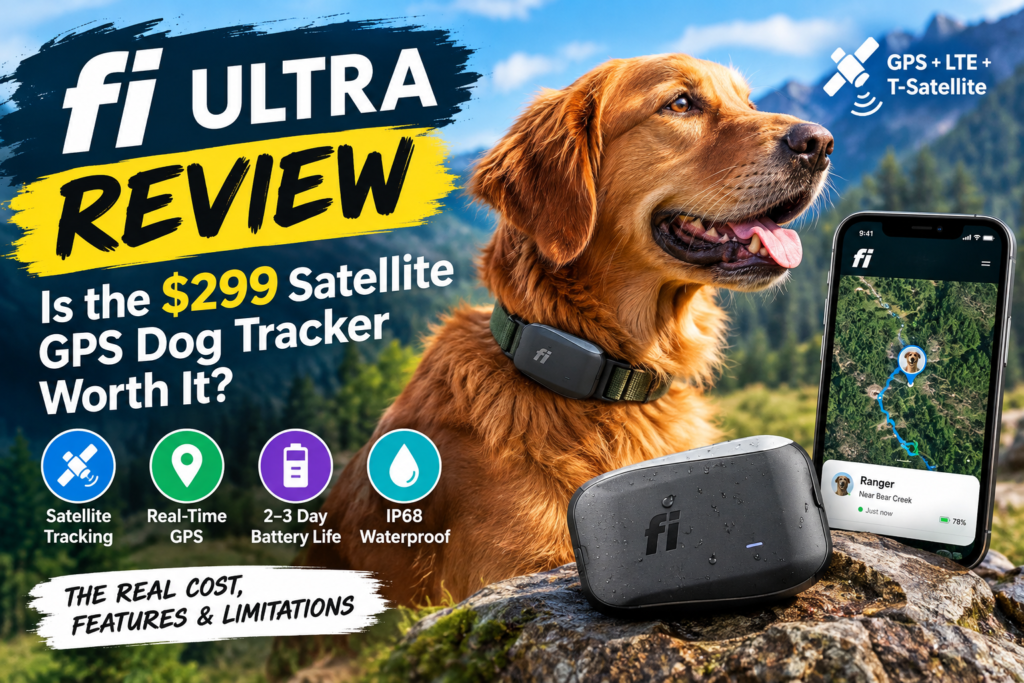
Pricing and specifications checked September 30, 2026. Fi changes pricing and features often, so confirm details on Fi’s official product page before buying. Some links on this page may be affiliate links. Details are in the disclosure at the end.
Short answer: Fi Ultra is worth considering if your dog regularly goes places where your phone and ordinary cellular trackers lose signal. It is a hard sell if your dog mostly walks in the neighborhood.
Fi Ultra is a clip-on GPS tracker with LTE plus satellite backup through T-Satellite with Starlink. It is built for hikers, campers, rural-property owners and owners of escape-prone dogs. Its biggest strength is that the tracker can keep reporting a location after cell towers drop out. Its biggest limitation is battery life: Fi rates it at 2–3 days, and independent testing has been closer to the low end. It also does not make your own phone work without service.
About the “$299”: it is not the price for everyone.
- Existing Fi members pay a flat $299 and keep their current membership.
- New customers pay $199 plus a $20 activation fee, then $189 per year.
Digital Trends reports the $199 + $20 activation + $189 annual structure, with existing members paying a flat $299. Either way, an ongoing Fi membership is required. This is not a one-time purchase. digitaltrends
Note: Fi Ultra is a location-focused tracker. Fi’s own feature chart lists Health Insights and AI Insights as not available on Ultra. If you want an AI health collar, look at the Fi Series 3+ or other options in our best GPS trackers for dogs guide. fitracking
How I Researched This Review
PetTrackerHub did not physically test Fi Ultra for this article. This is a research-based buyer’s guide built from:
- Fi’s official documentation, cited as “Fi states” (manufacturer claims)
- Independent hands-on coverage, mainly The Verge and GearJunkie
- General technical explanation of how satellite-to-cell systems work (labeled as such)
- User-reported experiences: very few exist so far, since the product launched July 8, 2026
Independent testing is still thin. The most-cited test used one dog over about a week in one forest, according to secondary coverage. Treat performance claims as early evidence, not settled fact.
Fi Ultra at a Glance
| Spec | Detail | Source type |
|---|---|---|
| Price | $299 flat (existing members); $199 + $20 activation (new customers) | Fi / press coverage |
| Membership | Required; $189/year reported for new customers | Fi / press coverage |
| Weight | 68 g | Fi |
| Dimensions | 75 × 40 × 25 mm | Fi |
| Tracking | Always-on dual-band GPS | Fi |
| Cellular | LTE (T-Mobile network) | Fi |
| Satellite | T-Satellite with Starlink | Fi |
| Other connectivity | Wi-Fi, Bluetooth | Fi |
| Battery | 2–3 days; Fi suggests charging every 1–2 days | Fi |
| Power Saving Mode | Reduces update frequency; up to 5 days total | Fi |
| Waterproofing | IP68, tested in salt water | Fi |
| Mounting | Universal integrated clip | Fi |
| Callback | Sound and vibration, adjustable intensity | Fi |
| Safe Zones / Lost Mode | Part of Fi’s app; see the section below for a caveat | Fi |
| Availability | U.S. only; dogs only | Fi |
| Health/AI features | None (no Health Insights or AI Insights) | Fi |
Specs come from Fi’s Ultra overview and Fi’s membership features page.
What Is Fi Ultra?
Fi Ultra is a separate device, not a collar. Think of it as a small rugged pod that clips onto a collar, harness or working vest. Inside are a GPS receiver, an LTE modem, Wi-Fi, Bluetooth and a satellite-capable radio.
Fi positions it as its most advanced tracker for dogs that explore remote areas. Fi says it also works with the Apple Watch app and that it supports dog profiles only. fitracking
How Fi Ultra’s Satellite Tracking Works
The chain has more links than the marketing suggests:
- GPS works out where the tracker is. GPS receives signals from space but doesn’t transmit anything.
- The tracker chooses a network to send that position. It prefers Wi-Fi/Bluetooth nearby, then LTE, then satellite.
- T-Satellite with Starlink carries the message when there are no towers. In general terms, these are low-orbit satellites that act like cell towers in the sky. That is a general technical explanation, and satellite links usually need a reasonably open view of the sky. See T-Mobile’s T-Satellite page for the network side.
- The Fi network receives the location.
- The Fi app shows it on your phone, if your phone has a data connection.
That last step is where expectations go wrong. GearJunkie points out that the app needs cell service or Wi-Fi on the owner’s phone, and that the tracker may keep transmitting even if you can’t retrieve the data. Fi says the same in its own documentation: Ultra is built for off-leash use, not off-grid use, and in no-service areas the app may not communicate with the tracker in real time. gearjunkie
Does Fi Ultra Actually Work Off-Grid?
Partly. The tracker can report from places with no cell service. Your phone still has to reach the internet to display it.
If you and your dog are both in a dead zone, you may not see live updates until you reach service, or until your own phone has a connection. That is a limitation of the whole system, not a defect. If you spend days deep in the backcountry, plan around it (see the Garmin comparison below).
Fi Ultra Pricing and Membership Cost
These are the numbers as of today. Fi promotions and plan structures can change, so verify at checkout.
Existing Fi member: $299 flat, and Fi says you keep your current membership. Your ongoing cost depends on the plan you already have. Confirm at checkout whether a second tracker adds to your bill, since I couldn’t verify multi-tracker billing rules.
New customer:
- Hardware: $199
- Activation: $20
- Membership: $189/year
Reviewers such as The Gadgeteer put the first year at about $408 ($199 + $20 + $189). That assumes the first year’s membership is billed at signup.
| Ownership period (new customer) | Estimated total |
|---|---|
| Year 1 | ~$408 |
| Year 2 | ~$597 |
| Year 3 | ~$786 |
| Year 5 | ~$1,164 |
A conflict worth noting: early Fortune coverage described the membership as $99 per six months, which would be about $198 per year. Most other outlets and later coverage report $189 per year. I’d trust Fi’s checkout page over any article, including this one.
Setup steps are on Fi’s activation guide. [Check current Fi Ultra pricing and membership options →]
Real-World Tracking Performance
LTE performance. With LTE, Ultra should behave like other cellular Fi trackers, with faster updates when signal is good. I found no independent measurements of GPS accuracy, so I won’t claim a number. GearJunkie’s hands-on reported the tracker as fast so far, the clip as very secure, and battery better than expected.
Satellite performance. Secondary coverage of The Verge’s hands-on reports that the tracker connected to Starlink in an LTE dead zone and updated roughly every two to three minutes. The same secondary coverage mentions occasional longer stalls when the tracker moved between networks. You can read The Verge’s original test directly. digitaltrends
The takeaway: satellite mode found the dog where LTE couldn’t, but it isn’t “watch your dog move live.”
Satellite Mode: How Fast Is It Really?
Four things are easy to confuse:
- GPS calculation happens on the tracker, often quickly and continuously.
- LTE transmission sends that position through cell towers, usually the fastest link.
- T-Satellite transmission sends it via satellites, with slower and less frequent updates.
- App refresh is how often your phone shows new data, which depends on all of the above plus your own connection.
So a dog can have an accurate GPS fix on the tracker while the app is minutes behind. A 2–3 minute update cadence is useful for finding a lost dog. It is not “instant, real-time tracking.” Think of it as following a trail of breadcrumbs, not watching a live video.
Battery Life
- Manufacturer estimate: 2–3 days, charge every 1–2 days.
- Power Saving Mode: extends battery to up to 5 days, according to Fi, by reducing how often the tracker checks in.
- Independent evidence: GearJunkie reports the 2-day claim and says battery was better than expected. Secondary coverage of The Verge’s test says a 30-minute live-tracking session used nearly 20% of the battery. If accurate, that is a heavy drain, but it was a specific test condition rather than typical use.
Why it drains faster: always-on GPS plus LTE plus satellite radio all draw power, and Fi says the tracker prioritizes ground networks and keeps searching for them. Compare this with weeks or months on Series 3+, which Fi says can last far longer on a charge in low-activity use.
For multi-day hikes: carry a power bank and a USB-C cable. Plan on charging daily in high-use conditions. Power Saving Mode helps but reduces update frequency, which is a poor trade-off if your dog is actually lost.
Design, Weight and Fit
At 68 g and 75 × 40 × 25 mm, Ultra is noticeably bulkier than Fi’s other trackers.
| Device | Weight | Size |
|---|---|---|
| Fi Ultra | 68 g | 75 × 40 × 25 mm |
| Fi Series 3+ | 47 g | 81.5 × 30 × 11.5 mm |
| Fi Mini | 16 g | 42 × 30 × 12.5 mm |
Source: Fi’s product comparison.
Dog size (general guidance, not Fi rules):
- Small dogs: likely too big and heavy for many. Fi Mini is designed for small dogs.
- Medium dogs: workable, especially on a harness.
- Large dogs: the best physical fit.
- Hunting/working dogs: the clip is designed for working vests, harnesses and thick collars, but you should test fit on your own gear.
Attachment: Fi says the universal clip works on collars, harnesses and vests. For the most secure fit it recommends a band 1 inch wide or narrower. Test it on your dog’s actual gear before a trip.
Waterproofing and Durability
Fi rates Ultra IP68 and says it was tested in salt water. IP68 generally means dust-tight and rated for continuous submersion under conditions set by the manufacturer, so swimming and rain are fine. It does not guarantee protection from impact, chewing or crushing, and I found no independent long-term durability data yet.
Fi Callback
Callback lets you trigger sound and vibration from the Fi app, with adjustable intensity, to help get your dog’s attention. It is not an electric-shock or e-collar system and does not deliver any static correction. It is a recall aid and only helps if the dog is within earshot and trained to respond. It won’t physically stop a dog that is chasing something.
Lost Mode and Safe Zones
Fi’s app provides Safe Zone alerts and a Lost Mode that increases location-update frequency. Fi’s Series 3+ documentation describes these features in detail. The Ultra pages I reviewed did not spell out Ultra-specific behavior, such as how Lost Mode updates over satellite, so I can’t give you specifics. Check Fi’s documentation before relying on it.
What Happens When the Tracker Moves Between LTE and Satellite?
Fi says switching is automatic. Because the tracker favors ground networks, it may keep searching for LTE while on satellite. Secondary coverage of The Verge’s test described occasional reconnection stalls when the dog moved in and out of coverage. Expect some gaps in canyons, dense forest and terrain edges. Fi’s satellite service is U.S.-only.
Fi Ultra vs Fi Series 3+
| Fi Ultra | Fi Series 3+ | |
|---|---|---|
| Tracking | GPS + LTE + satellite | GPS + cellular |
| Satellite | Yes | No |
| Battery | 2–3 days (Fi) | Far longer in low-activity use (Fi) |
| Health monitoring | No | Yes |
| AI features | No | Yes |
| Form factor | Bulky clip-on pod | Integrated collar tracker |
| Weight | 68 g | 47 g |
| Outdoor use | Best for remote areas | Good for general outdoor use |
| Everyday use | Charging is a chore | Better fit |
| Membership | Required | Required |
| Ideal user | Remote-area owners | Everyday, health-conscious owners |
Why some owners may want both: Series 3+ for daily wear and health data, Ultra clipped on for hikes, camping or trips. Coverage of the launch notes that Ultra is designed to work alongside Series 3+ and Fi Mini. Verify how membership and billing work for two trackers on one dog. tomshardware
Everyday vs adventure: for most people, Ultra is an adventure tracker. Charging every day or two is annoying for routine use.
Fi Ultra vs Traditional Cellular GPS Trackers
Trackers like Tractive rely on cell networks. Where there is coverage, they generally work well, often at lower cost and with a smaller, lighter design. Where there is none, they can’t report. Ultra’s advantage is a fallback link; its costs are battery, bulk and price. Also see our guides on Whistle to Tractive and the Tractive GPS alternative route for cellular options, and check Tractive’s current specs directly rather than relying on this article.
Fi Ultra vs Tractive comes down to coverage versus cost and battery. If your dog stays where you have cell service, a conventional tracker likely does the job for less.
Fi Ultra vs Garmin-Style Remote Dog Tracking
Dedicated hunting systems such as Garmin’s use radio links between a handheld and the dog collar. They don’t depend on cell towers, satellites or a phone. Range varies by model, terrain and vegetation, so check the manufacturer’s numbers.
The trade-offs:
- Garmin-style systems: independent of phone service, built for hunting, typically a bigger up-front investment and a handheld to carry. Range is limited by radio line of sight.
- Fi Ultra: uses your phone and app, has no radio range limit but depends on the tracker having a network link, and needs your phone to have a connection to view data.
If you spend serious time deep in the wilderness, radio-based systems are the more self-contained choice. Ultra suits people who want a familiar app and occasional remote coverage.
Pros and Cons
What I like
- Satellite fallback fills a real gap for remote areas
- Independent hands-on reports say satellite mode located a dog where LTE couldn’t
- Clip works on harnesses, vests and thick collars
- IP68 with salt-water testing
- Sound and vibration callback
- Works with Apple Watch
What I don’t like
- Battery of 2–3 days (Fi) and less in some tests
- Bulky and heavy for small dogs
- Satellite updates every couple of minutes, not live
- Your phone still needs data to see updates
- No health or AI features
- U.S.-only
- Ongoing membership on top of hardware cost
Who Should Buy Fi Ultra?
- Rural property owners with dogs that roam beyond cell coverage
- Hikers and campers who can charge daily
- Hunters and working-dog owners who want an app-based option and understand the limits
- Escape-prone dogs in areas with patchy coverage
- Existing Fi members who value the lower $299 upgrade and keep their membership
Who Should Skip Fi Ultra?
- Budget shoppers. See dog trackers without monthly fees for subscription-free options.
- Owners who hate frequent charging
- International users, since it’s U.S.-only
- Owners of very small dogs or cats, since it’s dogs only and bulky
- Anyone expecting fully independent off-grid app use
- Owners who want AI health monitoring, since Ultra doesn’t offer it. Wearable data is informational anyway and doesn’t replace veterinary diagnosis.
Is Fi Ultra Worth $299?
It depends on who’s buying.
- Existing Fi member: the $299 flat fee with your existing membership is the best value case, if you truly need remote coverage.
- New Fi customer: you’re looking at about $408 in year one and roughly $786 over three years. Worth it only if your dog regularly leaves cell coverage. Otherwise a cheaper tracker will likely serve you better.
- Remote-area adventurer: the strongest use case, with caveats about your phone’s connectivity and battery. Consider a radio-based system for long backcountry trips.
- Everyday urban dog owner: probably not worth it. Cell coverage is usually available and the battery is a hassle.
- Small-dog owner: likely not, given the size and weight.
- Hunting/working-dog owner: possibly, if you accept phone-dependence. Serious hunters should compare radio systems.
Alternatives
- Fi Series 3+ for everyday tracking and health insights
- Tractive for cellular tracking; also see our Whistle Go Explore review for other GPS and health tracker alternatives
- Garmin dedicated tracking systems for radio-based hunting use
- More options in our guide to GPS trackers for outdoor dogs
[Compare Fi Ultra with other GPS dog trackers →]
FAQ
Is Fi Ultra worth $299?
For existing Fi members who need remote coverage, it can be. New customers pay $199 + $20 activation + membership, so the real cost is higher.
Does Fi Ultra work without cell service?
The tracker can send location via satellite. Your phone still needs service or Wi-Fi to view it in the app.
Does Fi Ultra use Starlink?
Yes, through T-Mobile’s T-Satellite with Starlink.
How long does Fi Ultra’s battery last?
Fi says 2–3 days, up to 5 with Power Saving Mode. Independent reports suggest closer to 2 days with heavy use.
Is Fi Ultra waterproof?
IP68, tested in salt water according to Fi.
How much does Fi Ultra cost per year?
New customers: about $189/year for membership after the initial hardware and activation cost. Existing members: their current plan.
Does Fi Ultra require a subscription?
Yes.
Is Fi Ultra suitable for small dogs?
Probably not; it’s 68 g and 75 × 40 × 25 mm. Fi Mini is designed for small dogs.
Can Fi Ultra attach to any collar?
Fi says it works on collars, harnesses and vests, and recommends bands 1 inch wide or narrower.
Is Fi Ultra better than Fi Series 3+?
For remote coverage, yes. For daily wear, battery and health data, Series 3+ is better.
Can Fi Ultra track my dog completely off-grid?
The tracker can, but the app on your phone still needs a connection.
Does Fi Ultra have AI health tracking?
No.
Affiliate disclosure: PetTrackerHub may earn a commission if you buy through links on this page, at no extra cost to you. This doesn’t affect our analysis.