
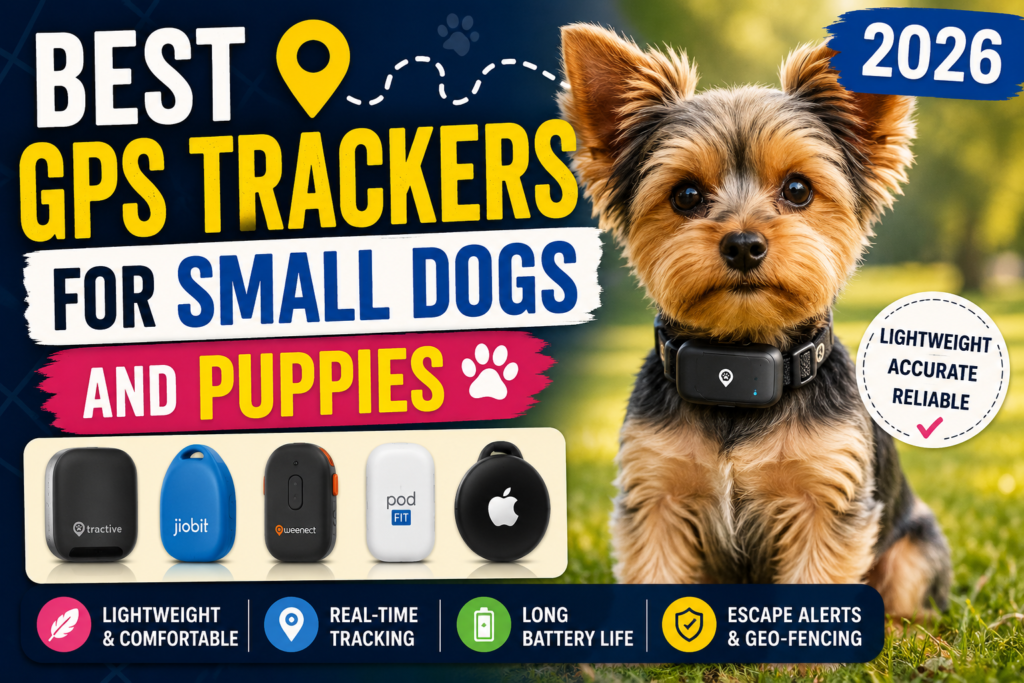
If you own a toy breed, a small dog, or a puppy who hasn’t hit full size yet, most “best dog GPS tracker” lists aren’t really written for you. They’re built around trackers designed for Labs and Shepherds, then footnoted with “also works for small dogs” — even when the device weighs as much as a small deck of cards.
The short answer: for most small dogs and puppies under 10 pounds, the Fi Mini is the best all-around pick — it’s a genuine cellular GPS tracker, weighs 16 grams, and was built specifically for dogs this size. If your dog is closer to 9–20 pounds, the Tractive GPS DOG 6 gives you the fastest live tracking and the lowest starting price. And if you just want basic location pings with zero subscription, an Apple AirTag can work as a backup — but it is not a substitute for real GPS, and we’ll explain exactly why below.
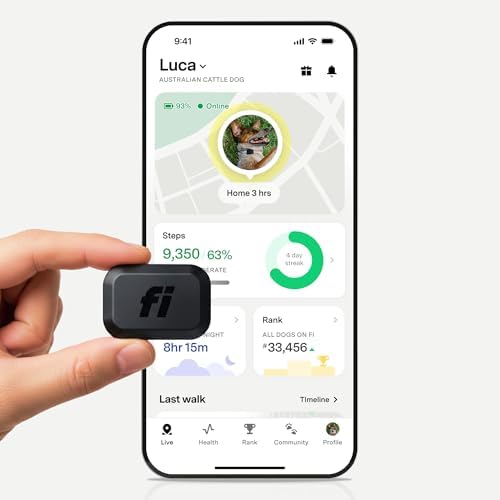
- GPS THAT CLIPS ONTO THEIR OWN COLLAR: The Fi Mini attaches to the collar your dog already wears and shows their live loc…
- 12-MONTH MEMBERSHIP INCLUDED, NOTHING EXTRA AT CHECKOUT: One price covers the tracker and 12 months of Fi Membership, th…
- ESCAPE ALERTS AND VIRTUAL FENCES: Set safe zones around home, the yard, or a sitter’s house and get notified the instant…
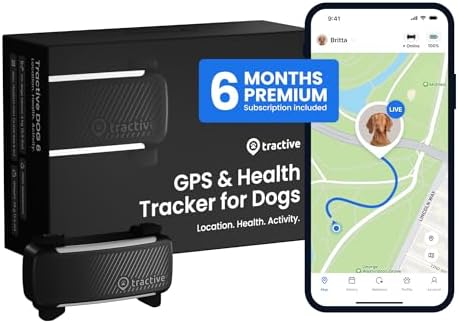
- REAL-TIME GPS TRACKING WITH UNLIMITED RANGE: Track your dog’s live location nationwide with updates every 2-3 seconds—up…
- VIRTUAL FENCES & LOCATION HISTORY: Set up safe zones and receive alerts when your dog leaves the area. Activate live tra…
- HEALTH & ACTIVITY MONITORING: Monitor your dog’s daily health, sleep patterns, and activity levels through the Tractive …

- FIND YOUR ITEMS ON FIND MY — AirTag (2nd generation) helps you keep track of what matters. Attach one to an item you wan…
- EXPANDED PRECISION FINDING ON IPHONE AND APPLE WATCH — Get step-by-step directions to your lost item on iPhone and, now,…
- ENHANCED SPEAKER — With a 50% louder speaker and a new, distinctive chime, it’s easier than ever to hear and find AirTag…
Here’s a quick comparison before we get into the details.
| Tracker | Best For | Weight | Minimum Dog Size | Battery | Subscription | Key Advantage |
|---|---|---|---|---|---|---|
| Fi Mini | Best overall for puppies & toy breeds | 16 g (0.56 oz) | Built for dogs under 10 lbs | ~3 weeks | ~$129/year (hardware + membership) | Real GPS built specifically for small dogs |
| Jiobit Smart Tag | Most versatile / growing puppies | 18 g (0.63 oz) | No fixed manufacturer minimum | Up to 30 days in ideal conditions (shorter with heavy use) | $8.33–$14.99/mo | Modular attachment, no rigid collar requirement |
| Tractive GPS DOG 6 | Best budget & escape-prone dogs | 39 g (1.4 oz) | 8.8 lbs and up | Up to 14 days (power-saving) | From ~$5–9/mo (term-dependent) | 2–3 second live-tracking refresh |
| Fi Series 3+ | Best battery life (10–20 lb dogs) | Collar-integrated | Not recommended under 10 lbs | ~2–3 months real-world | $189/yr (12-mo bundle) | Longest runtime between charges |
| Weenect XS | Small/toy breeds wanting tiny size | 27 g (0.95 oz) | Marketed for dogs under ~22 lbs | Up to 10 days (3 days continuous) | Subscription required (confirm current pricing) | Compact clip-on with flashlight/ring functions |
| Apple AirTag (2nd gen) | No-subscription backup only | 11.8 g (0.42 oz) | Not designed for pets | ~1 year (replaceable coin cell) | None | Zero monthly cost, but not real-time GPS |
Prices and specifications above are approximate as of 2026 and can change — always confirm current details on the manufacturer’s page before buying.
Quick Picks
- Best Overall for Small Dogs and Puppies: Fi Mini
- Best for Puppies: Fi Mini
- Best Lightweight GPS Tracker: Fi Mini (16 g) — Jiobit (18 g) close behind
- Best Budget Pick: Tractive GPS DOG 6
- Best Battery Life: Fi Series 3+
- Best for Escape-Prone Small Dogs: Tractive GPS DOG 6
- Best No-Subscription Alternative: Apple AirTag (2nd gen), used with caveats
- Best for Travel: Tractive GPS DOG 6 (175+ countries)
Why Small Dogs and Puppies Need a Different GPS Tracker
A GPS tracker built for a 60-pound retriever isn’t automatically a bad piece of hardware — it’s just built for a different dog. Weight, bulk, and collar hardware that a large breed never notices can be genuinely uncomfortable, or even risky, on a 6-pound Chihuahua or a Yorkie puppy still growing into its collar.
Small dogs also have proportionally smaller necks and more delicate tracheas, so a heavy or bulky device concentrated at the throat matters more than it would for a bigger dog. That’s why this guide only considers trackers that are actually light enough, small enough, and (where stated) rated for small-dog or toy-breed use — not just “technically able to clip onto any collar.”
What to Look for in a GPS Tracker for a Small Dog
Weight and dimensions. This is the single most important spec for a small dog. Look for trackers under roughly 30 grams (about 1 ounce) for dogs under 15 pounds, and ideally under 20 grams for toy breeds and puppies.
Manufacturer’s minimum dog weight. Some brands, like Tractive, publish an official minimum weight for their standard model. Others, like Jiobit, don’t set a hard cutoff but describe the device as suited to small pets. Always check the current spec page rather than an old review, since minimums can change between hardware generations.
Collar fit and attachment. A tracker that clips onto an existing collar is usually easier on a small dog than one that requires replacing the collar entirely, especially for a puppy whose neck size is changing month to month.
GPS accuracy and connectivity type. True GPS trackers use satellite positioning plus cellular data to report a live location. Some cheaper devices rely only on Bluetooth and a crowdsourced device network — which is a very different (and much less precise) technology, discussed in detail below.
Battery life. Smaller trackers generally have smaller batteries, so expect shorter runtimes than large-dog trackers. A tracker rated for “up to 30 days” in ideal, low-use conditions may realistically deliver a week or two for an active small dog with live tracking turned on.
Waterproofing. Small dogs still splash in puddles, get bathed, and occasionally take an unplanned swim. Look for an IP67 or IP68 rating.
Subscription cost. Nearly every real GPS tracker requires an ongoing data plan. Factor this into your decision from day one — it’s often more expensive over two years than the hardware itself.
App quality. A tracker is only as good as the app reporting its location. Look for live tracking, geofencing (escape alerts), and location history, and check current app store reviews before buying.
Best GPS Trackers for Small Dogs and Puppies
Fi Mini — Best Overall for Small Dogs and Puppies
Who it’s best for: Toy breeds, small dogs under 10 pounds, and puppies who need a lightweight tracker that can move with them as they grow.
- GPS THAT CLIPS ONTO THEIR OWN COLLAR: The Fi Mini attaches to the collar your dog already wears and shows their live loc…
- 12-MONTH MEMBERSHIP INCLUDED, NOTHING EXTRA AT CHECKOUT: One price covers the tracker and 12 months of Fi Membership, th…
- ESCAPE ALERTS AND VIRTUAL FENCES: Set safe zones around home, the yard, or a sitter’s house and get notified the instant…
Key specifications: 16 grams (0.56 oz), clips onto any collar or harness from 3/8″ to 1″ wide, real-time GPS plus Verizon LTE-M cellular, roughly 3 weeks of battery life, IP68 waterproof rating.
Why it’s good for small dogs: Fi designed the Mini specifically as a scaled-down version of its flagship Series 3+ collar for dogs under 10 pounds and cats — it wasn’t adapted from a large-dog device after the fact. At 16 grams, it’s genuinely one of the lightest cellular GPS trackers on the market.
Puppy suitability: Because it clips onto whatever collar or harness the puppy is currently wearing, you don’t need to buy a new integrated collar every time your puppy sizes up — a real advantage during the fast-changing first year.
GPS/location performance: Real-time live tracking and escape alerts through Fi’s app, the same underlying platform used on the Series 3+.
Battery: Roughly 3 weeks under typical use; expect shorter runtime if live tracking is used constantly.
Subscription: Fi bundles hardware and a year of membership for roughly $129, a straightforward all-in-one price for owners who don’t want to think about a separate monthly bill.
Pros: Purpose-built for small dogs, universal collar/harness compatibility, real GPS and cellular (not just Bluetooth), reasonable bundled first-year cost.
Cons: US cellular coverage only (Verizon LTE-M), newer product with a shorter track record than Fi’s flagship collar, renewal pricing should be confirmed directly with Fi before you buy.
Who should buy it: Owners of dogs under roughly 10 pounds who want dedicated small-dog engineering rather than a shrunk-down big-dog tracker.
Who should skip it: Owners in areas with weak Verizon coverage, or dogs over about 15 pounds who can comfortably wear a Series 3+ instead.
Jiobit Smart Tag — Best for Puppies and Most Versatile Attachment
Who it’s best for: Puppies whose weight and neck size are changing quickly, and owners who want one tracker they can move between a collar, harness, or even a jacket.
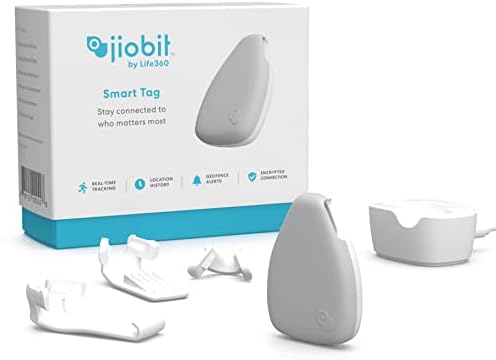
- Small, Lightweight and Durable: With our most powerful battery yet. Jiobit easily and discreetly attaches to clothing, s…
- Real-time GPS Location Sharing with Unlimited Nationwide Range: Our advanced, patented beacon technology leverages the c…
- Powerful Smart Alerts & Location History: Easily set up custom trusted places to be alerted when an area is entered or l…
Key specifications: 18 grams (0.63 oz), about 37 x 50 x 12 mm, combines GPS, cellular (LPWA CatM1), Wi-Fi, and Bluetooth, IP68-rated, battery rated up to 30 days in ideal conditions.
Why it’s good for small dogs: Jiobit didn’t start life as a pet product — it was originally built for tracking children and people with special needs — which is part of why it’s so light and doesn’t rely on a dedicated collar mount. It attaches with a strap clip, hem-lock clip, or secure loop, so it isn’t tied to one piece of gear. For more detail, our full Jiobit Smart Tag review covers real-world battery performance and setup.
Puppy suitability: Because Jiobit doesn’t publish a strict minimum dog weight the way some collar-integrated trackers do, and because it can move freely between collar, harness, or coat, it tends to handle a puppy’s growth spurts more gracefully than a device built around one fixed collar size. That said, always check the current attachment options and Jiobit’s own guidance for very young or very small puppies before use.
GPS/location performance: Combines four connection types (GPS, cellular, Wi-Fi, Bluetooth) for what Jiobit calls “Progressive Beaconing,” which is designed to keep a location fix even indoors or in dense buildings — useful if your puppy is prone to slipping out a door.
Battery: Manufacturer-rated up to 30 days in ideal, low-use conditions; real-world battery life for an active pet with frequent tracking will typically be shorter.
Subscription: A required monthly plan, priced around $8.33/month on a prepaid annual term (about $124.99 upfront) or $14.99/month with no contract.
Pros: No rigid minimum weight, modular attachment options, strong indoor performance, tamper-resistant design.
Cons: US-only coverage, mandatory subscription with no free tier, originally designed for people rather than pets so it lacks pet-specific features like activity or health tracking.
Who should buy it: Owners of very young or very small puppies who want flexibility as their dog grows, or anyone who wants a tracker that isn’t locked to a single collar.
Who should skip it: Anyone who travels internationally with their dog, since Jiobit currently only operates in the US.
Tractive GPS DOG 6 — Best Budget Pick and Best for Escape-Prone Dogs
Who it’s best for: Small dogs on the larger end of “small” (roughly 9–25 pounds) who are prone to bolting, plus owners who want the lowest realistic total cost of ownership.
- REAL-TIME GPS TRACKING WITH UNLIMITED RANGE: Track your dog’s live location nationwide with updates every 2-3 seconds—up…
- VIRTUAL FENCES & LOCATION HISTORY: Set up safe zones and receive alerts when your dog leaves the area. Activate live tra…
- HEALTH & ACTIVITY MONITORING: Monitor your dog’s daily health, sleep patterns, and activity levels through the Tractive …
Key specifications: 39 grams (1.4 oz), about 71 x 28 x 18 mm, IP68 waterproof, suitable for dogs 8.8 pounds (4 kg) and up per Tractive’s official DOG 6 product page.
Why it’s good for small dogs: While it’s heavier than the Fi Mini or Jiobit, the DOG 6 clips onto any standard collar and is one of the more affordable true GPS trackers that still explicitly lists a small-dog-friendly minimum weight.
Puppy suitability: Because Tractive states an 8.8-pound minimum, it’s appropriate once a puppy has grown past that point, but it isn’t the right choice for very young or very small puppies still under that weight.
GPS/location performance: Live tracking updates roughly every 2–3 seconds during active tracking — notably faster than many competitors that refresh every 30–60 seconds — which matters if your dog is actually running loose and you’re trying to close the distance.
Battery: Up to 14 days with Power Saving Zones enabled, closer to about 10 days under typical mixed use, according to Tractive and independent reviews.
Subscription: Plans start around $5–9/month depending on the length of the term you commit to, with the effective first-year Basic cost landing around $108–$187 including the device — one of the lower total costs among true GPS trackers.
Pros: Fast live-tracking refresh rate, works across 175+ countries via cellular coverage, competitive pricing, health and activity tracking layered on top of GPS.
Cons: Heavier than dedicated toy-breed trackers, its stated minimum weight excludes true toy breeds and young puppies, requires an ongoing subscription for any tracking functionality.
Who should buy it: Small dogs on the upper end of the “small dog” range who need fast escape alerts, plus owners who travel and want broad international cellular coverage — for more on that use case, see our guide to GPS dog trackers for active and outdoor dogs.
Who should skip it: Dogs under about 9 pounds, since it sits outside Tractive’s own stated minimum.
Fi Series 3+ — Best Battery Life
Who it’s best for: Small dogs at the higher end of the weight range (roughly 10–20 pounds) who need the longest possible stretch between charges.

- REAL-TIME GPS TRACKING, NO RANGE LIMITS: See your dog’s live location nationwide in the Fi app. This GPS dog tracking co…
- 12-MONTH MEMBERSHIP INCLUDED, NOTHING EXTRA AT CHECKOUT: One price covers the collar and 12 months of Fi Membership, the…
- ESCAPE ALERTS AND LOST DOG MODE: Draw safe zones around home, the yard, or a sitter’s house and get an alert the moment …
Key specifications: Collar-integrated design, fits neck sizes from about 11.5 to 34.5 inches, IP68 waterproof, GPS plus LTE cellular and Wi-Fi.
Why it’s good for small dogs: Fi’s real-world reviewers report roughly 6–8 weeks of battery life in normal GPS-tracking mode, and up to about 3 months in lower-power activity-tracking mode — dramatically longer than clip-on trackers designed for tiny dogs.
Puppy suitability: Fi itself doesn’t recommend the Series 3+ for dogs under about 10 pounds due to the weight and bulk of the integrated collar module, so this is not the right pick for young puppies or true toy breeds — use the Fi Mini instead for that range.
GPS/location performance: Real-time GPS with escape alerts, activity tracking, and sleep monitoring through Fi’s app.
Battery: Manufacturer-rated up to 3 months; independent reviewers report closer to 6–8 weeks with regular GPS use.
Subscription: The Series 3+ ships with a 12-month membership included in its roughly $189 purchase price, then renews at about $99 for 6 months, $189 for a year, or $339 for 2 years — all prepaid, with no month-to-month option.
Pros: Exceptional battery life relative to other cellular GPS trackers, well-reviewed app, integrated collar design that’s harder for a determined dog to remove.
Cons: Not intended for dogs under 10 pounds, no monthly billing option, US-only (AT&T LTE-M) coverage.
Who should buy it: Small dogs comfortably above 10 pounds who need long battery life and don’t need international travel coverage.
Who should skip it: Toy breeds, puppies, or anyone who wants month-to-month billing flexibility.
Weenect XS — Best for Owners Who Prioritize Small Physical Size
Who it’s best for: Small and toy breed owners who want one of the physically smallest trackers available and don’t mind a required subscription.

- 💳 SUBSCRIPTION REQUIRED – The GPS tracker comes with a SIM card included. A subscription is required to use the GPS trac…
- 📍 REAL-TIME GPS TRACKING – The GPS tracker sends its location continuously: a new GPS position every second with Superli…
- 🌍 NO DISTANCE LIMIT – The GPS tracker operates without any distance restrictions. Track your cat from your phone (iPhone…
Key specifications: 27 grams (0.95 oz), about 60.5 x 24.5 x 15 mm, IP68 rated to 1.5 meters, includes a built-in SIM with global 5G/4G/2G connectivity.

- 💳 SUBSCRIPTION REQUIRED – The GPS tracker comes with a SIM card included. A subscription is required to use the GPS trac…
- 📍 REAL-TIME GPS TRACKING – The GPS tracker sends its location continuously: a new GPS position every second with Superli…
- 🌍 NO DISTANCE LIMIT – The GPS tracker operates without any distance restrictions. Track your cat from your phone (iPhone…
Why it’s good for small dogs: Weenect markets the XS as suited to dogs under roughly 22 pounds (10 kg), and its compact dimensions make it one of the smaller cellular GPS units by footprint, even though it’s a bit heavier than the Fi Mini or Jiobit.
Puppy suitability: Reasonable for puppies who have grown past the very smallest range, though its 27-gram weight is noticeably more than the lightest options on this list, so it’s a better fit once a puppy is closer to its adult toy-breed weight.
GPS/location performance: Uses multiple satellite constellations plus a proprietary positioning algorithm Weenect calls InfinityTrack, with real-time refresh.
Battery: Up to 10 days in power-saving mode, or roughly 2–3 days with continuous live tracking.
Subscription: A subscription is required for the SIM and tracking service; Weenect bundles a tracker-plus-subscription pack, but current pricing should be confirmed directly on Weenect’s site before purchase, since we could not independently verify a stable current monthly rate.
Pros: Compact size, worldwide cellular coverage, lifetime hardware warranty against manufacturing defects.
Cons: Heavier than the smallest dedicated small-dog trackers, shorter continuous-tracking battery life, subscription pricing needs to be checked at checkout.
Who should buy it: Owners who specifically want the smallest physical footprint and plan to travel outside the US.
Who should skip it: Anyone prioritizing the lowest possible weight, since the Fi Mini and Jiobit are both lighter.
GPS Tracker vs Apple AirTag for Small Dogs: What’s the Difference?
This is one of the most common points of confusion for small-dog owners, and it’s worth being direct about: an AirTag is not a GPS tracker.
According to Apple’s official tech specs, the current AirTag (2nd generation) weighs 11.8 grams, uses Bluetooth and Apple’s second-generation Ultra Wideband chip for “Precision Finding,” and runs on a user-replaceable coin cell battery rated for roughly a year. It does not contain a GPS chip and does not use cellular data.
Instead, an AirTag relies on Apple’s Find My network — a crowdsourced mesh of hundreds of millions of iPhones and iPads. When another Apple device passes near a lost AirTag, it anonymously relays an approximate location back to the owner. Apple’s own 2026 AirTag announcement is explicit that the product is “designed exclusively for tracking objects, and not people or pets.”
What this means in practice for a dog:
- Real-time tracking: A true GPS tracker like the Fi Mini or Tractive DOG 6 reports a live location every few seconds to a minute. An AirTag only updates when a nearby Apple device happens to detect it — which can mean minutes, hours, or no updates at all in a rural or low-iPhone-density area.
- Rural vs. urban performance: AirTags perform reasonably well in dense urban and suburban areas with lots of iPhones nearby. In rural areas, on farmland, or in wooded off-leash areas, the Find My network can be sparse or effectively nonexistent.
- Subscription: This is the AirTag’s biggest advantage — it’s a one-time $29 purchase with no monthly fee, versus $5–15/month for most true GPS trackers.
- Battery: An AirTag’s coin-cell battery lasts roughly a year, far longer than any rechargeable GPS tracker, but it isn’t rechargeable — you replace the battery.
- Escape alerts: True GPS trackers offer real geofencing with instant push notifications when a dog leaves a set area. AirTags don’t have this feature built for pet use.
When an AirTag makes sense: as a low-cost backup layered on top of a properly fitted collar, ID tag, and microchip, especially in a dense neighborhood where lots of iPhones are nearby and your dog is unlikely to travel far. Some owners compare its value directly in our Apple AirTag vs. Tractive GPS comparison.
When a true GPS tracker is safer: if your dog roams, hikes off-leash, lives in a rural area, or has a history of escaping, real-time cellular GPS tracking meaningfully increases the odds of a fast recovery compared to waiting for a random Bluetooth ping.
How Much Should a GPS Tracker Weigh for a Small Dog?
There’s no single official “safe percentage” of body weight that applies to every dog, and we won’t invent one — a tracker’s comfort depends on the individual dog’s neck, coat, and temperament as much as raw grams. What we can say from the specifications above:
- A 16–20 gram tracker (Fi Mini, Jiobit) is broadly considered comfortable for dogs in the 5–15 pound range.
- A 27–39 gram tracker (Weenect XS, Tractive DOG 6) is more appropriate once a dog is comfortably above roughly 9–10 pounds.
- For dogs under about 5 pounds, consider mounting a lightweight tracker on a well-fitted harness rather than a collar, which spreads the weight across the chest instead of concentrating it at the throat.
If in doubt, weigh the tracker yourself, weigh your dog, and use common sense: a device your dog can move, sit, and play normally while wearing is the goal — not a specific formula.
What Makes a GPS Tracker Safe for a Puppy?
Puppies present a moving target — literally. A tracker and collar combination that fits comfortably today may be too loose, too tight, or simply too heavy in six weeks. Before putting any tracker on a puppy, think through:
Current weight vs. expected adult size. A 4-pound Yorkie puppy will likely mature around 4–7 pounds, while a 4-pound Golden Retriever puppy will be unrecognizable in a year. Choose a tracker rated for your puppy’s current weight, not its eventual adult weight.
Neck size and collar fit. According to the American Kennel Club, a properly fitted collar should allow you to slip one finger between the collar and a small dog’s neck — not two, which is the standard for large breeds. Check this fit weekly during a growth spurt.
Tracker weight relative to the puppy. A tracker that’s fine on a 20-pound adult dog may be genuinely inappropriate on a 5-pound puppy of the same eventual breed, simply because the puppy hasn’t grown into that body mass yet.
Collar vs. harness attachment. Many trainers and owners prefer a harness for puppies still learning leash manners, since it avoids concentrating pressure — or tracker weight — on a developing neck and trachea.
Comfort and movement. Watch your puppy for the first hour after attaching a new tracker. Excessive scratching at the collar, head-shaking, or reluctance to move normally are signs the fit or weight needs adjusting.
We are not veterinarians, and this section is general guidance, not a substitute for advice from your dog’s vet — especially for breeds with known tracheal sensitivity, like Yorkies and Chihuahuas.
How to Put a GPS Tracker on a Small Dog’s Collar
- Choose the right collar width. Most clip-on trackers (Fi Mini, Tractive, Weenect) are designed for standard collar widths — check the tracker’s spec sheet for the minimum and maximum width it supports.
- Position the tracker at the back or side of the neck, not directly under the chin, so it doesn’t interfere with eating, drinking, or a leash clip.
- Secure the clip fully and give it a firm tug test before letting your dog loose — a loose clip is the most common cause of a lost tracker.
- Recheck the collar fit using the one-finger test for small dogs, and adjust as needed.
- Let your dog wear it indoors first for an hour or two before relying on it outdoors, so you can catch any comfort issues early.
What If Your Puppy Outgrows the Tracker?
Growth is the single most overlooked factor in small-dog and puppy tracking. A few practical points:
- Collar-integrated trackers (like the Fi Series 3+) may need a larger replacement collar band as your dog grows — check whether the manufacturer sells replacement bands separately from the tracker module.
- Clip-on trackers (Fi Mini, Jiobit, Tractive, Weenect) move to a new collar easily, since the tracker and collar are separate purchases.
- Reassess the tracker itself, not just the collar, once your dog’s adult weight is closer to confirmed. A tracker chosen for a 4-pound puppy may not be the ideal choice — in features, battery life, or price — once that dog is a settled 15-pound adult.
- Check the manufacturer’s current minimum weight again before your dog’s next growth milestone, since specs and model lineups do change over time.
Do GPS Trackers Work Without Cell Service?
Cellular GPS trackers, like every option on this list except the AirTag, need both a GPS satellite fix (for location) and a cellular connection (to transmit that location to your phone). If your dog wanders into an area with no cellular coverage — deep in the backcountry, for instance — the tracker will typically store its last known location and transmit an update once it reconnects to a network, rather than reporting live in real time. This is worth checking specifically if you hike or camp in remote areas; Tractive’s broad 175+ country coverage tends to fare better here than single-carrier US trackers.
Do GPS Trackers Work for Indoor Dogs?
GPS itself requires a relatively clear view of the sky, so accuracy drops indoors and in dense buildings. Some trackers, like the Jiobit, supplement GPS with Wi-Fi and Bluetooth positioning specifically to improve indoor accuracy — useful if your small dog spends most of its time inside and you mainly want to know if it’s slipped out a door. If your dog is almost always indoors, prioritize a tracker with multi-technology positioning over one that relies on GPS alone.
GPS Trackers You Should Avoid in 2026
Whistle (Go Explore, Switch, Health & GPS). Whistle’s pet-tracking service was shut down on August 31, 2025, after Tractive acquired the Whistle brand from Mars Petcare. All Whistle hardware — new, used, or even sealed and unopened — lost the ability to connect once Whistle’s servers went offline, and there is no way to reactivate it. Even though older articles and marketplace listings still reference Whistle as a recommended small-dog tracker, do not buy Whistle hardware in 2026 under any circumstances; it will not function.
If you already own a Whistle device, treat it as unsupported hardware and plan to replace it with a currently active tracker like the ones reviewed above.
Real Cost of Ownership
Device price is only part of the story — most GPS trackers require an ongoing subscription that adds up quickly over one or two years.
| Tracker | Hardware Price | Typical Subscription | Approx. First-Year Cost | Approx. Two-Year Cost |
|---|---|---|---|---|
| Fi Mini | Bundled | ~$129/year (hardware + membership) | ~$129 | ~$258 (renewal pricing may vary) |
| Jiobit Smart Tag | $129.99 | $8.33–$14.99/mo | ~$255 (1-yr prepay) to ~$310 (no contract) | ~$435–$490 |
| Tractive GPS DOG 6 | $79 | ~$5–9/mo depending on term | ~$108–$187 | ~$216–$298 |
| Fi Series 3+ | Bundled | $189/yr, or $99/6mo, or $339/2yr | ~$189 | ~$339–$378 |
| Weenect XS | Bundled pack | Subscription required (confirm current rate) | Verify at checkout | Verify at checkout |
| Apple AirTag (2nd gen) | $29 | None | $29 | $29 (plus occasional battery swap) |
These figures are approximate, based on publicly listed pricing at the time of writing, and are provided to illustrate relative cost — always confirm exact current pricing on the manufacturer’s site before purchasing, since plans and promotions change frequently.
How We Evaluated the Trackers
We compared currently available small-dog and puppy-appropriate GPS trackers using published manufacturer specifications and independent reviews across these factors:
- Device weight and physical dimensions relative to small-dog and toy-breed comfort
- Stated or implied minimum dog size/weight
- GPS technology type (true GPS/cellular vs. Bluetooth-only)
- Live-tracking refresh rate and escape-alert responsiveness
- Battery life, both manufacturer-rated and real-world reported
- Total subscription cost over one and two years
- Waterproofing rating
- Attachment security and collar/harness compatibility
- Overall app quality and current user feedback
We did not physically test every device ourselves for this guide; recommendations are based on manufacturer documentation and a review of current, dated third-party testing. We’ve flagged anywhere pricing or specifications should be double-checked directly with the manufacturer before purchase.
Final Verdict
- If your dog is under 10 pounds or still a growing puppy: the Fi Mini is the strongest overall choice — it’s genuinely built for this size range rather than adapted from a bigger device.
- If you want maximum flexibility as a puppy grows, or need indoor-friendly tracking: the Jiobit Smart Tag is the most adaptable option.
- If your dog is 9–25 pounds and prone to escaping, or you want the best price-to-performance ratio: the Tractive GPS DOG 6 offers the fastest live tracking at one of the lowest starting prices — see also our roundup of GPS trackers for dogs under $100.
- If your small dog is comfortably over 10 pounds and you want the longest stretch between charges: the Fi Series 3+ wins on battery life alone.
- If you want zero monthly fees and mainly need peace of mind in a well-covered neighborhood: an Apple AirTag can serve as a low-cost backup — never as your only line of defense. For a deeper breakdown of subscription-free options, see our guide to dog tracking devices without monthly subscription fees.
Whichever tracker you choose, remember that GPS tracking is an added safety layer, not a replacement for the basics: a properly fitted collar, a current ID tag, and a microchip on file with your vet.
FAQs
What is the smallest GPS tracker for a puppy? Among trackers that use true GPS and cellular connectivity, the Fi Mini (16 g) and Jiobit Smart Tag (18 g) are currently the lightest options suited to small dogs and puppies.
What is the best GPS tracker for a 5-pound dog? For a dog this small, prioritize the lightest options — the Fi Mini or Jiobit — and consider harness rather than collar attachment to distribute the weight more evenly.
Can a puppy wear a GPS tracker? Yes, provided the tracker’s weight and any stated minimum size are appropriate for the puppy’s current weight (not its expected adult weight), and the collar or harness fit is checked regularly as the puppy grows.
How much should a GPS tracker weigh for a small dog? There’s no single official standard, but trackers in the 16–20 gram range are generally considered comfortable for dogs under 15 pounds, while 27–39 gram devices are better suited to dogs closer to 10–25 pounds.
Is AirTag better than GPS for a small dog? No — an AirTag uses Bluetooth and Apple’s Find My network, not GPS or cellular data, so it cannot provide real-time tracking the way a true GPS tracker can. It works best as a low-cost backup in dense, iPhone-heavy areas, not as a primary safety tool.
Do GPS dog trackers require a monthly fee? Almost all true GPS trackers require an ongoing subscription to cover cellular data, typically $5–20 per month depending on the brand and plan length. AirTags are the main subscription-free exception, at the cost of real-time accuracy.
Can GPS trackers work without cell service? Not in real time. Most trackers store the last known location and send an update once cellular service is available again, rather than tracking live in a dead zone.
What is the best GPS tracker for a Chihuahua? The Fi Mini or Jiobit Smart Tag are the best fits given their light weight and lack of a rigid large minimum-weight requirement, though always confirm the current specs against your dog’s exact weight.
What is the best GPS tracker for a Yorkie? For a typical adult Yorkie (roughly 4–7 pounds), the Fi Mini or Jiobit are the most appropriate choices; the Tractive DOG 6 becomes viable once a Yorkie is at or above its stated 8.8-pound minimum.
What is the best GPS tracker for an escape-prone small dog? The Tractive GPS DOG 6 offers the fastest live-tracking refresh rate (about every 2–3 seconds) among trackers reviewed here, which is particularly useful for dogs that bolt. For dogs under its 8.8-pound minimum, the Fi Mini and Jiobit both offer escape/geofence alerts as well.
Will my puppy outgrow its GPS tracker? Possibly the collar it’s attached to, more than the tracker itself. Clip-on trackers move easily to a new, larger collar as your puppy grows; collar-integrated systems may require a separate, larger replacement band.
What is the best GPS tracker for dogs under 10 pounds? The Fi Mini is purpose-built for dogs under 10 pounds and is the top recommendation in this weight range, with the Jiobit Smart Tag as a strong alternative for owners who want more flexible attachment options.
Pingback: Pawfit 3 GPS Pet Tracker Review: Long Battery Life Tested - PetTrackerHub – Pet GPS Tracker Reviews & Comparisons