
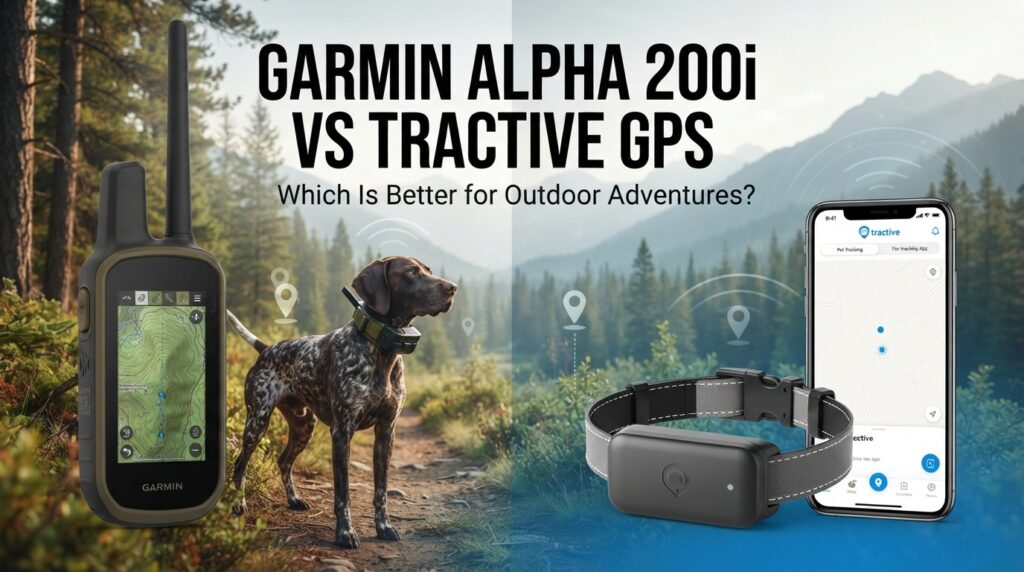
A dog tracker that works flawlessly in a suburban neighborhood can behave in a completely different way once you’re a mile down a logging road, deep in a river valley, or working a bird dog through thick timber. The two systems people compare most often for outdoor use — the Garmin Alpha 200i and Tractive GPS — aren’t built the same way, and that difference matters a lot more outdoors than it does in a backyard.

- Features sunlight-readable 3.5” capacitive touchscreen display and a button-operated, dog-focused design for quick, mino…
- Easily set up and monitor up to 20 dogs from up to 9 miles away with a 2.5-second update rate by using multiple global n…
- Dog list and group management lets you keep inactive dogs in the system for easier setup
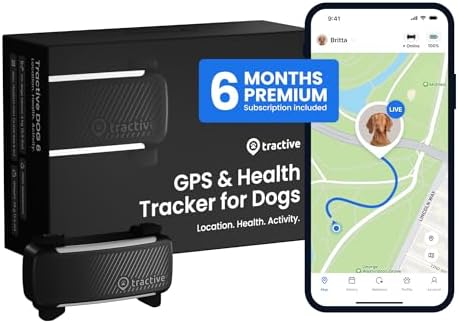
- REAL-TIME GPS TRACKING WITH UNLIMITED RANGE: Track your dog’s live location nationwide with updates every 2-3 seconds—up…
- VIRTUAL FENCES & LOCATION HISTORY: Set up safe zones and receive alerts when your dog leaves the area. Activate live tra…
- HEALTH & ACTIVITY MONITORING: Monitor your dog’s daily health, sleep patterns, and activity levels through the Tractive …
At a glance, the two aren’t really competing for the same job. The Garmin Alpha 200i is a dedicated long-range dog tracking and training system: a handheld device that talks directly to compatible Garmin dog collars over radio, independent of cell towers. Tractive is a cellular-connected GPS tracker built around your smartphone: a small collar attachment that reports your dog’s location over LTE, the same way your phone gets a signal. For a broader look at the category, see our guide to the best GPS dog trackers.
Neither one is a universal “better” choice. The right pick depends heavily on where you actually use your dog — a fenced rural property with weak cell service, a national forest with no bars at all, a hunting lease, or a neighborhood and local trail system with solid LTE coverage. This guide walks through the real technical differences and how they play out on a hike, at a hunting camp, or on a property with no signal at all — not just a spec sheet. If you’re deciding purely on a training/tracking basis for hunting dogs, our hunting dog GPS collar guide digs deeper into that use case alone.
Note on sourcing: figures below are drawn from Garmin’s and Tractive’s published specifications as of publication, cross-checked against retailer listings and independent reviews where available. Manufacturer-stated range, coverage, and battery figures are noted as such — they’re tested under specific conditions and will vary with terrain, obstructions, and how the device is used. Prices fluctuate; use them as reference points and verify current pricing on Garmin’s official site and Tractive’s official site before purchase.
Quick Answer
- Choose the Garmin Alpha 200i if you need long-range tracking that keeps working with zero cell service, you’re tracking multiple hunting or working dogs, you want e-collar training built into the same device, or you spend serious time in national forests, mountains, or remote rural land. Read our full Garmin Alpha 200i review for hands-on impressions.
- Choose Tractive if you want an affordable, easy smartphone-based tracker for everyday walks, hikes, and off-leash time in areas with decent cell coverage, and you value health/activity monitoring, geofencing, and a lightweight collar attachment over a dedicated handheld. See our full Tractive GPS review for more detail.
- Neither is the better all-around pick for every dog owner — the deciding factor is almost always where your dog roams and whether that place has reliable cell service. Not sure? Our dog GPS tracker buying guide walks through how to check your coverage before you buy.
Quick Comparison Table
| Feature | Garmin Alpha 200i | Tractive GPS (DOG 6 / DOG 6 XL) |
|---|---|---|
| Tracking technology | GPS/GLONASS on collar + dedicated radio (VHF-style) link to handheld | GPS on collar + cellular (2G/LTE-M) link to app |
| Communication method | Direct radio link, handheld-to-collar, no cell/internet needed | Cellular network, relayed through Tractive’s servers to your phone |
| Range | Up to 9 miles line-of-sight (collar-dependent, per Garmin) | “Unlimited” — works anywhere there’s partner LTE/2G coverage, in 175+ countries (per Tractive) |
| Requires cell service? | No, for core dog-tracking link. Yes, only for optional inReach satellite messaging (uses satellite, not cell) | Yes, always — no cell/data signal means no live location |
| Requires subscription? | No subscription for tracking/training. Optional paid plan only for inReach satellite messaging | Yes, mandatory — see Tractive’s plan pricing |
| Smartphone required? | No — fully self-contained handheld; optional Garmin Explore app sync | Yes — core experience is the Tractive smartphone app |
| Dedicated handheld? | Yes, purpose-built 3.5″ touchscreen handheld | No — uses your existing phone |
| Live tracking | Continuous, 1–2.5 second update rate depending on collar/mode | “LIVE Mode” updates every 2–3 seconds when triggered; standard mode is less frequent to save battery |
| Update frequency | As fast as ~1–2.5 sec (radio link) | 2–60 min in standard GPS mode; 2–3 sec in LIVE Mode |
| Multi-dog tracking | Up to 20 dogs on one handheld — see our multi-dog tracking guide | One device per dog; each needs its own hardware + subscription |
| Training functions | Built-in e-collar stimulation, tone, and vibration (18 correction levels) with compatible collars | None — tracking and health only, no training/correction |
| Health monitoring | Basic activity data (Hunt Metrics) on compatible collars | Detailed activity, sleep, and wellness tracking built into the app |
| Geofencing | Proximity/range alerts relative to handheld | Virtual Fences with push notifications |
| Maps | Preloaded TopoActive maps, optional BirdsEye satellite imagery, optional TOPO/HuntView overlays | Street-map based location pin in the app; not a topo navigation tool |
| Navigation | Full GPS navigation: waypoints, routes, altimeter, compass | Location display only — not built for backcountry navigation |
| SOS/emergency messaging | Optional built-in inReach two-way satellite messaging and SOS (requires separate inReach subscription) | None built in; relies on your phone’s own emergency features |
| Battery life (handheld/device) | Up to 20 hrs standard, up to 15 hrs with inReach active (per Garmin) | Up to 2 weeks (DOG 6) / up to 6 weeks (DOG 6 XL) with Power Saving Zones (per Tractive) |
| Waterproofing | IPX7-rated handheld | Fully waterproof, IP68-style rating on the tracker |
| Weight | Handheld ~0.6 lb; collar devices vary by model | Tracker itself well under 2 oz depending on model |
| Upfront cost | ~$550–$750 handheld (MSRP varies/sale pricing common) + ~$180–$350 per collar device | ~$50 per device |
| Recurring cost | None for tracking; inReach plans priced separately if used | ~$5–$13/month per dog depending on plan length — see current plans |
| Best use case | Hunting, multi-dog work, remote land, backcountry navigation, training | Everyday walks, hikes with cell coverage, escape alerts, health tracking |
Specifications vary by specific collar/handheld model and current product generation. Always confirm exact figures for the specific SKU you’re buying on Garmin’s site or Tractive’s site, since both sell multiple hardware tiers. For a broader shortlist beyond just these two, see our best dog GPS trackers roundup.
1. Garmin Alpha 200i Overview
The Alpha 200i is a handheld GPS unit that pairs with Garmin’s compatible dog devices — collars like the TT15 or T5 — to track and, on training-capable collars, correct your dog in the field. It has a 3.5-inch sunlight-readable touchscreen, weighs about 0.6 lb, and is built as a rugged standalone device rather than an app add-on. Our full Garmin Alpha 200i review covers setup and field testing in more depth.
How it tracks a dog: each collar has its own GPS/GLONASS receiver that calculates the dog’s position independently, the same way any GPS device does. That position is then transmitted from the collar to the handheld over a dedicated radio link — not Wi-Fi, not cellular data. This is why the Alpha 200i keeps tracking dogs in places that have zero bars of cell signal: the GPS fix and the radio transmission to your hand both work without a cell tower. For more on this mechanism, see our explainer on how VHF dog trackers work.
Range: Garmin states up to 9 miles depending on the specific dog device used, under open, line-of-sight conditions.
Multi-dog tracking: the handheld can track and manage up to 20 dogs at once, grouped and toggled from a single list — a feature aimed squarely at hunters and handlers running multiple dogs. See our multi-dog tracking guide.
Training: on compatible collars, the same handheld delivers 18 levels of stimulation correction plus tone and vibration, so tracking and training run through one device.
Navigation: preloaded TopoActive maps, optional BirdsEye satellite imagery downloads, a barometric altimeter, and a tilt-compensated compass make the Alpha 200i a genuine backcountry navigation tool, not just a dog locator.
inReach: the “i” in Alpha 200i refers to built-in Garmin inReach two-way satellite messaging and interactive SOS. This is a separate system from the dog-tracking radio link — it talks to satellites, not to the dog collar, and requires its own paid inReach subscription to activate. It lets you send/receive texts and trigger an SOS to Garmin’s 24/7 response center essentially anywhere on Earth, dog tracking aside. Our Garmin inReach explained guide breaks this down further.
Battery: up to 20 hours in standard use, dropping to roughly 15 hours with inReach actively enabled, per Garmin’s published figures. Some retailers cite longer runtimes at reduced update rates; treat 20 hours as the realistic baseline for active field use.
Durability: IPX7 water resistance on the handheld, with collar devices separately rated for submersion (Garmin lists the TT15 as water-rated to 32 feet).
- Features sunlight-readable 3.5” capacitive touchscreen display and a button-operated, dog-focused design for quick, mino…
- Easily set up and monitor up to 20 dogs from up to 9 miles away with a 2.5-second update rate by using multiple global n…
- Dog list and group management lets you keep inactive dogs in the system for easier setup
2. Tractive GPS Overview
Tractive is a small, clip-on GPS tracker (current models: DOG 6 and DOG 6 XL) that attaches to any collar your dog already wears. Instead of a dedicated handheld, everything runs through the Tractive smartphone app on iOS or Android. Our full Tractive GPS review covers real-world battery life and app usability.
How it tracks a dog: the tracker has its own GPS receiver that determines location, exactly like the Garmin collar does. The difference is what happens next — instead of radioing that position to a handheld, the Tractive device sends it over a cellular data connection (2G or LTE-M, via Tractive’s roaming partner network) to Tractive’s servers, which then push it to your phone’s app. GPS itself doesn’t need a cell signal to calculate a position; it’s the step of getting that position to your phone that depends on cellular coverage.
Live tracking: standard mode updates every 2–60 minutes to conserve battery. Triggering LIVE Mode — typically when your dog leaves a Virtual Fence or you open the app to check — bumps updates to roughly every 2–3 seconds.
Range: Tractive markets this as “unlimited,” meaning there’s no fixed distance limit the way there is with a radio link — it works anywhere its cellular partners have coverage, in 175+ countries. That’s a real advantage for travel and for dogs that could end up miles away after bolting, but it is entirely dependent on there being a cell signal at all.
Health and activity: the app tracks daily activity, sleep, and wellness trends, and compares them against breed-and-age benchmarks — a feature set the Alpha 200i doesn’t really attempt to match. See our dog activity tracker comparison for more on this category.
Geofencing: Virtual Fences send a push notification the moment your dog leaves a set boundary.
Battery: up to roughly 2 weeks on the standard DOG 6 with Power Saving Zones enabled, and up to about 6 weeks on the larger DOG 6 XL, according to Tractive. Heavy LIVE Mode use drains the battery meaningfully faster than passive tracking.
Waterproofing: the tracker is fully waterproof and built to handle mud, rain, and swimming without a case.
Subscription: tracking is non-functional without an active plan. As of this writing, Tractive’s published pricing runs roughly $9/month billed annually (Basic) up to $10/month billed annually (Premium), dropping to about $5–7/month on multi-year plans — plus an optional “Tractive Care” device-replacement add-on for a few dollars more per month. The device itself does nothing on its own; the subscription is what activates the SIM.
- REAL-TIME GPS TRACKING WITH UNLIMITED RANGE: Track your dog’s live location nationwide with updates every 2-3 seconds—up…
- VIRTUAL FENCES & LOCATION HISTORY: Set up safe zones and receive alerts when your dog leaves the area. Activate live tra…
- HEALTH & ACTIVITY MONITORING: Monitor your dog’s daily health, sleep patterns, and activity levels through the Tractive …
3. Tracking Technology: How Each System Actually Works
This is the single most important difference between the two, and it’s the one most comparison articles gloss over.
Garmin’s chain: GPS satellites → collar’s GPS/GLONASS receiver calculates a position → collar radios that position directly to the handheld over a dedicated frequency. Two independent devices, one direct link, no third party in between.
Tractive’s chain: GPS satellites → tracker’s GPS receiver calculates a position → tracker sends that position over the cellular network → Tractive’s servers relay it to the app on your phone. Same starting point (GPS), but an extra hop through cell infrastructure and Tractive’s own servers.
Why it matters outdoors:
- No cell service: Garmin’s radio link keeps working. Tractive’s chain breaks at step three — the device may still know where it is, but it can’t tell you until it reconnects to a cell network, and it may queue location updates until then. More on this in our section on tracking without cell service below.
- Dense forest / mountain valleys: both GPS signal (satellite line-of-sight) and, for Tractive, cell signal (tower line-of-sight) can degrade in heavy canopy or steep terrain. Garmin only has to fight the GPS problem; Tractive has to fight both the GPS problem and the cellular problem.
- Rural properties and national forests: these are exactly the places cell coverage maps show as spotty or blank. This is the scenario where the practical gap between the two systems is largest.
- Open fields and urban areas: both systems generally perform well, since GPS visibility is good and, for Tractive, cell coverage is typically strong.
4. Range and Coverage
Garmin’s published range — up to 9 miles depending on the collar model — describes the radio link’s line-of-sight capability under favorable conditions. It is not a promise of 9 miles through dense timber or over a ridgeline; hills, thick vegetation, and buildings between the collar and handheld will shorten real-world range, sometimes substantially. Independent hunting-focused reviews, including Outdoor Life’s Alpha 200i testing, generally describe effective range in rolling or wooded terrain as noticeably less than the flat-ground maximum.
Tractive’s “unlimited” range claim is accurate in a specific sense: there’s no radio-link distance ceiling, because the signal doesn’t have to travel directly from dog to owner — it travels through cell infrastructure instead. But “unlimited” only holds where a partner network has coverage. Step outside that coverage — a canyon, a remote forest service road, many rural counties — and the practical range drops to zero until signal returns, regardless of how close you physically are to your dog.
In short: Garmin’s range is a distance limit that shrinks with terrain; Tractive’s range is a coverage-map limit that becomes an all-or-nothing gap the moment you’re off the grid. See our rural property GPS tracking guide for a deeper look at this trade-off.
5. Tracking Accuracy and Live Updates
Both systems use standard consumer GPS chipsets, and manufacturer-quoted accuracy for GPS collars in this category is generally in the same ballpark (roughly within several meters under open sky, per typical GPS/GLONASS performance). Where they diverge is update frequency and how consistently that frequency holds up.
- Garmin: the radio link supports fast, consistent update rates (Garmin cites intervals as tight as roughly 1–2.5 seconds depending on mode and collar) because it isn’t waiting on a cellular handshake. This is what handlers rely on when they need to know, in real time, which direction a dog is moving through cover.
- Tractive: standard mode intentionally throttles updates (2–60 minutes) to preserve battery, since every check-in costs both cellular data and power. LIVE Mode closes that gap to 2–3 seconds, but it has to be actively triggered and it’s the fastest way to burn through the battery.
Independent reviewers, including Dogster’s Tractive breakdown and Treeline Review’s testing, have generally found Tractive’s location fix reliable when a cell signal is present, with the caveat — echoed by Tractive itself — that update speed and accuracy both depend on the underlying GPS/cellular conditions at the dog’s location, not just the device.
6. Outdoor Adventure Performance
Hiking
On trails with cell coverage, Tractive’s lighter hardware and phone-based app are genuinely more convenient — no second device to carry, and Virtual Fence alerts are handy on multi-trailhead parks. On trails that run through canyons, national forest, or backcountry with spotty service, the Alpha 200i’s independence from cell towers becomes the deciding factor. See our dog GPS trackers for hiking guide.
Camping
At a campsite with a known cell dead zone (common at many public campgrounds), Tractive’s live tracking may simply stop functioning until you’re back in range. The Alpha 200i keeps a live link to the dog the entire time you’re in camp, which matters if a dog slips a leash overnight.
Backpacking
Weight and battery duration both favor Tractive for multi-day trips if coverage is expected — a 2–6 week battery beats recharging a handheld every 15–20 hours. But in true backcountry with no coverage for days, that long battery life doesn’t help if the tracker can’t transmit; Garmin’s shorter-but-functional-anywhere link is the more dependable option, provided you can recharge the handheld periodically.
Hunting
This is the Alpha 200i’s core use case: multi-dog tracking, training integration, fast update rates through cover, and independence from rural cell coverage (hunting land is disproportionately likely to have weak or no signal). Tractive isn’t built for this job — no training feature, one subscription per dog, and a dependency on coverage that hunting leases often don’t have. For more, see Field & Stream’s roundup of GPS dog trackers and our own hunting dog GPS collar guide.
Trail Running
For a single dog running established, covered trails, Tractive’s lighter unit and simple app are usually sufficient, assuming coverage.
Mountain Adventures
Elevation changes create both GPS line-of-sight issues and cellular dead zones on the far side of ridgelines. Garmin’s radio link and topo navigation features are built for exactly this environment.
Rural Properties
If your property has weak cell service — common in rural areas — Tractive’s live tracking may be unreliable exactly when you need it. Garmin’s link doesn’t care about your carrier’s coverage map. Check your own area against a cellular coverage map before deciding.
Off-Leash Exploration
For everyday off-leash time in town or on covered local trails, Tractive’s convenience, geofencing, and health tracking are a strong, affordable fit. For off-leash time on large rural or public land where a dog could range far and fast, Garmin’s longer effective tracking chain and higher update reliability matter more.
7. Tracking in Areas Without Cell Service
This deserves its own section because it’s the single biggest functional gap between the two systems.
When Tractive’s tracker has no cellular signal, it cannot relay a live location to your phone. Depending on the device and firmware, it may store recent positions and upload them once signal returns, but there is no live picture of where your dog is while you’re both out of coverage. For a dog that bolts in a dead zone, this is the worst-case scenario for a cellular tracker.
The Garmin Alpha 200i’s dog-tracking link doesn’t touch cellular infrastructure at all — it’s a direct radio connection between collar and handheld. As long as the dog is within the link’s effective range and roughly in line of sight, the handheld keeps showing a live position, cell towers or not.
Important distinction: the Alpha 200i’s built-in inReach messaging (two-way texting, SOS to Garmin’s response center) is a separate satellite system, not the same link used for dog tracking. inReach requires its own subscription and communicates with satellites, which is why it can send an SOS from the middle of nowhere — but it is not what’s finding your dog’s location on the handheld screen. Don’t confuse “no cell service” as a problem inReach solves for dog tracking; the VHF-style radio link already does that job on its own, with or without inReach active. Our Garmin inReach explained guide covers this distinction in detail.
8. Battery Life
Garmin Alpha 200i handheld: up to 20 hours of standard use, dropping to roughly 15 hours with inReach satellite messaging actively running, per Garmin’s specifications. Heavy use of the touchscreen, backlight, and fast collar update rates will pull that down further. It uses a removable, rechargeable lithium-ion pack, so carrying a spare is realistic for multi-day trips.
Garmin collar devices: battery life varies by specific model and how often correction/training features are used; expect daily or near-daily charging during active hunting or training seasons.
Tractive tracker: up to about 2 weeks on the standard DOG 6, and up to roughly 6 weeks on the larger DOG 6 XL, with Power Saving Zones enabled — a mode that reduces GPS polling when the dog is in a familiar area (like home). Battery life drops noticeably with heavy LIVE Mode use, since continuous 2–3 second updates are the most power-intensive mode the device has.
The trade-off in plain terms: Tractive’s battery lasts far longer between charges, but that battery life assumes light-to-moderate use and available cellular coverage. Garmin’s battery is shorter in absolute hours, but every one of those hours delivers a fast, continuous update rate regardless of cell coverage — and a spare battery pack effectively removes the limitation for extended trips.
9. Waterproofing and Durability
Both systems are built to handle genuinely wet, rough outdoor conditions, not just splashes.
- Garmin Alpha 200i handheld: IPX7-rated, meaning it can withstand temporary submersion. Collar devices like the TT15 are separately rated (Garmin lists water resistance to 32 feet) and are built with rugged, field-tested housings designed for dogs running through brush, water, and mud.
- Tractive tracker: fully waterproof and designed to stay on the dog through swimming, rain, and rough play without a separate case. Reviewers testing the device through rainy hikes and swimming sessions, including Treeline Review, have generally found the waterproofing to hold up as advertised.
Neither product line has a documented durability weakness serious enough to be a deciding factor on its own — this comparison largely comes down to tracking technology and cost, not ruggedness.
10. Subscription Costs vs. Upfront Hardware Cost
This is where the two products diverge sharply in total cost of ownership.
Garmin Alpha 200i: the money is almost entirely upfront. Handheld MSRP is typically around $700–$750, though it’s commonly discounted; compatible collar devices (like the TT15) run roughly $180–$350 depending on new/used condition and model. After that purchase, there is no recurring fee for the dog-tracking or training function itself. The only ongoing cost is optional: an inReach satellite subscription, priced separately and only needed if you want two-way satellite messaging and SOS.
Tractive: the hardware is cheap — around $50 per device — but it is genuinely non-functional without an active subscription, which runs roughly $9–$10/month billed annually, or $5–$7/month on longer prepaid plans, per dog, per Tractive’s current plan pricing. An optional device-replacement plan (Tractive Care) adds a few dollars more per month.
1-Year Cost Example (single dog)
- Garmin: ~$550–$750 handheld + ~$180–$350 collar ≈ $730–$1,100 total, no recurring fee (inReach excluded).
- Tractive: ~$50 device + ~$108–$120 subscription (annual plan) ≈ $158–$170 total.
3-Year Cost Example (single dog)
- Garmin: same one-time cost as above — still roughly $730–$1,100, since there’s no recurring fee for core tracking.
- Tractive: ~$50 device + subscription over 3 years (roughly $180–$324 depending on plan tier and length) ≈ $230–$375 total.
5-Year Cost Example (single dog)
- Garmin: still roughly $730–$1,100 for the original hardware, plus the cost of any battery or collar replacements over that span.
- Tractive: ~$50 device + subscription over 5 years (roughly $300–$600 depending on plan) ≈ $350–$650 total, and that’s assuming the original hardware survives 5 years without replacement.
The crossover point: Garmin’s higher upfront cost is paid once; Tractive’s lower upfront cost compounds every month. For a single dog, Tractive tends to stay cheaper out to 5 years on longer-term plans. The economics shift fast with multiple dogs, since each dog needs its own Tractive device and its own subscription, while a single Alpha 200i handheld can track and train up to 20 dogs — only the collar devices multiply, not the handheld or any ongoing fee. Our total cost of ownership calculator guide walks through this math for your own number of dogs.
11. Multi-Dog Tracking
The Alpha 200i was built with multi-dog handling in mind: one handheld manages up to 20 dogs, grouped and toggled from a single screen, which is standard practice for hunters running a pack or kennel operators managing several working dogs. The only added cost per dog is the collar device itself — no additional subscriptions, no additional screens to manage.
Tractive has no equivalent multi-dog architecture. Each dog needs its own tracker and its own active subscription, viewed as separate entries in the app. For two or three dogs, this is manageable and still relatively affordable; for a kennel or a hunting operation with half a dozen dogs, the recurring subscription cost multiplies quickly and becomes one of the more expensive parts of ownership. See our full multi-dog tracking guide for setup tips either way.
12. Health and Activity Monitoring
Tractive has a real advantage here. Its app tracks daily activity, sleep quality, and wellness trends, comparing them against breed-and-age benchmarks — genuinely useful for owners monitoring a senior dog, tracking recovery after surgery, or just keeping tabs on whether a young dog is getting enough exercise. Our dog health and activity tracker comparison covers Tractive alongside other wellness-focused options.
Garmin’s Alpha 200i offers Hunt Metrics on compatible collars — data on each dog’s movement patterns and behavior during a hunt — which is useful for handlers evaluating a working dog’s performance in the field, but it isn’t built as a general wellness or sleep-tracking tool the way Tractive’s app is. If day-to-day health monitoring is a priority alongside location tracking, Tractive covers that ground more directly.
13. Maps and Navigation
The Alpha 200i is a genuine navigation device: preloaded TopoActive maps, optional BirdsEye satellite imagery, optional TOPO 24K and HuntView Plus map overlays, a barometric altimeter, and a tilt-compensated compass. It’s built to help you navigate terrain, not just locate a dog on a street map — useful for planning routes, marking waypoints, and finding your own way back out of unfamiliar land.
Tractive shows your dog’s location as a pin on a standard map layer inside the app. It’s clear and easy to read, but it isn’t designed for backcountry route planning, elevation data, or waypoint navigation — it answers “where is my dog,” not “how do I get there through this terrain.”
14. SOS and Emergency Communication
The Alpha 200i’s built-in inReach technology provides two-way satellite text messaging and an interactive SOS button that connects to Garmin’s 24/7 response center, functioning anywhere with satellite visibility — including places with no cell service at all. This requires an active inReach subscription and is a capability entirely separate from the dog-tracking radio link discussed earlier.
Tractive has no built-in emergency communication feature; any SOS or emergency contact would need to go through your phone’s own service (a cell call, if you have signal) rather than through the Tractive device or app itself.
For anyone who spends real time in areas without cell coverage — backcountry hunters, remote hikers — the Alpha 200i’s inReach option is a meaningful safety feature that has nothing to do with the dog at all; it’s about you. Our Garmin inReach explained guide has the full rundown of subscription tiers and coverage.
15. Smartphone vs. Dedicated Handheld Experience
Tractive’s whole design philosophy is “use the phone you already carry.” That means no second device to charge, pack, or learn — tracking, health data, and alerts all live in one app you already check. The trade-off is that your dog’s location is only as available as your phone’s battery and cell signal.
The Alpha 200i’s dedicated handheld is a second device by design — bigger, heavier, and something you have to actively bring along. In exchange, it’s purpose-built: bigger screen, physical buttons usable with gloves on, a battery not shared with phone calls and other apps, and full offline map/navigation capability that a phone app doesn’t replicate for backcountry use.
Neither approach is objectively “better” — it depends on whether you’d rather manage one device or two, and whether you already carry a dedicated GPS unit for your own navigation regardless of the dog.
Who Should NOT Buy the Garmin Alpha 200i
- Owners who only need tracking for walks, local parks, or neighborhoods with reliable cell coverage — the cost isn’t justified for that use case.
- Anyone who doesn’t want to carry, charge, and learn a second dedicated device.
- Owners primarily interested in health/wellness tracking rather than location and training.
- Budget-conscious owners with a single dog and no plans for backcountry or off-grid use — Tractive will do the job for far less money.
Who Should NOT Buy Tractive
- Hunters or handlers who need multi-dog tracking, training/correction features, or fast, reliable updates through heavy cover.
- Anyone who regularly spends time on land with weak or no cell coverage — national forests, remote rural properties, many hunting leases.
- Owners who want built-in emergency satellite communication for themselves, not just the dog.
- Owners with several dogs who want to avoid a subscription that multiplies per animal.
Decision Framework
Ask these questions in order:
- Does the area you use most often have reliable cell coverage? Check a cellular coverage map for your specific trails or property. If no, the Alpha 200i’s radio link is the only one of the two that reliably keeps working there.
- Do you have more than one dog to track? If yes, the Alpha 200i’s single-handheld, multi-dog design avoids stacking subscriptions.
- Do you need training/correction features, not just tracking? Only the Alpha 200i offers this.
- Is your budget upfront-cost-sensitive rather than monthly-cost-sensitive? If you’d rather pay less now and more over time, Tractive’s model fits; if you’d rather pay once and be done, Garmin’s model fits.
- Do you want health, sleep, and activity data alongside location? Tractive’s app is built specifically for this; Garmin’s is not.
- Do you want emergency satellite communication for yourself in the backcountry, separate from the dog? Only the Alpha 200i (via inReach) offers this, and only with its own subscription.
If most of your answers point toward remote land, multiple dogs, or training needs — Garmin. If most point toward everyday use, coverage-rich areas, and convenience — Tractive. Still torn? Our dog GPS tracker buying guide has a longer walkthrough, and you can also browse our best GPS dog trackers roundup for alternatives to both.
FAQ
Does the Garmin Alpha 200i need cell service to track a dog? No. The core dog-tracking link between a compatible collar and the handheld uses a direct radio connection, not cellular data. Cell/satellite service is only relevant to the separate, optional inReach messaging feature.
Does Tractive work with no cell signal? No. Tractive’s tracker needs an active cellular connection to relay location data to the app. Without signal, live tracking is unavailable until the device reconnects.
What is the real range of the Garmin Alpha 200i in the woods? Garmin’s published figure is up to 9 miles under favorable, line-of-sight conditions and depends on the specific collar model. Expect meaningfully less range in dense timber, hilly terrain, or with obstructions between collar and handheld — see Outdoor Life’s field testing for real-world impressions.
Is Tractive’s “unlimited range” actually unlimited? It means there’s no fixed distance cap the way a radio-based system has — it works anywhere Tractive’s partner cellular networks have coverage, in 175+ countries. It is not unlimited in places without a cell signal.
Do I need a subscription for the Garmin Alpha 200i? Not for dog tracking or training. A subscription is only required if you activate the built-in inReach satellite messaging/SOS feature, which is optional and separate from tracking.
Can the Alpha 200i track multiple dogs at once? Yes — up to 20 dogs on a single handheld, which is a core feature for hunters and handlers managing multiple dogs. See our multi-dog tracking guide.
Can Tractive track multiple dogs? Yes, but each dog requires its own tracker and its own active subscription — there’s no shared-handheld model.
Which is better for hunting dogs? The Alpha 200i, due to its independence from cell coverage, multi-dog support, faster update rates through cover, and integrated training functions. See Field & Stream’s best dog GPS trackers and our own hunting dog GPS collar guide.
Which is better for everyday walks and hikes near cell coverage? Tractive, due to lower cost, lighter hardware, no second device to carry, and built-in health/activity tracking.
What’s the difference between Garmin’s VHF-style radio tracking and cellular GPS tracking? Both start with GPS to determine location. Garmin then sends that location directly from collar to handheld over radio, with no network in between. Tractive sends that location over the cellular network to Tractive’s servers and then to your phone. Garmin’s link doesn’t need a cell tower; Tractive’s does. Our how VHF dog trackers work explainer covers this in plain language.
Is Garmin inReach the same as the dog-tracking feature? No. inReach is a separate satellite messaging and SOS system built into the Alpha 200i handheld, requiring its own subscription. It’s used for human communication and emergencies, not for locating the dog — that’s handled by the radio link to the collar.
Which costs less over time? For a single dog, Tractive is usually cheaper across 1, 3, and even 5 years due to Garmin’s high upfront hardware cost. The economics shift toward Garmin as you add more dogs, since Tractive’s subscription cost multiplies per dog while Garmin’s handheld doesn’t. Run your own numbers with our cost of ownership calculator guide.
Does either system work internationally? Tractive is built for international use, working in 175+ countries via roaming cellular partners. Garmin’s radio-link tracking works anywhere GPS is available, since it isn’t tied to a specific country’s cellular network; inReach satellite messaging also has global coverage where satellite visibility allows.
Can I use Tractive without buying a subscription? No — the hardware itself does not transmit location data without an active plan; it’s non-functional as a live tracker until a subscription is running.
This article compares publicly available manufacturer specifications and independent reviews as of publication. Specifications, pricing, and subscription terms change — verify current details on Garmin’s official product pages and Tractive’s official product pages before purchasing. For related reading, see our Garmin Alpha 200i review, our Tractive GPS review, and our full best GPS dog trackers guide.
Pingback: Best Premium GPS Dog Trackers for Hunting and Working Dogs in 2026 - PetTrackerHub – Pet GPS Tracker Reviews & Comparisons