
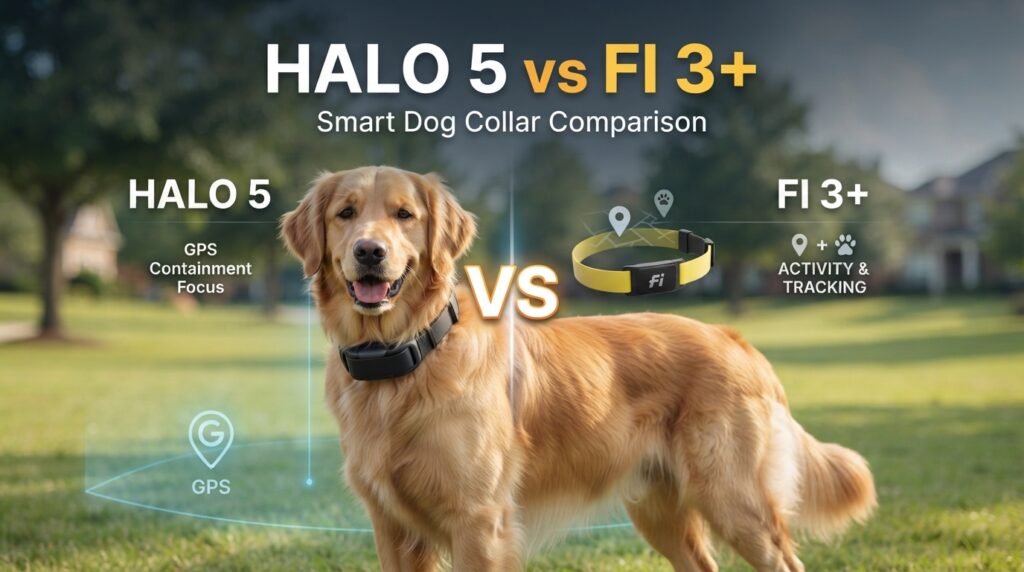
If your dog has ever slipped a gate, bolted after a squirrel, or vanished on a hike, you have probably searched for a GPS collar. Then you hit the two names that keep showing up: Halo Collar 5 and Fi Series 3+.
Both can show you where your dog is. But they solve the problem in different ways. One tries to stop your dog from leaving a boundary you set. The other tries to tell you fast when your dog has left and help you find them. That difference matters more than any spec on the box.
Last updated: September 28, 2026. Affiliate disclosure: PetTrackerHub may earn a commission if you buy through links on this page, at no extra cost to you. It does not change our analysis.
So instead of naming a universal winner, this guide shows which collar fits which dog and owner, with current pricing and a three-year cost breakdown.

- Halo Collar 5 Powered by Precision+: No other wireless dog fence combines dual-frequency L1 and L5 satellites with real-…
- Subscription required to activate GPS & fence features: Your Halo membership unlocks GPS tracking, unlimited cellular da…
- Know where your dog is the moment it matters: Know your dog’s exact location 24/7 with AlwaysOn GPS that comes standard …

- REAL-TIME GPS TRACKING, NO RANGE LIMITS: See your dog’s live location nationwide in the Fi app. This GPS dog tracking co…
- FI MEMBERSHIP REQUIRED: All Fi trackers require a GPS/LTE Plan that you can select at activation.
- ESCAPE ALERTS AND LOST DOG MODE: Draw safe zones around home, the yard, or a sitter’s house and get an alert the moment …
How We Researched This Comparison
PetTrackerHub did not physically test either collar for this article, and we have not run our own GPS accuracy or battery tests. This comparison is based on:
- Manufacturer information (Halo and Fi product, support, and pricing pages, checked in September 2026)
- Independent editorial reviews (for example, Outdoor Life’s Halo Collar 5 review)
- Owner-reported experience (long-term Fi owners’ published diagnostics and reviews)
- Our editorial interpretation, which we label as such
Where a number is a company claim, we say so. Where sources disagree or we couldn’t confirm a figure, we say that too. Prices change often, so verify the current manufacturer price before purchasing.
Quick Answer
Halo Collar 5 is built primarily for:
- GPS containment (a wireless dog fence)
- Boundary training and feedback the dog feels
- Real-time tracking
- Owners who want the collar to actively keep the dog inside an area
Fi Series 3+ is built primarily for:
- GPS tracking with safe-zone escape alerts
- Very long battery life between charges (up to 3 months, per Fi, under light-use conditions)
- A slim, integrated collar design
- Activity, sleep, and AI-based behavior insights
The short version: if your main goal is keeping your dog inside a boundary, Halo is the product designed for that. If your main goal is knowing when your dog leaves and finding them fast, with less charging and more wellness data, Fi is the better match. If you’re still deciding between categories, our guide to the best smart dog collars with GPS tracking and health monitoring covers more options.
Side-by-Side Comparison Table
| Feature | Halo Collar 5 | Fi Series 3+ |
|---|---|---|
| Product type | GPS containment + tracking + training collar | Integrated GPS tracking collar with escape alerts and wellness features |
| Main purpose | Keep the dog inside virtual fences | Track the dog, alert on escape, monitor activity |
| GPS tracking | Yes, live tracking in app | Yes, with GPS/LTE-M, Wi-Fi and Bluetooth assist |
| GPS accuracy | Halo claims accuracy within about 2 ft with Precision+ (manufacturer claim) | Fi says Series 3+ is “2x” more accurate than Series 3; no absolute figure published that we found |
| Location update behavior | Halo says the collar analyzes 20 location updates per second, and the app shows updates about 4x per second (manufacturer claims) | Intermittent in normal use; Lost Dog Mode updates every few seconds |
| Escape alerts | Yes, on fence breach | Yes, when the dog leaves a safe zone without a trusted person |
| Virtual fencing | Yes; unlimited fences on Gold, 5 on Bronze, 20 on Silver | Yes, as safe zones (alert-based) |
| Active containment | Yes (sound, vibration, static options) | No |
| Training | Built-in 5-step boundary training program | No containment training system |
| Feedback methods | Sound, vibration, static (optional, adjustable) | None to the dog; alerts go to the owner |
| Battery life | Up to 48 hours (Halo claim) | Up to 3 months (Fi claim, light use); about 2 days in Lost Dog Mode |
| Waterproof rating | IP67 | IP68 and IP66K (Fi says rated to 50 m) |
| Connectivity | GPS/GNSS, cellular, Wi-Fi, Bluetooth | GPS, LTE-M cellular, Wi-Fi via Fi Base, Bluetooth |
| Cellular coverage | Auto-switches between major carriers (AT&T, Verizon, T-Mobile, others) | Reported to use AT&T’s LTE-M network; verify coverage where you live |
| International availability | Fences are stored on the collar and work offline; Halo states it is starting in the U.S. and will expand | Fi lists U.S. and Canadian pricing and regional support pages; verify your country |
| Health/activity tracking | Activity logs and walks; more detail on Silver and Gold | Activity, sleep, steps, plus behavior detection |
| AI/behavior insights | Collar sensors identify dog behavior for fence logic; not a wellness suite | Detects barking, licking, scratching, eating, drinking |
| Integrated collar vs. existing collar | Halo device on its own strap | Integrated; needs a Fi-compatible band |
| Minimum dog size | 10 lb and 5 months; neck 8″–30.5″ | Neck sizes from 9.5″ (XS) to 31″ (XL); Fi Mini is aimed at smaller dogs |
| App | Halo app (iOS/Android) | Fi app (iOS/Android) |
| Apple Watch | We could not confirm current support | Yes |
| Subscription requirement | Yes; plans start at $9.99/mo | Yes; prepaid plans |
| Activation fee | None found | $20 listed by Fi; sometimes waived in promotions |
| Hardware price | $599 list; $524 at time of research | $129 list; some Fi offers include the device with a new membership |
| First-year estimated cost | About $634 | About $209–$338 |
| Two-year estimated cost | About $734 | About $398–$527 |
| Three-year estimated cost | About $844 | About $587–$716 |
| Multi-dog considerations | One collar per dog; extra collars discounted on plan | One tracker per dog; Fi lists 5% off multiple memberships |
| Best suited for | Owners who need boundaries and training | Owners who want tracking, alerts, low charging, and wellness data |
Cost estimates assume one collar, Halo Bronze on annual/2-year billing, and Fi 1-year renewals. Taxes and shipping excluded. Full math is in the cost section below.
Check the current Halo Collar 5 price | See the latest Fi Series 3+ details
- Halo Collar 5 Powered by Precision+: No other wireless dog fence combines dual-frequency L1 and L5 satellites with real-…
- Subscription required to activate GPS & fence features: Your Halo membership unlocks GPS tracking, unlimited cellular da…
- Know where your dog is the moment it matters: Know your dog’s exact location 24/7 with AlwaysOn GPS that comes standard …
- REAL-TIME GPS TRACKING, NO RANGE LIMITS: See your dog’s live location nationwide in the Fi app. This GPS dog tracking co…
- FI MEMBERSHIP REQUIRED: All Fi trackers require a GPS/LTE Plan that you can select at activation.
- ESCAPE ALERTS AND LOST DOG MODE: Draw safe zones around home, the yard, or a sitter’s house and get an alert the moment …
Halo Collar 5 Explained
What it actually is
Halo Collar 5 is a wireless GPS dog fence that also tracks location and activity. You draw a boundary in the Halo app, the collar stores that boundary, and the collar gives your dog feedback as they approach the edge.
Virtual fences and boundary feedback
You can create fences by dropping a pin or entering an address, and Halo can auto-generate a fence from property lines. According to Halo, fences can be as small as 900 square feet and as large as 1,200 square miles, and the collar stores them so they keep working without Wi-Fi or cellular.
When your dog nears a boundary, the collar gives feedback that Halo describes as a “Keep Away” cue. If the dog keeps going, feedback escalates until they stop or turn back, and then “Come Back” cues guide them home. Halo lists six feedback types, three preventive (Warning, Boundary, Emergency) and three encouraging (Whistle, Good Dog, Go Home). You can use sound, vibration, or static, and Halo says static is optional and adjustable.
Halo also sells Beacons for indoor keep-out zones, such as a garden bed or a room.
Live tracking, battery, and build
Halo says Collar 5 delivers up to 48 hours of battery and about one hour of rapid charging. Its own FAQ recommends removing the collar nightly and charging it overnight. In Outdoor Life’s review, the reviewer reports roughly 48 hours and charges nightly to avoid a dead battery. The rating is IP67, which covers rain, mud, and swimming according to Halo.
Fit
Halo says one size fits neck sizes from 8″ to 30.5″, for dogs at least 10 lb and 5 months old.
Pack Membership
A plan is required for GPS service, cellular data, and fence creation. According to Halo’s plans page, the tiers are:
- Bronze: 5 virtual fences, unlimited cellular data
- Silver: 20 fences, plus activity reports
- Gold: unlimited fences, advanced activity reports, and more perks
Plans start at $9.99 per month. Annual billing gives one month free, and the 2-year option gives three months free. Halo Protection (discounted replacement or upgrade) comes with the plan, and an optional Halo Care add-on costs $9.99 per month per collar. We could not verify current Silver and Gold monthly prices, so check Halo’s plan page.
Halo also lists a 90-day satisfaction guarantee and a one-year hardware warranty, and offers live support through its team.
GPS tracking vs. GPS containment
This is the most important idea in this comparison.
- GPS tracking tells you where the dog is. It’s information. If the dog leaves, the collar reports it, and you act.
- GPS containment acts on the dog in real time. The collar itself gives feedback at the boundary so the dog learns to stay in.
Halo does both. Fi does tracking and alerts. That’s why the two collars aren’t direct substitutes.
Fi Series 3+ Explained
Integrated design and connectivity
Fi Series 3+ is a small device that clicks into a compatible Fi collar band. Because the tracker is built into the band, there’s no separate box hanging from a collar. The catch is that you must use Fi-compatible bands rather than any collar you already own. If you’re also comparing Fi to a Tractive-style tracker, see our Tractive GPS vs. Fi smart dog collar comparison.
Fi’s connection strategy is layered. The collar uses Bluetooth near your phone, Wi-Fi when it can reach your home Fi Base, and cellular (reported to be AT&T’s LTE-M network) when away. That layering is a big part of why the battery can last so long, and why a Fi Base placed in an open area at home matters. Fi’s help center says a base that is offline or hidden away hurts battery life.
Escape alerts, safe zones, and Lost Dog Mode
You set safe zones, and Fi alerts you if your dog leaves without a trusted person. Lost Dog Mode turns on live tracking with frequent location updates until your dog is found. Fi says it is battery-intensive and gives about 2 days on a full charge, so treat it as an emergency mode.
A long-term owner review on Life With Klee Kai describes Fi alerting them when a dog left the yard, letting them retrieve the dog quickly. That is one owner’s experience, not a guarantee.
Battery: advertised vs. realistic
Fi advertises up to 3 months of battery. Fi’s own help center says actual battery life depends on your dog’s activity and how much time they spend away from home. One independent owner (Rebarkable) published diagnostics from two Series 3 collars showing extrapolated lifetimes of roughly 22 and 38 days over a 28-day sample. Series 3+ results may differ, but the point holds: real-world life depends heavily on use.
Water resistance and durability
Fi lists IP68 plus IP66K and says it is rated to 50 meters. Fi also says the stainless steel frame resists tug force, and it has a customizable light for low-visibility situations.
Activity, sleep, and AI behavior insights
Per Fi’s Series 3+ announcement, the collar tracks activity, naps, and sleep, and detects barking, licking paws, scratching, eating, and drinking. Fi says its AI was trained on a large collection of dog data. That is a manufacturer claim, and we found no independent accuracy study.
Important: these are wellness and behavior trends. They can prompt a conversation with your vet, but they are not a diagnosis. Never use a collar’s data to delay veterinary care.
App, extras, and membership
The Fi app includes Apple Watch integration and AI-organized vet records. Membership is required. Per Fi’s billing page, U.S. plans renew at $99 per 6 months, $189 per year, or $339 per 2 years, with a 6-month minimum commitment. The Series 3+ tracker is listed at $129, though Fi has also advertised a complimentary device for new members, and promotions vary.
Sizing
Fi sells five band sizes, from XS (9.5″–11″ neck) to XL (20″–31″ neck), based on retailer specs. Fi’s smaller Fi Mini is designed for small dogs and cats and is about 80% lighter, though it doesn’t fit Fi collar bands.
GPS Accuracy and Tracking
Accuracy is not update speed
These are two separate things, and marketing often blurs them.
- Accuracy is how close the reported spot is to the dog’s real position.
- Update frequency is how often a new position reaches you.
- Position fixes happen inside the collar. Phone updates depend on the cellular or Wi-Fi link.
Halo says its collar analyzes 20 location updates per second and that the app updates about four times per second. We treat the 20-per-second figure as an on-collar processing claim, not proof that your phone map refreshes 20 times per second. Fi doesn’t publish a comparable per-second figure. In normal use it checks in intermittently to save battery, and Lost Dog Mode refreshes every few seconds.
Why accuracy matters differently
- Finding a lost dog: being within a few dozen feet is often enough. You need direction and a fast, reliable signal.
- Enforcing a fence: feet matter. A boundary 10 feet from a road is useless if the reported position drifts 15 feet. That’s why Halo built its pitch around precision.
In April 2026 Halo announced Precision+, pairing dual-frequency GPS with cloud corrections from Swift Navigation’s Skylark service. Halo claims about 2-foot accuracy and says independent testing found 3x better accuracy than other GPS dog fences, though the release doesn’t name the tester or publish full methods, so treat it as a manufacturer claim. The release also says Precision+ is delivered over a continuous internet connection, so it is reasonable to expect regular GPS accuracy where that connection drops (our inference; confirm with Halo).
You can read more on Halo’s GPS and location tracking page. For tracker-only options, see our real-time GPS tracker roundup for 2026.
Environmental limits
Dense tree cover, canyons, and buildings weaken any GPS signal. Cellular dead zones block live updates for both products. Halo’s stored fences keep working offline, but Fi’s location reports need coverage. Indoors, expect only rough location from either.
Battery Life
Halo (advertised: up to 48 hours). Continuous GPS, frequent feedback events, time in the app, weather, and firmware all affect it. Halo says it doesn’t use low-power modes for tracking. Plan on nightly charging, about an hour on the charger.
Fi (advertised: up to 3 months). That figure applies to light use with regular Wi-Fi base connection at home. More time away from home, more cellular use, and Lost Dog Mode shorten it. Fi says Lost Dog Mode lasts about 2 days.
How to read “3 months.” It does not mean three months of continuous live GPS. It means a low-power, mostly-idle pattern. Halo’s 48 hours is a different job: always-on tracking plus fence enforcement.
Cold weather also cuts lithium-ion battery capacity for any GPS collar. For hikers who need to compare more devices, see our best GPS trackers for active and outdoor dogs.
GPS Fence vs. Safe Zone
Example: your dog trots toward the edge of your yard.
- With Halo: the collar gives a warning cue as they approach. If they continue, the feedback escalates. When they turn back, encouragement cues guide them home. You get a notification if they cross.
- With Fi: nothing happens to the dog. If they leave the safe zone, you get a notification, you open the app, and you go get them.
Halo: active containment, feedback delivered to the dog, and unlimited fences on Gold. Fi: monitoring and alerts to the owner, plus location tracking to find the dog.
Fi’s alert is valuable, especially for a dog behind a fence who occasionally escapes. But it is not a substitute for containment. Halo’s “escape proof” marketing should also be read carefully: no system is guaranteed, and training, fit, and settings all matter.
Compare current Halo membership options | Check current Fi Series 3+ pricing
- Halo Collar 5 Powered by Precision+: No other wireless dog fence combines dual-frequency L1 and L5 satellites with real-…
- Subscription required to activate GPS & fence features: Your Halo membership unlocks GPS tracking, unlimited cellular da…
- Know where your dog is the moment it matters: Know your dog’s exact location 24/7 with AlwaysOn GPS that comes standard …
- REAL-TIME GPS TRACKING, NO RANGE LIMITS: See your dog’s live location nationwide in the Fi app. This GPS dog tracking co…
- FI MEMBERSHIP REQUIRED: All Fi trackers require a GPS/LTE Plan that you can select at activation.
- ESCAPE ALERTS AND LOST DOG MODE: Draw safe zones around home, the yard, or a sitter’s house and get an alert the moment …
Training
Halo includes a five-step boundary training program developed with Cesar Millan. Halo says the owner should do the training, and how fast a dog learns varies. A GPS fence is a tool that needs the dog to understand the boundary first.
Some practical rules:
- Train before you rely on the fence.
- Reward the behavior you want. The AKC’s guide to positive reinforcement explains marking correct behavior and following with a reward.
- Don’t treat GPS as a replacement for recall, leash skills, or supervision.
Halo says its training uses positive association and that static feedback is optional. Some owners and trainers prefer to avoid static feedback entirely, so start with sound and vibration and talk to a qualified trainer if your dog is anxious or reactive. We make no claims about behavioral outcomes.
Fi is not a containment or training system. It won’t teach a dog boundaries.
Health and Activity Monitoring
| Feature | Halo Collar 5 | Fi Series 3+ |
|---|---|---|
| Activity/steps | Yes; walks and daily activity | Yes |
| Sleep/rest | Limited detail found | Yes |
| Eating/drinking | Not listed | Yes (AI-detected) |
| Licking/scratching | Not listed | Yes (AI-detected) |
| Barking | Not listed | Yes (AI-detected) |
| Reports | Weekly/monthly on Silver; advanced on Gold | Trends in app |
Fi has the clearly broader wellness feature set. Halo’s activity data is a helpful side feature. These are wellness and behavior monitoring tools, not veterinary diagnostic tools. A spike in scratching means “ask your vet,” not “your dog has a condition.”
Subscription Cost and Total Cost of Ownership
Both collars require a paid plan to work. Prices below were checked in September 2026. Prices can change, so verify the current manufacturer price before purchasing. Promotions are temporary, so we based estimates on regular plan pricing.
Halo Collar 5 (one collar, Bronze plan)
- Hardware: $524 sale price, or $599 list
- Bronze: $9.99/month (annual billing pays 11 months; 2-year billing pays 21 months)
- No activation fee found
Fi Series 3+ (one tracker)
- Hardware: $129 list, or $0 when included with a new-member offer
- Activation fee: $20 (has been waived in some promotions)
- Membership: $189 per year, $99 per 6 months, or $339 per 2 years
Estimated cost over time
| Timeframe | Halo (at $524) | Halo (at $599 list) | Fi (1-yr renewals) | Fi (2-yr prepay) |
|---|---|---|---|---|
| Year 1 | ~$634 | ~$709 | $209–$338 | $359–$488 (2 yrs upfront) |
| 2 years | ~$734 | ~$809 | $398–$527 | $359–$488 |
| 3 years | ~$844 | ~$919 | $587–$716 | $548–$677 |
The Fi range’s low end assumes a free device; the high end assumes the $129 list price. Halo estimates use Bronze annual/2-year billing. Monthly billing would run roughly $644, $764, and $884 at the $524 price. Silver and Gold plans cost more.
Extras worth knowing:
- Halo Protection is included with plans; Halo Care adds $9.99/month per collar.
- Fi says its membership includes a Series 3+ warranty.
- Fi Base is included with the collar kit, but you’ll want a Fi-compatible band for each size.
Over three years, Fi typically costs several hundred dollars less. Halo’s higher cost buys active containment, which Fi doesn’t offer. For context, Outdoor Life’s reviewer noted a wired invisible fence quote of $2,000 for one acre, so containment via Halo can still be cheaper than physical fencing. That is one reviewer’s quote, not a universal figure.
See the latest product details for Halo | See the latest product details for Fi
- Halo Collar 5 Powered by Precision+: No other wireless dog fence combines dual-frequency L1 and L5 satellites with real-…
- Subscription required to activate GPS & fence features: Your Halo membership unlocks GPS tracking, unlimited cellular da…
- Know where your dog is the moment it matters: Know your dog’s exact location 24/7 with AlwaysOn GPS that comes standard …
- REAL-TIME GPS TRACKING, NO RANGE LIMITS: See your dog’s live location nationwide in the Fi app. This GPS dog tracking co…
- FI MEMBERSHIP REQUIRED: All Fi trackers require a GPS/LTE Plan that you can select at activation.
- ESCAPE ALERTS AND LOST DOG MODE: Draw safe zones around home, the yard, or a sitter’s house and get an alert the moment …
Which Is Better for Different Dogs?
| Dog/Owner Situation | Better Fit | Why |
|---|---|---|
| Escape-prone dog | Halo for containment; Fi if the dog is already fenced | Halo acts at the boundary. Fi alerts you after the dog has left. |
| Large unfenced property | Halo | Fences up to 1,200 sq mi and no wire installation; Fi can’t contain |
| Existing physical fence | Fi | Alerts if the dog escapes anyway; you don’t need a second containment system |
| Urban/suburban dog | Depends | Halo can fence yards and parks; Fi suits leashed walkers who want alerts and wellness data |
| Rural dog | Halo (with caveats) | Stored fences work offline, but cellular gaps limit live updates for both |
| Hiking/adventure dog | Depends | Fi’s light and IP68 build suit trails; Halo’s boundary control helps off-leash; both need coverage |
| Swimming dog | Fi (slight edge) | IP68/IP66K tested to 50 m vs. Halo’s IP67; both are marketed as swim-safe |
| Owner who hates charging | Fi | Weeks between charges vs. Halo’s nightly routine |
| Owner wanting training tools | Halo | Structured boundary training built in |
| Owner wanting health insights | Fi | Broader behavior detection, including eating, licking, scratching |
| International traveler | Verify first | Halo fences are stored offline; both firms’ non-U.S. support varies |
| Multi-dog household | Either | Both need one device per dog and offer multi-dog plan discounts |
| Budget-focused owner | Fi | Lower hardware and multi-year cost; Halo Collar 4 was also discounted to $424 at last check |
Pros and Cons
Halo Collar 5
Pros
- Active GPS containment and boundary feedback
- Built-in training program
- Fences stored on the collar and portable to any location
- Precision+ dual-frequency GPS (per Halo)
- Fast charging, 90-day guarantee
Cons
- Higher hardware and three-year cost
- About 48 hours of battery, so nightly charging is the norm
- Subscription required; fence counts tier-based
- Training takes time; static feedback isn’t for every owner
- Wellness insights are lighter than Fi’s
Fi Series 3+
Pros
- Very long battery life under typical light use
- Slim integrated design
- Broad activity and AI behavior detection
- IP68/IP66K build
- Lower long-term cost; Apple Watch support
Cons
- No active containment or training
- Requires Fi-compatible bands and a home Base
- Lost Dog Mode drains the battery in about 2 days
- Real battery life depends on use
- Location tracking needs cellular coverage
- 6-month minimum commitment; no month-to-month plan
Who Should Buy Halo Collar 5?
- You want your dog contained, not just tracked
- You have a property where physical fencing is impractical or costly
- You want a wireless fence you can take on trips
- You’re willing to train your dog and charge nightly
- You value boundary control over battery longevity
Who Should Buy Fi Series 3+?
- You already have a secure physical fence and want a backup
- You want alerts and fast tracking rather than containment
- You prefer charging every few weeks
- You like an integrated, low-profile collar
- You want activity and behavior trends for a vet conversation
Who Should NOT Buy Either?
- Tiny dogs: Halo requires 10 lb and up. Fi’s smaller Fi Mini may suit better.
- Hunting dogs needing long-range radio GPS: cellular collars fail beyond coverage. Look at radio systems.
- Owners wanting no subscription: both require paid plans.
- Areas with poor cellular coverage: live tracking suffers, especially for Fi.
- Owners wanting a simple Bluetooth tracker: a basic tag may be enough for short-range use.
- Owners who only need an ID backup: a tag or microchip with current contact details is far cheaper.
If you want a tracker without a fence, compare our Tractive GPS dog tracker review.
Final Decision Framework
- If your priority is stopping the dog from leaving a boundary → consider Halo.
- If your priority is training boundaries with structured feedback → consider Halo.
- If your priority is fast escape alerts and finding a lost dog → consider Fi.
- If your priority is minimal charging and a slim collar → consider Fi.
- If your priority is wellness trends and Apple Watch access → consider Fi.
- If you have a good fence already → Fi is usually the better value.
- If you need no subscription, long-range radio, or a tiny-dog tracker → look at another category.
Check the current Halo Collar 5 price | Compare Fi Series 3+ options
- Halo Collar 5 Powered by Precision+: No other wireless dog fence combines dual-frequency L1 and L5 satellites with real-…
- Subscription required to activate GPS & fence features: Your Halo membership unlocks GPS tracking, unlimited cellular da…
- Know where your dog is the moment it matters: Know your dog’s exact location 24/7 with AlwaysOn GPS that comes standard …
- REAL-TIME GPS TRACKING, NO RANGE LIMITS: See your dog’s live location nationwide in the Fi app. This GPS dog tracking co…
- FI MEMBERSHIP REQUIRED: All Fi trackers require a GPS/LTE Plan that you can select at activation.
- ESCAPE ALERTS AND LOST DOG MODE: Draw safe zones around home, the yard, or a sitter’s house and get an alert the moment …
Frequently Asked Questions
1. Is Halo Collar 5 better than Fi Series 3+? Neither is better overall. Halo is stronger for containment and training. Fi is stronger for battery life, wellness data, and lower long-term cost.
2. What is the main difference between Halo and Fi? Halo gives feedback to the dog at a boundary. Fi alerts the owner when the dog leaves a safe zone.
3. Does Fi Series 3+ have a GPS fence? It has virtual safe zones with escape alerts, but it doesn’t deliver active containment feedback to the dog.
4. Can Halo Collar 5 track a lost dog? Yes. It includes live GPS tracking in the Halo app, subject to plan and connectivity.
5. Does Halo require a subscription? Yes. A Pack Membership is required for GPS service, cellular data, and fences. Plans start at $9.99 per month.
6. Does Fi Series 3+ require a subscription? Yes. Fi lists an active membership as required to activate the collar. U.S. plans are prepaid.
7. Which has better battery life? Fi, by a wide margin on paper (up to 3 months vs. up to 48 hours). They do different jobs, and real results vary with use.
8. Which has better GPS accuracy? Halo publishes a specific accuracy claim (about 2 feet with Precision+). Fi doesn’t publish a comparable figure that we found. Both claims are manufacturer-reported.
9. Which is better for escape-artist dogs? Halo if you want to stop escapes; Fi if you want fast alerts and tracking after an escape. Many owners with a physical fence choose Fi as a backup.
10. Which is better for large dogs? Both support large neck sizes (Halo up to 30.5″, Fi up to 31″). Choose by containment need, not size.
11. Can Fi Series 3+ monitor dog health? It tracks activity, sleep, and behaviors such as scratching, licking, eating, and drinking. It is not a diagnostic tool.
12. Can Halo work without Wi-Fi? Yes, once fences are saved to the collar, though live updates, app changes, and Precision+ corrections need a connection.
13. Can these collars work internationally? Halo’s fences are stored on the collar, but Halo says it is starting in the U.S. Fi lists regional pricing for some countries. Confirm coverage for your country first.
14. Which one is better for hiking? Fi has the lighter build and longer battery; Halo has boundary control if your dog is off-leash. Cellular coverage on the trail matters for both.
15. Which one is better if I already have a physical fence? Usually Fi, since you mainly need escape alerts.
Bottom Line
Choose Halo Collar 5 if you need the collar to hold a boundary. Choose Fi Series 3+ if you need it to warn you and help you find your dog, with less charging and more wellness data. And if neither fits, our roundup of the best GPS trackers for active and outdoor dogs is a good next step.