
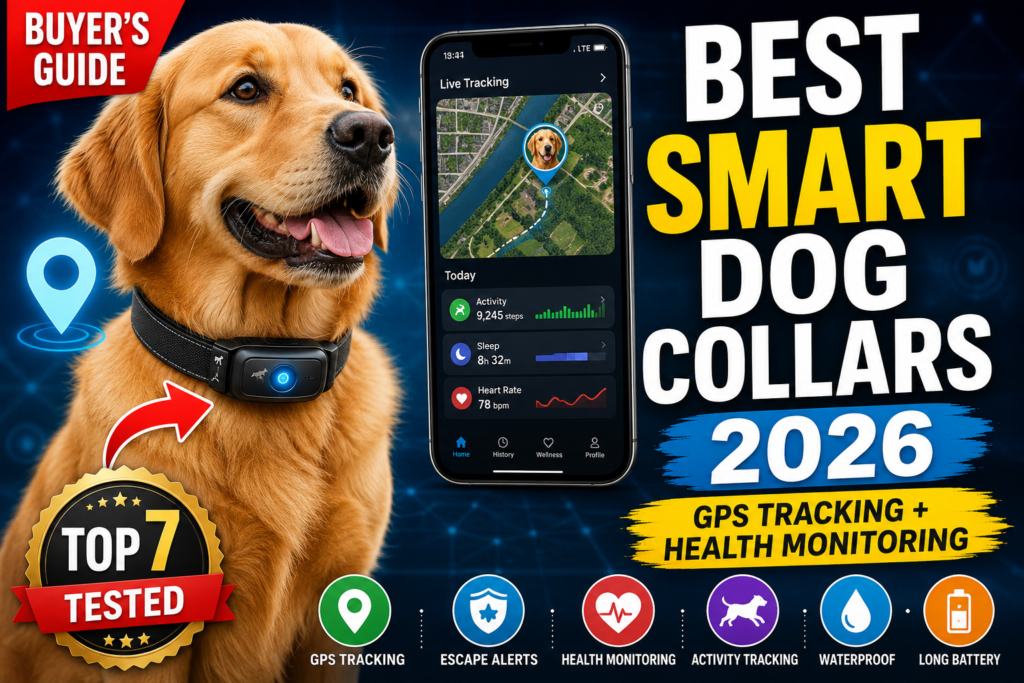
My neighbor’s Australian Shepherd, Scout, got out through a gap in the fence last spring. Fifteen minutes of panic later, she found him three streets over because his collar pinged her phone the second he crossed the yard boundary. No frantic flyers, no driving around in circles. That’s the entire pitch for this category of product, and it’s why smart dog collars have moved from “nice gadget” to “thing responsible owners just have now.”
A decade ago, a dog collar told you exactly one thing: that your dog had a collar on. Today’s smart collars combine GPS tracking, activity monitoring, and in some cases genuine health diagnostics into a single device that talks to an app on your phone. That shift matters for two reasons. First, dogs go missing more often than most owners expect — gates get left open, fences get jumped, leashes slip. Second, dogs can’t tell you when something’s wrong. A collar that notices your senior Lab is sleeping 20% more than usual, or that your young Border Collie’s resting heart rate has crept up for three days straight, is catching things a once-a-year vet visit simply can’t.
This guide breaks down the smart collars actually worth your money in 2026 — what they get right, where they fall short, and which one fits your situation. We also flag a couple of once-popular collars that have been discontinued, because nothing is more frustrating than buying hardware for a service that no longer exists.
Why Smart Dog Collars Matter in 2026
Three things changed to make this category genuinely useful rather than a novelty.
Cellular coverage got better and cheaper. Early GPS collars relied on Bluetooth, which only worked within a few hundred feet of your phone — useless for an actual lost-dog scenario. Modern collars use embedded LTE-M SIM cards, the same low-power cellular tech used in some medical devices, giving them real range almost anywhere there’s cell service.
Sensors got smaller and smarter. The accelerometers and heart-rate sensors that used to require bulky hardware now fit inside a standard collar attachment. That’s what makes health monitoring possible without turning your dog into a science experiment.
Vets started taking the data seriously. Several of the collars in this guide let you export health reports directly for your veterinarian, and some companies have published peer-reviewed validation of their vital-sign accuracy. That’s a meaningful shift from “fitness tracker gimmick” to “diagnostic-adjacent tool.”
It’s worth being clear about what these collars are not. A microchip is a passive identification chip with no battery and no ability to transmit your dog’s location — it only helps if someone finds your dog and scans it. A GPS collar is an active tracking device that shows you where your dog is in real time. The two aren’t substitutes for each other; most veterinary organizations recommend using both.
Quick Comparison Table
| Product | GPS Tracking | Health Monitoring | Battery Life | Subscription | Best For | Rating |
|---|---|---|---|---|---|---|
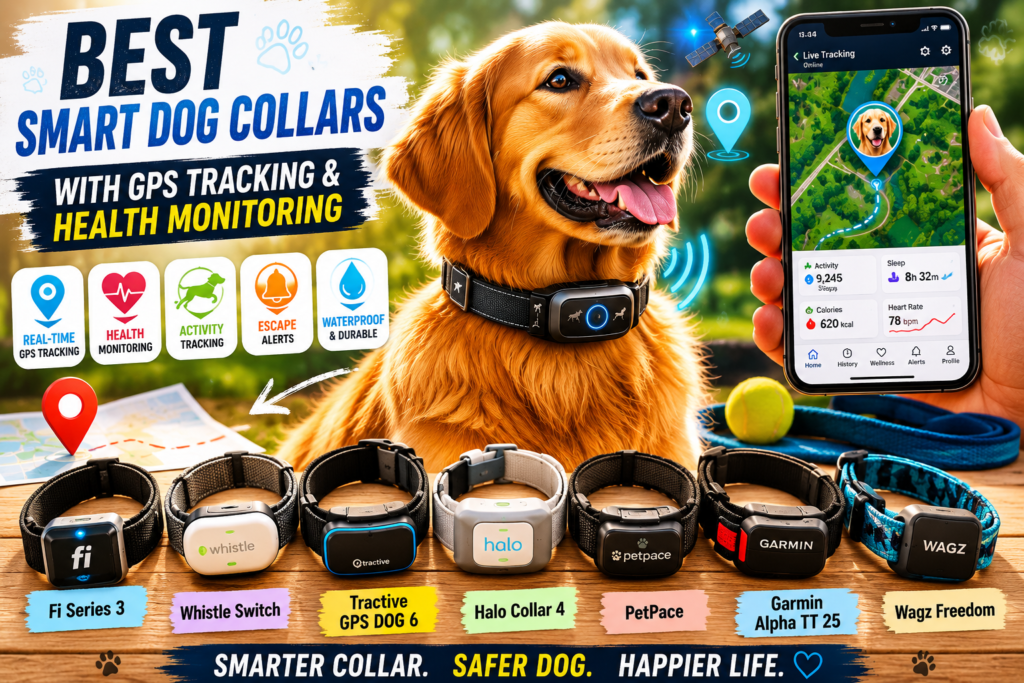
| Fi Series 3+ | Real-time, LTE + GPS + Wi-Fi | Activity, sleep, licking/scratching | Up to 3 months | Required ($9.75–$19/mo) | Longest battery life | 4.6/5 |
| Tractive DOG 6 | Real-time, LTE-M, 2–3 sec updates | Activity, sleep, heart rate, respiration, barking | Up to 2 weeks (6 weeks on XL) | Required (from ~$5/mo) | Best value overall | 4.6/5 |
| Halo Collar 5 | Dual-frequency GPS fence + tracking | Activity tracking, training data | 30+ hours | Required (from $9.99/mo) | Invisible-fence training | 4.4/5 |
| PetPace V3.0 | Real-time GPS (V3.0 only) | Heart rate, HRV, respiration, temperature, pain score | Up to 3 weeks | Required (~$25/mo or less on annual) | Deepest health diagnostics | 4.7/5 |
| Garmin Alpha TT 25 | VHF/GPS, paired to handheld, up to 9 miles | None (tracking/training only) | Up to 68–136 hrs | None | Hunting & working dogs | 4.3/5 |
| SpotOn GPS Fence | True Location GPS fence | Basic activity via tracking plan | Multi-day | Optional (core fence works without one) | No-subscription fencing | 4.5/5 |
A note on two names you might expect to see here: Whistle trackers were discontinued in August 2025 after Tractive acquired the brand and shut down Whistle’s servers, and Wagz collars stopped working back in 2023 when the company ceased operations. Any “new” or secondhand units from either brand are non-functional bricks — there’s no backend left to connect to. We’ve swapped in their realistic 2026 replacements (Tractive and SpotOn, respectively) so this guide actually reflects what you can buy and use today.
Best Smart Dog Collars Reviewed
1. Fi Series 3+ Smart Dog Collar
Overview
Fi has been the name people reach for first when they search “GPS dog collar,” and the Series 3+ is the reason why. It’s not a clip-on add-on like most of this list — it’s a fully integrated collar with the GPS module built into a rugged, chew-resistant band. You don’t pay anything upfront for the hardware (it ships free), but you do pay a $20 activation fee plus a recurring subscription, and that subscription is non-negotiable if you want the collar to actually track.
Key Features
- Built-in GPS, LTE, and Wi-Fi for location tracking with no practical range limit
- Magnetic charging base that doubles as an in-home tracker hub
- Escape alerts the moment your dog leaves a designated safe zone
- Step counting, distance traveled, and sleep tracking
- Shareable access so dog walkers or family members can see your dog’s location too
GPS Accuracy
Because Fi blends GPS with LTE and Wi-Fi rather than relying on satellite positioning alone, it tends to lock on fast and stays accurate in suburban and urban environments. Performance dips somewhat in areas with weak cell coverage, which is true of every cellular-based tracker on this list, not just Fi.
Health & Activity Monitoring
This is where the “3+” upgrade shows up. Beyond basic steps and sleep, the Series 3+ uses AI to flag changes in licking, scratching, eating, and drinking patterns — early indicators of skin issues, dental pain, or digestive trouble that owners often miss. You can export the data as a report to bring to your vet, which is a small feature that makes a real difference during an actual appointment.
Battery Life
Fi’s standout feature. The company advertises up to three months per charge, and real-world testers consistently report two to three months under normal use — dramatically longer than any cellular GPS competitor. The trade-off is that this long life partly comes from using Bluetooth and Wi-Fi for routine tracking and only switching to power-hungry LTE when your dog actually leaves a safe zone. During continuous live tracking, battery life drops closer to what Tractive offers.
Mobile App Experience
Clean and genuinely easy to navigate, with a map view, activity dashboard, and the option to add multiple people to a single dog’s account. The escape-alert notifications are fast and reliable, which is the single most important thing an app like this needs to get right.
Pros
- Exceptional battery life compared to other cellular trackers
- Free hardware with no large upfront cost
- Strong escape-alert and lost-dog mode
- AI-driven behavioral insights most competitors don’t offer
Cons
- Subscription is mandatory — there’s no way to use the collar without one
- Multi-year plans are the only way to get real value; monthly billing is expensive long-term
- US-only coverage
Best For
Owners who want the longest possible stretch between charges and don’t mind committing to a multi-year plan to get the best price.
Verdict
The Fi Series 3+ earns its reputation. If battery anxiety is your main hesitation about GPS collars, this is the one that resolves it. Just go in expecting a real, ongoing subscription cost — budget accordingly before you fall in love with the free collar offer.
👉 Ready to stop worrying every time your dog’s in the yard alone? The Fi Series 3+ is the easiest “set it and forget it” GPS collar on this list — check current plan pricing before you commit to a multi-year term, since the per-month savings are significant.

- REAL-TIME GPS TRACKING, NO RANGE LIMITS: See your dog’s live location nationwide in the Fi app. This GPS dog tracking co…
- 12-MONTH MEMBERSHIP INCLUDED, NOTHING EXTRA AT CHECKOUT: One price covers the collar and 12 months of Fi Membership, the…
- ESCAPE ALERTS AND LOST DOG MODE: Draw safe zones around home, the yard, or a sitter’s house and get an alert the moment …
2. Tractive DOG 6 GPS Tracker
Overview
Tractive isn’t new — the Austria-based company has been building pet trackers since 2012, and in 2025 it absorbed Whistle’s customer base after that brand’s shutdown. The DOG 6 is a clip-on tracker rather than an integrated collar, which means it attaches to whatever collar your dog already wears, standard 1-inch width.
Key Features
- Live tracking with location updates every 2–3 seconds — among the fastest refresh rates in this category
- Virtual fences (geofencing) with instant escape alerts
- Health monitoring: heart rate, respiratory rate, sleep, and bark detection
- Works in 175+ countries on partner cellular networks
- IP68 waterproof rating, fully submersible
GPS Accuracy
Tractive’s live-tracking mode is genuinely fast — faster than most consumer GPS collars, including Fi’s standard mode. That 2–3 second refresh makes a real difference if your dog is actively running rather than just wandering, since slower trackers can leave you chasing a location that’s already out of date.
Health & Activity Monitoring
For the price, Tractive’s health suite is unusually deep: steps, calories, sleep quality, resting and active heart rate, and respiratory rate, plus alerts when any of those shift outside your dog’s normal pattern. This kind of early-warning system is particularly valuable for senior dogs, who often hide symptoms of illness until a condition has progressed.
Battery Life
Rated up to two weeks on the standard DOG 6, and up to six weeks on the DOG 6 XL for larger dogs. Continuous live tracking will burn through battery faster — a 45-minute live session noticeably dents the charge — but for everyday geofencing and periodic check-ins, two weeks is realistic.
Mobile App Experience
The app is straightforward: a live map, a health dashboard, and configurable alerts. Some advanced health features are gated behind the Premium subscription tier rather than the Basic plan, so check what’s included before assuming you have full access.
Pros
- Best value-to-feature ratio in this guide
- Fastest live-tracking refresh rate
- Genuinely useful health monitoring at a lower price than premium competitors
- Works internationally, not just in the US
Cons
- Clip-on design isn’t as sleek as an integrated collar like Fi or Halo
- Best battery life requires staying out of Live Tracking mode
- Some users report the silicone mounting clip loosening over time
Best For
Owners who want strong GPS tracking and solid health monitoring without paying premium-tier prices — and anyone outside the US who needs international coverage.
Verdict
If you’re trying to figure out where your money goes furthest in this category, it’s here. Tractive doesn’t have the absolute longest battery life or the flashiest design, but it nails the fundamentals at a price that doesn’t sting, which is exactly why it absorbed Whistle’s former customer base so smoothly.
👉 Want fast, reliable tracking without paying for features you’ll never use? The Tractive DOG 6 strikes the best balance of price and performance on this list — see our full [Tractive GPS Review] for a deeper dive into real-world battery testing.

- REAL-TIME GPS TRACKING WITH UNLIMITED RANGE: Track your dog with live location updates every 2–3 seconds. Unlike others …
- VITAL SIGNS MONITORING: The Tractive smart tracker monitors changes in your dog’s heart and respiratory rates, helping d…
- HEALTH & BARKING ALERTS: The tracker learns your dog’s normal behavior and detects changes. If it notices unusual sleep,…
3. Halo Collar 5
Overview
Halo — co-founded with celebrity dog trainer Cesar Millan — built its name on one core idea: a completely wireless, GPS-based invisible fence, no buried wires required. The current Halo Collar 5 is a meaningful step up from the Halo 4, adding dual-frequency GPS and a significantly faster location-update engine.
Key Features
- Dual-frequency (L1 and L5) GPS for improved accuracy near buildings and tree cover
- Draw custom virtual fences directly in the app, no professional installation
- Up to 20 GPS location updates per second in tracking mode
- Built-in training program developed with Cesar Millan
- Customizable boundary feedback: tone, vibration, or static correction
GPS Accuracy
This is genuinely Halo’s strongest selling point. Dual-frequency GPS filters out a lot of the signal noise that confuses single-frequency trackers near tall buildings or heavy tree cover, and the high-frequency update rate keeps the fence boundary enforcement tight even with fast-moving dogs.
Health & Activity Monitoring
Lighter than Fi, Tractive, or PetPace on the health side. Halo tracks activity and integrates that data into its training program, but it doesn’t offer the vital-sign monitoring (heart rate, respiration) that the health-focused collars in this guide provide. If health diagnostics are your priority, this isn’t the strongest pick.
Battery Life
Rated at 30+ hours, which is a real improvement over earlier Halo models but still shorter than the multi-day or multi-week life you get from Tractive, Fi, or PetPace. Expect to charge it every day or two with regular use.
Mobile App Experience
The app handles fence creation well — drawing a boundary is fast and intuitive — and the built-in training lessons add genuine value if your dog is new to boundary training. Live tracking and unlimited fences are gated behind higher subscription tiers, so the entry-level plan is more limited than it first appears.
Pros
- Best-in-class fence accuracy thanks to dual-frequency GPS
- Strong built-in training program, useful for boundary-training a new dog
- 33% smaller and lighter than the previous generation
Cons
- Shortest battery life on this list among the cellular-connected options
- Health monitoring is basic compared to Fi, Tractive, or PetPace
- Higher-tier subscription required to unlock live tracking and unlimited fences
Best For
Owners whose main goal is a reliable invisible fence with training support, rather than deep health monitoring.
Verdict
Halo Collar 5 does one thing extremely well — wireless containment — and does it better than almost anyone else. Just go in clear-eyed that this is a fencing-and-training tool first, a GPS tracker second, and a health monitor a distant third.
👉 Tired of buried wires and flags all over your yard? Halo Collar 5’s GPS fence sets up in minutes and adjusts as easily as redrawing a line on your phone — worth comparing directly against SpotOn below if a one-time purchase appeals to you more than a subscription.

- Halo Collar 5 Powered by Precision+: No other wireless dog fence combines dual-frequency L1 and L5 satellites with real-…
- Subscription required to activate GPS & fence features: Your Halo membership unlocks GPS tracking, unlimited cellular da…
- Know where your dog is the moment it matters: Know your dog’s exact location 24/7 with AlwaysOn GPS that comes standard …
4. PetPace V3.0 Smart Collar
Overview
PetPace takes a different approach from everything else on this list: it was built first as a veterinary health-monitoring tool and only later added GPS. The collar is used in veterinary hospitals and research settings, not just living rooms, and that clinical pedigree shows up in how seriously it treats vital-sign data.
Key Features
- Continuous monitoring of heart rate, heart rate variability, respiratory rate, and temperature
- AI-driven pain scoring and posture analysis
- 24/7 telehealth access to licensed vets through the AskaVet feature
- Direct data sharing with your own veterinarian
- GPS tracking and smartwatch compatibility on the V3.0 model
GPS Accuracy
GPS is a newer addition for PetPace (introduced with the V3.0), and it’s solid for everyday location tracking, but this isn’t the collar to buy if real-time escape tracking is your number-one priority — Tractive and Fi are built around that use case more directly. PetPace’s GPS is a useful bonus layered onto a health-first device.
Health & Activity Monitoring
This is the entire point of the product, and it shows. PetPace tracks vital signs continuously — not just step counts, but heart rate variability, respiration, and temperature, the same categories of data your vet would monitor during a hospital stay. The AI-powered alerts are tuned to catch subtle deviations from your dog’s individual baseline, which matters because “normal” varies a lot between breeds, ages, and individual dogs.
Battery Life
Up to three weeks indoors via Wi-Fi, which is respectable for a device running this many sensors continuously.
Mobile App Experience
The app presents data in a genuinely clinical way — wellness scores, trend graphs, and shareable reports for your vet — rather than gamified fitness-app styling. Some owners find this less fun to check casually but more useful when something is actually wrong.
Pros
- Most comprehensive vital-sign monitoring of any collar in this guide
- 24/7 telehealth access included in the subscription
- Strong fit for senior dogs or dogs with chronic conditions
- Data export makes vet visits more productive
Cons
- Among the more expensive subscriptions on this list
- GPS is a newer, secondary feature rather than the core strength
- Healthy young dogs may not get proportional value from this much monitoring
Best For
Senior dogs, dogs managing a chronic illness, or any owner who wants veterinary-grade health data rather than basic fitness tracking.
Verdict
If your dog has a known health condition, is getting older, or you’ve simply had a scare that made you want real diagnostic data rather than step counts, PetPace is built for exactly that. For a young, healthy dog, it may be more monitoring than you actually need.
👉 Managing a senior dog or a chronic condition? PetPace’s vital-sign monitoring gives your vet data they can actually act on — ask about the multi-year plans, which bring the effective monthly cost down significantly compared to month-to-month billing.
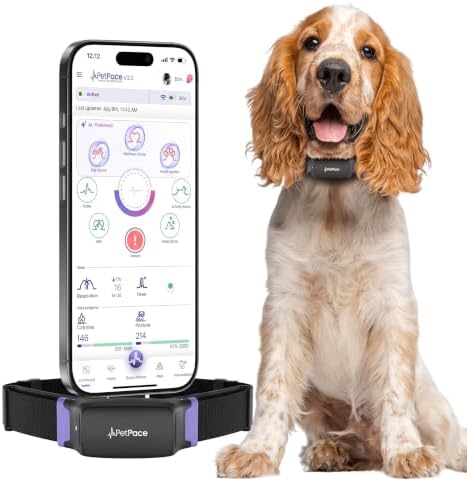
- 24/7 ADVANCED DOG HEALTH MONITORING – Tracks heart rate, breathing, temperature, pulse, activity, sleep, and HRV every 2…
- TELEHEALTH – AskaVet & Share With Your Vet gets you 24/7 Telehealth access to licensed vets via chat or video. Enable Re…
- GPS TRACKING & SMARTWATCH COMPATIBILITY – Monitor your dog’s location and health in near real-time directly from your ph…
5. Garmin Alpha TT 25
Overview
The Alpha TT 25 is a different category of product from everything else on this list, and it’s worth understanding that distinction before you buy. This is a tracking-and-training collar built for hunters and working-dog handlers, designed to pair with a separate Garmin handheld device — it does not use a smartphone app or cellular subscription at all.
Key Features
- High-sensitivity GPS and Galileo satellite receiver
- VHF signal transmission to a compatible handheld, up to 9 miles away
- Location updates as frequent as every 2.5 seconds when paired with a handheld
- 18 levels of training stimulation, plus tone and vibration
- Bright, multicolor LED beacon for visibility in low light
GPS Accuracy
Excellent, with the caveat that you need a compatible Garmin handheld (sold separately, often $300–$800) to actually see your dog’s location. There’s no app-based tracking here — this is purpose-built hardware for field use, not a casual backyard-and-neighborhood solution.
Health & Activity Monitoring
None. This is purely a tracking-and-training device. If health monitoring matters to you, the Alpha TT 25 won’t deliver it.
Battery Life
Up to 68 hours with the standard battery pack, or up to 136 hours with the extended pack, both using dynamic tracking that adjusts update frequency based on your dog’s movement. No subscription means no recurring fees, but no subscription also means no cloud backup or remote access if you and your dog are ever separated by more than the VHF range.
Mobile App Experience
There isn’t one in the traditional sense — everything runs through the dedicated handheld unit, which is a meaningfully different experience from glancing at your phone.
Pros
- No subscription, ever
- Extremely long battery life relative to cellular trackers
- Rugged build designed for genuine field conditions
- Fast update rate when paired with a handheld
Cons
- Requires a separate, expensive handheld device to function
- No health monitoring whatsoever
- Range is limited to about 9 miles (VHF), not unlimited like cellular trackers
- Overkill — and the wrong tool — for typical backyard or neighborhood use
Best For
Hunters, field-trial competitors, and working-dog handlers who need rugged, subscription-free tracking across genuinely large, remote areas — not the average suburban dog owner.
Verdict
This is an excellent piece of equipment for its intended audience and a poor fit for almost everyone else reading this guide. If you’re picturing “GPS collar for my backyard dog,” skip this one. If you’re picturing “tracking my bird dog across 400 acres,” it’s hard to beat.
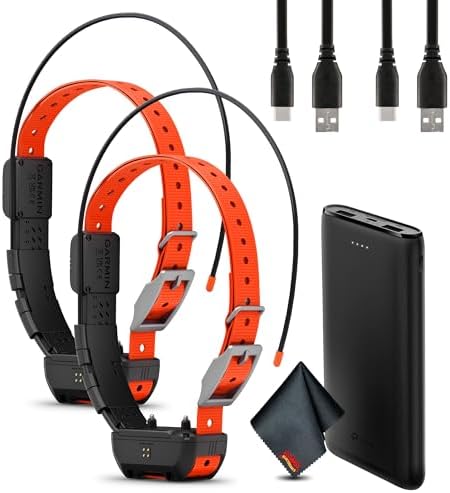
- 6ave Bundle Includes: 2x Garmin Alpha TT25 Tracking and Training Collar For Dog + P-Bank + 6Ave Microfiber Cleaning Clot…
- Training With Confidence: With Garmin Dog Training Collar You can train your dog using the collar, which offers 18 level…
- Dynamic Tracking: Alpha TT25 Dog Tracker Collar With GPS offers dynamic tracking based on your dog’s movement, helping t…
6. SpotOn GPS Fence
Overview
SpotOn earned the distinction of being named the Official GPS Collar of the American Kennel Club in 2026, and it’s the clearest answer for owners who want fence-style containment without committing to a subscription forever. The collar uses what SpotOn calls True Location technology, combining multiple satellite connections for boundary accuracy.
Key Features
- Custom virtual fences of any shape or size, drawn directly in the app
- Core containment functions work without an active subscription
- Coverage from half an acre up to over 100,000 acres
- Manual feedback (tone, vibration, or static correction) available with an active tracking plan
- AKC partnership focused on training and responsible containment
GPS Accuracy
Independent third-party testing has shown SpotOn achieving notably higher containment success rates than several competing GPS fence systems, particularly in challenging environments like dense tree cover — a common weak spot for GPS-based fencing.
Health & Activity Monitoring
Basic activity tracking is available if you opt into a tracking plan, but this isn’t a health-monitoring device the way PetPace or Tractive are. SpotOn’s entire design philosophy centers on containment, not wellness.
Battery Life
Solid multi-day performance under normal containment use, though exact figures vary by usage pattern (continuous tracking drains it faster than passive fence enforcement).
Mobile App Experience
Fence creation is the app’s strongest feature — overlapping fences, keep-out zones around pools or gardens, and reliable boundary alerts. It’s a more utilitarian experience than Fi’s lifestyle-oriented app, but it does its core job well.
Pros
- No subscription required for core containment features — genuinely rare in this category
- Strong third-party-tested accuracy, even in difficult terrain
- AKC partnership lends real credibility
- Massive coverage range for rural properties
Cons
- High upfront cost compared to subscription-model competitors
- Bulkier collar than integrated options like Fi or Halo
- Minimal health-monitoring features
Best For
Owners with large or rural properties who want a one-time-purchase fence solution and don’t want to pay a subscription forever.
Verdict
SpotOn flips the cost structure of this entire category: pay more upfront, pay little to nothing ongoing. Over a three-year span, that math often beats subscription-based competitors, and the AKC partnership and independent testing results back up the accuracy claims.
👉 Done paying a monthly fee just to keep your dog in the yard? SpotOn’s no-subscription core functionality is the rare exception in this space — compare the total 3-year cost against Halo Collar 5 before deciding which fencing system fits your budget better.

- ESCAPE PREVENTION BUILT IN – Keeps dogs within virtual boundaries 99.3% of the time (based on aggregate user data), with…
- CONSISTENT BOUNDARY CUES IN CHALLENGING TERRAIN – Engineered for dependable signal performance in dense tree cover and l…
- CUSTOMIZABLE FENCES & KEEP OUT ZONES – Create and adjust unlimited fences of any shape and size, add correction-free or …
Health Monitoring Features Explained
Not all “health monitoring” collars measure the same things, and the differences matter more than the marketing copy suggests.
Activity tracking is the baseline — step counts, active minutes, distance covered, and calories burned. Every collar in this guide offers some version of this. It’s useful for spotting a gradual decline in energy, which can be an early sign of arthritis, obesity, or other chronic issues, but on its own it’s closer to a fitness tracker than a diagnostic tool.
Sleep monitoring tracks how long and how restfully your dog sleeps. A sudden drop in sleep quality, or a dog that’s sleeping noticeably more than usual, is often one of the first visible signs that something’s off — pain, anxiety, or illness can all disrupt normal sleep patterns before other symptoms show up.
Heart rate monitoring, where available (Tractive and PetPace both offer it), gives you resting and active heart rate data. According to VCA Animal Hospitals, normal resting heart rate varies significantly by size — small dogs run faster (100–140 bpm) than large dogs (60–100 bpm) — which is exactly why these collars build a personalized baseline for your specific dog rather than comparing against a single fixed number.
Behavioral insights cover things like licking, scratching, and changes in eating or drinking habits. Fi’s AI-driven detection of these patterns is a genuine differentiator — a dog that suddenly starts licking one paw repeatedly, for instance, might be developing a hot spot or an allergy long before it’s visible to the naked eye.
Wellness alerts are the notifications that tie all this together: a push alert when any tracked metric drifts outside your dog’s individual normal range. The quality of these alerts depends heavily on how much baseline data the collar has gathered — expect a “learning period” of a few weeks before alerts become reliably personalized.
Recovery monitoring is most relevant after surgery, injury, or illness. PetPace in particular is used in veterinary and post-operative settings specifically because it can track whether a recovering dog’s vitals are trending in the right direction, giving both owners and vets objective data instead of guesswork.
It’s worth saying clearly: none of these collars replace a veterinarian. They’re monitoring tools that can flag something worth investigating, not diagnostic instruments. The American Veterinary Medical Association and most veterinary professionals view wearable pet health data as a useful supplement to — not a substitute for — regular checkups and professional diagnosis.
GPS Tracking Features Explained
Live location tracking shows your dog’s real-time position on a map in the app. Update frequency varies a lot between products — Tractive refreshes every 2–3 seconds in Live mode, while some other trackers update every 30–60 seconds outside of an active “find” session. That difference matters enormously if your dog is actually running.
Geofencing lets you draw a virtual boundary — your yard, a park, a specific neighborhood — and get notified the instant your dog crosses it. This is the core technology behind both wireless fence products (Halo, SpotOn) and the escape-alert features on tracker-style collars (Fi, Tractive).
Escape alerts are the geofencing notification itself: an immediate push alert the moment your dog leaves the designated safe zone. Speed matters here — a notification that arrives 30 seconds after the fact is far less useful than one that arrives in real time.
Lost dog mode typically switches a tracker into a higher-frequency update mode once your dog has left a safe zone, trading battery life for tracking precision when you actually need it most. This is the mode you’ll lean on hardest in an actual emergency.
Location history lets you review where your dog has been — useful for spotting patterns (does your dog always head toward the same gap in the fence?) and occasionally useful for settling “did the dog walker actually take them on a walk” questions.
LTE vs. Bluetooth vs. Wi-Fi tracking is the most important technical distinction to understand before buying:
- Bluetooth-only trackers (like Apple AirTags) only work within roughly 100–300 feet of a paired device, or rely on other nearby devices in a tracking network to relay location. They’re cheap and require no subscription, but they’re not reliable for an actual lost-dog scenario in a rural area or anywhere outside a populated network.
- Wi-Fi tracking works when your dog is within range of a known Wi-Fi network (like your home router) and adds precision indoors or in a backyard, but doesn’t help once your dog is genuinely out of range.
- LTE/cellular tracking, used by Fi, Tractive, Halo, PetPace, and SpotOn, connects through cell towers the same way your phone does, giving you real-time location virtually anywhere there’s coverage. This is what makes a true emergency recovery possible, and it’s why every collar built around safety (rather than training or hunting) in this guide uses it.
How to Choose the Right Smart Dog Collar
Dog size and breed. Most collars have a minimum weight requirement — Halo Collar 5, for example, is designed for dogs 10 lbs and up, while Tractive’s standard DOG 6 starts around 9 lbs with an XL version for dogs over 44 lbs. A toy breed and a Great Dane have very different needs, both in terms of collar weight (you don’t want a heavy tracker on a Chihuahua) and battery drain (bigger dogs can carry bigger batteries).
Battery life. Be honest with yourself about how often you’ll actually charge a device. If “remembering to charge the dog’s collar” is going to fall through the cracks in your household, prioritize Fi or Tractive’s longer-life options over Halo’s 30-hour cycle.
Subscription costs. This is the hidden expense that catches a lot of first-time buyers off guard. Almost every GPS collar in this category requires an ongoing subscription because real-time cellular tracking isn’t free — the company is paying for cell service on your dog’s behalf, much like a second phone line. Calculate the 2–3 year total cost, not just the sticker price of the hardware, before comparing options. A “free” collar with an expensive monthly plan can cost more over time than a pricier collar with no subscription at all.
GPS coverage. If you live or travel outside the US, check coverage explicitly — some trackers (Fi, in particular) are US-only, while others (Tractive) work across 175+ countries.
Waterproof rating. Look for an IP67 or IP68 rating if your dog swims, plays in rain, or is generally not gentle with their gear. IP68 means fully submersible; IP67 means resistant to splashing and brief submersion but not designed for swimming.
Durability. Chew-resistant materials and a secure mounting system matter more than they sound like they would — a tracker that pops off mid-walk is a tracker that isn’t tracking anything.
Health tracking needs. Be realistic about what you actually need. A young, healthy dog probably doesn’t need PetPace-level vital-sign monitoring; a senior dog or one managing a chronic condition genuinely might. Don’t pay premium prices for diagnostic depth you won’t use.
Pros and Cons of Smart Dog Collars
Pros
- Dramatically faster lost-dog recovery compared to relying on tags and luck alone
- Early detection of health changes that might otherwise go unnoticed between vet visits
- Peace of mind for off-leash hikes, large properties, or multi-dog households
- Shareable access lets family members, sitters, or dog walkers stay in the loop
- Some models (SpotOn, Garmin) eliminate subscription costs entirely
Cons
- Most options require an ongoing subscription, which adds up over the life of the collar
- Battery management becomes another household chore
- GPS accuracy can degrade in dense urban canyons, heavy tree cover, or areas with weak cell signal
- Added bulk and weight on the collar, which some dogs take time adjusting to
- Health data is a monitoring aid, not a diagnostic replacement for veterinary care
Frequently Asked Questions
Do smart dog collars actually work for finding a lost dog?
Yes, for cellular GPS-based collars with real-time tracking. Recovery is fastest within the first 24–48 hours after a dog goes missing, which is exactly the window real-time alerts and live tracking are built for. Bluetooth-only trackers are far less reliable for this specific use case since they depend on nearby devices to relay a signal.
What’s the difference between a GPS collar and a microchip?
A microchip is a passive RFID chip with no battery or transmitter — it only identifies your dog when a scanner is held close to it, typically by a shelter or vet clinic after your dog has already been found. A GPS collar actively transmits your dog’s real-time location to an app on your phone. They solve different problems, and most veterinary organizations recommend using both together rather than choosing one over the other.
Do I need a subscription for a smart dog collar?
For most cellular GPS trackers, yes — real-time tracking requires ongoing cell service, similar to a phone plan. A few products, like SpotOn and Garmin’s Alpha series, offer core functionality without a recurring subscription, though SpotOn’s optional plan unlocks additional features.
How accurate is GPS tracking for dogs?
Accuracy varies by technology and environment. Dual-frequency GPS systems (like Halo Collar 5) tend to perform best near buildings and under tree cover, where single-frequency GPS can struggle. In open areas, most cellular GPS trackers are accurate to within a few meters.
Can smart collars detect illness before symptoms appear?
They can flag behavioral and physiological changes — altered sleep, shifts in heart rate or activity, increased licking or scratching — that sometimes precede visible symptoms. This is genuinely useful as an early-warning system, but a collar identifies a pattern worth investigating; it doesn’t diagnose a condition. That’s still your veterinarian’s job.
What’s the best smart collar for a senior dog?
PetPace V3.0 is the strongest fit given its depth of vital-sign monitoring (heart rate, respiration, temperature, pain scoring), which is particularly valuable for catching the subtle, easy-to-miss symptoms common in aging dogs.
Are smart dog collars safe and comfortable for daily wear?
Generally yes, when properly fitted. Look for adjustable sizing, lightweight construction, and a waterproof rating appropriate to your dog’s lifestyle. As with any collar, check the fit periodically, especially with growing puppies, and give your dog a brief adjustment period when first wearing one.
Do these collars work for cats too?
Some do — Tractive, in particular, makes dedicated cat-sized trackers, and PetPace offers a feline version. Most of the dog-specific products in this guide (Fi, Halo, SpotOn, Garmin) are sized and designed specifically for dogs and aren’t a good fit for cats.
What happened to the Whistle and Wagz collars?
Whistle was acquired by Tractive in 2025, and its servers were permanently shut down on August 31, 2025 — existing Whistle hardware no longer functions, regardless of subscription status. Wagz ceased operations in 2023 and shut down its cloud infrastructure shortly after, leaving all Wagz collars non-functional. Don’t purchase either brand’s hardware, new or used; there’s no service left for either to connect to.
How much does a smart dog collar cost per year?
It varies widely by approach. Subscription-based collars typically run $150–$350 per year for monitoring service, on top of the hardware cost (which ranges from free, as with Fi, to several hundred dollars). Subscription-free options like SpotOn or Garmin’s Alpha series carry a higher upfront cost — often $300 to $1,000+ — but little to no recurring expense afterward.
Can I use a GPS dog collar internationally?
It depends on the brand. Tractive operates in 175+ countries via partner cellular networks, making it the strongest choice for international travel or living abroad. Several US-focused options, including Fi, are currently limited to US coverage — confirm this before buying if international use matters to you.
Final Verdict
After weighing accuracy, battery life, health features, and real-world cost across every product in this guide, here’s how we’d point different types of owners:
Best overall: The Tractive DOG 6 earns this spot by combining genuinely fast live tracking, meaningful health monitoring, and a price that won’t make you wince — the rare product in this category that doesn’t ask you to sacrifice one major feature to afford another.
Best budget option: Also Tractive DOG 6. Its entry-level plan undercuts most competitors while still delivering real-time tracking and basic health monitoring, making it the most accessible starting point for a first-time smart collar buyer.
Best health-monitoring collar: PetPace V3.0, without much competition. Its vital-sign depth — heart rate variability, respiration, temperature, AI-driven pain scoring — goes well beyond what fitness-style trackers offer, and the built-in telehealth access adds real value for owners managing an ongoing health concern.
Best GPS-tracking collar: Halo Collar 5 for fence-style containment accuracy, or Fi Series 3+ if what you actually want is a true real-time tracker with the longest possible battery life between charges. Which one wins depends on whether your priority is keeping your dog inside a boundary or tracking them wherever they roam.
Whichever you choose, the most important step is matching the product to your actual use case rather than the longest feature list. A hunting collar won’t serve a city apartment dog well, and a health-monitoring powerhouse is overkill for a healthy two-year-old Labrador who just needs a reliable escape alert. Start with what you’re actually worried about — getting lost, getting sick, or both — and let that drive the decision.
Affiliate Disclosure: This article contains affiliate links. If you make a purchase through one of these links, we may earn a commission at no additional cost to you. This never influences our independent testing process or recommendations. Pricing and subscription details are accurate as of publication but are subject to change — always verify current pricing directly with the manufacturer before purchasing.
Pingback: Whistle Go Explore vs Tractive GPS: Complete Feature Comparison (2026 Update) - PetTrackerHub – Pet GPS Tracker Reviews & Comparisons
Pingback: What Happened to Whistle? Why Former Whistle Owners Are Switching to Tractive GPS (2026 Guide) - PetTrackerHub – Pet GPS Tracker Reviews & Comparisons
Pingback: Best GPS Dog Trackers for Active and Outdoor Dogs (2025 Guide) - PetTrackerHub – Pet GPS Tracker Reviews & Comparisons
Pingback: Halo Collar 5 vs Fi Series 3+: Which Smart Dog Collar Is Better? - PetTrackerHub – Pet GPS Tracker Reviews & Comparisons