
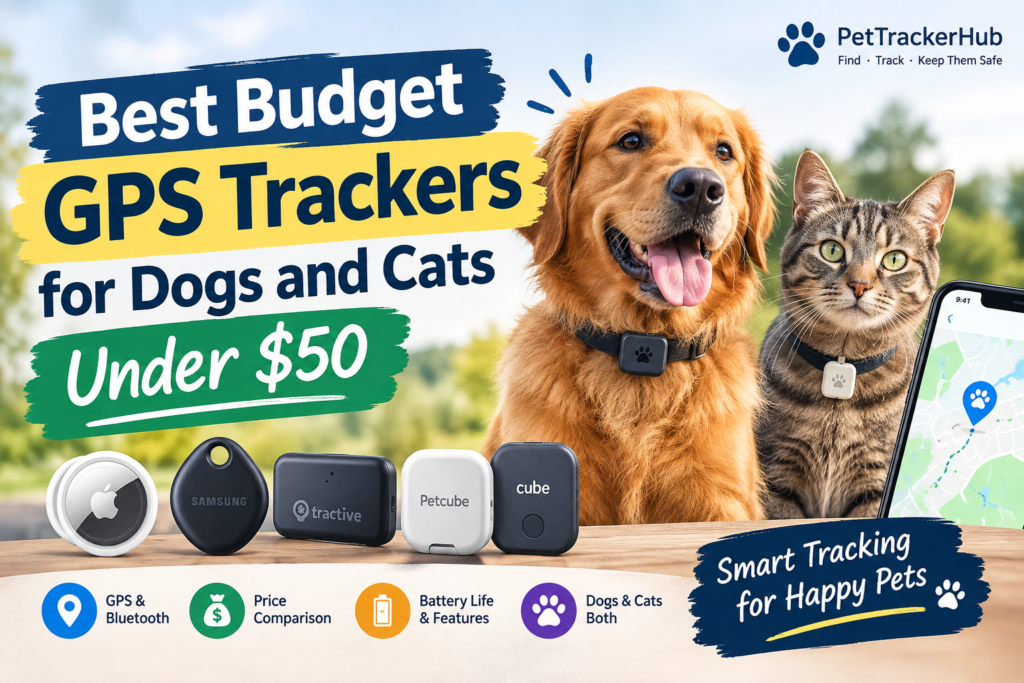
If you’ve ever typed “best GPS tracker for dogs under $50” into a search bar at 11 p.m. while your dog is still out in the yard somewhere, you already know the frustration: most “budget” pet trackers aren’t actually budget once you look past the sticker price.
That’s because “under $50” can mean a few different things depending on the product:
- The device price is under $50, but a subscription is required to actually use it.
- The device plus a required accessory (a collar mount, a charging dock, a breakaway collar) pushes you past $50.
- The device plus the first year of service is what really determines what you’re paying.
Here’s the short version, up front: true cellular GPS tracking for a dog or cat almost always comes with an ongoing subscription, because the tracker has to pay for its own cellular data connection every month. Bluetooth trackers and Apple/Samsung “Find My”-style tags can often be had with no monthly fee at all — but they trade that savings for real limitations in range and reliability, especially if your pet wanders somewhere without a lot of nearby smartphones.
Affiliate disclosure: PetTrackerHub may earn a commission from qualifying purchases made through links in this article, at no extra cost to you. This doesn’t influence which products we discuss or how we evaluate them.
This guide walks through what you can realistically buy for under $50, what you’re giving up compared to pricier GPS collars, and how to think about the total cost of ownership rather than just the price tag on the box.
A note on prices: Every price, subscription fee, and spec below is an approximate range based on current publicly available information at the time of writing. Pet tech pricing changes often — through sales, new model releases, and subscription tier changes — so always check the retailer’s page for the current price before buying.
Quick Answer: Best Budget Pet Trackers at a Glance
| Tracker | Approx. Device Price | Tracking Technology | True GPS? | Monthly Subscription? | Battery Life | Best For | Dog/Cat Suitability |
|---|---|---|---|---|---|---|---|
| Apple AirTag | ~$29 (single) | Bluetooth + Find My network | No | No | Up to ~1 year (coin cell) | iPhone households, urban/suburban areas | Both, with caveats |
| Samsung Galaxy SmartTag2 | ~$25–$35 | Bluetooth + SmartThings Find network | No | No | Up to ~500 days | Galaxy/Android households | Both, with caveats |
| Tractive GPS (Dog/Cat models) | Often $45–$70 depending on sales | Cellular GPS | Yes | Yes, plans often start around $4–$5/month on longer terms | Roughly 5–14 days depending on model | Owners who want real-time location | Dog and cat versions available |
| Petcube GPS Tracker | Roughly $30–$53 depending on sale | Cellular GPS (LTE/4G) | Yes | Yes, tiers commonly cited from about $5–$12/month | Up to ~30 days in power-saving mode | Small dogs and cats | Both |
| Cube GPS Tracker | Around $50 | Cellular GPS | Yes | Yes, monthly plans often in the high-teens per month | Varies by model | Dogs, generally too bulky for small cats | Mostly dogs |
| Tile Mate (Bluetooth) | Roughly $20–$30 | Bluetooth + Tile network | No | No (optional paid Premium tier) | Up to ~1–3 years depending on model | Budget-minded, populated areas | Both, mainly as a backup |
Specs and prices above are approximate and can change; always confirm current details on the manufacturer’s or retailer’s site before buying.
Best Budget Trackers Under $50
1. Apple AirTag
Approximate price: Apple sells a single AirTag for around $29, with four-packs priced higher per unit savings.
Tracking technology: Bluetooth, plus Ultra Wideband for close-range “Precision Finding,” relayed through Apple’s Find My network of iPhones, iPads, and Macs.

- FIND YOUR ITEMS ON FIND MY — AirTag (2nd generation) helps you keep track of what matters. Attach one to an item you wan…
- EXPANDED PRECISION FINDING ON IPHONE AND APPLE WATCH — Get step-by-step directions to your lost item on iPhone and, now,…
- ENHANCED SPEAKER — With a 50% louder speaker and a new, distinctive chime, it’s easier than ever to hear and find AirTag…
Is it true GPS? No. The AirTag has no built-in GPS chip and no cellular radio. It relies entirely on nearby Apple devices to relay its location.
Subscription: None. This is the AirTag’s biggest selling point for budget-conscious owners.
Battery life: Apple’s official AirTag tech specs list a user-replaceable CR2032 coin cell battery, with real-world use commonly reported at around a year before replacement.
Range/coverage: Effectively unlimited in areas with a lot of Apple devices, since any nearby iPhone can anonymously relay the AirTag’s location. In rural or sparsely populated areas, the AirTag may not update its location for hours or days.
Waterproofing: Apple rates the AirTag IP67, meaning it can handle brief submersion in shallow water, though this rating isn’t designed for a dog jumping into a lake repeatedly.
Weight and size: About 11 grams and roughly 1.26 inches in diameter — small and light.
Dog suitability: Workable for dogs that mostly stay in populated neighborhoods, but Apple has been explicit that the AirTag is not designed for tracking pets, animals, or people — it’s built for tracking items like keys, bags, and luggage.
Cat suitability: Similar caveats apply, plus the added concern that a curious cat may chew on the accessory holder or the battery compartment.
Major advantages: Low upfront cost, no subscription, tight integration with iPhone, widely available accessories to attach it to a collar.
Major limitations: Not true GPS, not marketed or designed for pets, poor performance in rural or unpopulated areas, requires an iPhone-centric household for the best experience.
Who should consider it: iPhone owners in urban or suburban areas who want basic location awareness as a low-cost backup, not a primary safety device.
Who should avoid it: Anyone in a rural area, anyone whose pet is an “escape artist” prone to running long distances, or anyone who wants live, continuous tracking during an active search.
2. Samsung Galaxy SmartTag2
Approximate price: Typically in the $25–$35 range for a single tag, with multi-packs often working out cheaper per unit.
Tracking technology: Bluetooth, relayed through Samsung’s SmartThings Find network of Galaxy devices.

- REDESIGNED TO DO MORE: The redesigned Galaxy SmartTag2 is made so you can keep calm and keep track; Its design makes it …
- EASY TO USE: It’s IP67-rated water- and dust-resistant, activates your compatible IoT devices and stays powered for up t…
- RELAX, YOU’VE GOT IT TAGGED: Simply register a new Galaxy SmartTag2 and get started right away with SmartThings Find; Wi…
Is it true GPS? No. Like the AirTag, it has no cellular or satellite GPS chip.
Subscription: None required for basic Find network tracking.
Battery life: Samsung’s own SmartTag2 product page states a battery life of up to about 500 days, or longer in a power-saving mode.
Range/coverage: Same basic limitation as the AirTag — location updates depend on a nearby Galaxy/SmartThings-connected device.
Waterproofing: Samsung rates the SmartTag2 IP67 as well.
Weight and size: Compact and lightweight, designed to clip onto keys, bags, or a pet’s collar attachment.
Dog suitability: Reasonable for Android/Galaxy households in populated areas; same rural/range caveats as the AirTag apply.
Cat suitability: Workable for supervised or mostly indoor cats; not a substitute for real GPS if a cat roams widely outdoors.
Major advantages: Long battery life, no subscription, works well within the Samsung/Android ecosystem, generally has more Android device density than some smaller Bluetooth-only brands.
Major limitations: Requires Samsung/Android devices nearby to be effective; not built or marketed for pet tracking, and won’t help much in a true escape scenario outside network range.
Who should consider it: Galaxy phone users who want a no-subscription tag as a secondary layer of protection.
Who should avoid it: Anyone expecting real-time GPS tracking during an active pet emergency.
3. Tractive GPS (Dog and Cat Models)
Approximate price: Tractive’s dog and cat trackers frequently list in the $50–$70 range but are commonly discounted to somewhere in the mid-to-high $40s, occasionally landing right at or just under the $50 mark during sales.

- REAL-TIME GPS TRACKING WITH UNLIMITED RANGE: Track your cat with live location updates every 2–3 seconds. Unlike others …
- HEALTH, SLEEP & ACTIVITY MONITORING: Stay on top of your cat’s wellness with daily insights into their sleep and activit…
- VIRTUAL FENCES AND LOCATION HISTORY: Set safe zones and get alerts if your cat leaves. See where they’ve been and activa…

- REAL-TIME GPS TRACKING WITH UNLIMITED RANGE: Track your dog with live location updates every 2–3 seconds. Unlike others …
- VITAL SIGNS MONITORING: The Tractive smart tracker monitors changes in your dog’s heart and respiratory rates, helping d…
- HEALTH & BARKING ALERTS: The tracker learns your dog’s normal behavior and detects changes. If it notices unusual sleep,…
Tracking technology: True cellular GPS with a built-in SIM.
Is it true GPS? Yes — this is a genuine GPS/cellular tracker, not a Bluetooth tag.
Subscription: Required. Tractive’s own materials describe plans starting at just a few dollars a month on longer-term commitments, with monthly-only plans costing more per month.
Battery life: Reported battery life varies by model, generally in the range of about 5 to 14 days between charges depending on usage and tracking mode.
Range/coverage: Effectively unlimited wherever cellular coverage exists, since the device transmits its own location rather than relying on nearby phones.
Waterproofing: Tractive markets its trackers as waterproof and built for active outdoor use.
Weight and size: Lightweight collar-mounted design, with dedicated “Mini” versions built specifically for cats and small dogs.
Dog suitability: Well suited to dogs of most sizes, particularly active or outdoor dogs, since it offers real-time tracking beyond Bluetooth range.
Cat suitability: The cat-specific model is designed to be lighter and often includes a breakaway safety collar, which matters for outdoor or free-roaming cats.
Major advantages: Genuine live GPS tracking with unlimited range, geofencing/virtual fence alerts, and separate models tuned for dogs versus cats.
Major limitations: The device price can sit right at or slightly above the $50 line depending on promotions, and the ongoing subscription is mandatory — without it, the hardware won’t transmit location data at all.
Who should consider it: Owners who genuinely need real-time tracking over long distances and are comfortable paying an ongoing fee for that capability.
Who should avoid it: Anyone who specifically wants zero recurring costs — see the best dog tracking devices without monthly subscription fees for subscription-free alternatives.
4. Petcube GPS Tracker
Approximate price: Listed price is commonly cited around $52.99, with frequent sale pricing bringing it down into the $30s to low $40s.
Tracking technology: Cellular LTE/4G-based GPS.

- REAL-TIME GPS TRACKING – UPDATES EVERY 3-5 SECONDS: See exactly where your dog is at any time. Built-in LTE gives live l…
- 24/7 VET CHAT, INCLUDED IN EVERY PLAN: Talk to a licensed vet anytime in the Petcube App – expert support the moment som…
- ESCAPE ALERTS & NIGHT TRACKING: Instant alert the moment your dog leaves a Safe Zone. IP67 waterproof glow-in-the-dark c…
Is it true GPS? Yes.
Subscription: Required for full functionality. Petcube’s official product listing describes basic and premium tiers, with reported monthly pricing commonly in the roughly $5–$12/month range depending on the plan and commitment length.
Battery life: Petcube states up to about 30 days in a low-power mode, though real-time tracking modes will drain the battery considerably faster.
Range/coverage: Unlimited within LTE/4G coverage areas.
Waterproofing: Rated IP67 for dust and water resistance.
Weight and size: Around 29 grams and roughly 60 x 25 x 20 mm — one of the more compact true-GPS options, which helps with smaller pets.
Dog suitability: Works for small to medium dogs comfortably; some reviewers have noted the tracker can feel a bit bulky on very small dogs.
Cat suitability: Its lighter weight compared to some other GPS trackers makes it one of the more cat-friendly true-GPS options, though it’s still heavier than a basic Bluetooth tag.
Major advantages: Genuine GPS with activity tracking layered in, relatively compact for a cellular device, frequently available at a discounted price.
Major limitations: Independent testing has raised questions about real-world location accuracy, and the ongoing subscription is required for the tracker to function at all.
Who should consider it: Owners who want true GPS in a lightweight form factor and don’t mind a monthly fee.
Who should avoid it: Owners expecting pinpoint accuracy every time, or anyone unwilling to commit to a subscription.
5. Cube GPS Tracker
Approximate price: Often listed around $50, sometimes slightly above or below depending on the retailer and promotions.

- KEEP TRACK OF YOUR ASSETS: Whether you need to track a vehicle, luggage, pet, or person, Cube GPS Tracker makes it conve…
- LONG-LASTING BATTERY: Cube is the perfect tracker for long-distance tracking. With a monthly or annual data subscription…
- SHARE YOUR LOCATION: Multiple people want to keep track? No problem. Cube GPS Tracker allows you to share the location o…
Tracking technology: Cellular GPS.
Is it true GPS? Yes.
Subscription: Required, with monthly plans commonly reported in the high-teens per month, or a discounted annual rate.
Battery life: Varies by model and usage pattern; check current listings for the specific version being sold.
Range/coverage: Unlimited within cellular coverage.
Waterproofing: Check the current model’s listing, as waterproof ratings have varied across Cube’s product generations.
Weight and size: Generally bulkier and heavier than the Petcube GPS Tracker, at roughly double the weight in some comparisons.
Dog suitability: Reasonable fit for medium to large dogs.
Cat suitability: Its larger size and weight make it a poor match for most cats and small dogs.
Major advantages: True GPS tracking at a device price that can land under or near $50.
Major limitations: One of the pricier ongoing subscriptions among true-GPS options in this price bracket, and its bulk limits which pets can comfortably wear it.
Who should consider it: Owners of larger dogs who prioritize the device price over long-term subscription cost.
Who should avoid it: Cat owners and small-dog owners, given the size and weight.
6. Tile Mate (Bluetooth Tracker)
Approximate price: Commonly found in the roughly $20–$30 range, with multi-packs offering a lower per-unit cost.

- THE EVERYTHING TRACKER: Protect lost or stolen stuff and make family life easier. Attach to everyday things like keys, w…
- STAY SAFE WITH SOS: Discreetly trigger an SOS alert to your loved ones in unsafe situations
- FIND YOUR THINGS: Ring your misplaced Tile, or track it down in the free app
Tracking technology: Bluetooth, relayed through the Tile community network of app users.
Is it true GPS? No.
Subscription: Not required for basic functionality; an optional Tile Premium subscription unlocks extras like smart alerts and battery replacement service.
Battery life: Depending on the generation, reported battery life ranges from about one year (replaceable battery models) to a few years (non-replaceable models).
Range/coverage: Bluetooth range is typically in the range of a couple hundred feet directly, extended opportunistically whenever another Tile app user’s phone passes nearby.
Waterproofing: Water-resistant, though not built for a pet that swims often.
Weight and size: Very light and compact, similar in spirit to the AirTag and SmartTag2.
Dog suitability: Best used as a low-cost supplemental tag rather than a primary safety device, particularly for dogs that stay close to home or in populated areas.
Cat suitability: Popular as an inexpensive way to keep tabs on indoor/outdoor cats within a neighborhood, again with the same network-density caveat as other Bluetooth trackers.
Major advantages: Very low price, cross-platform (works with both iOS and Android, unlike AirTag/SmartTag2), no subscription required for core functionality.
Major limitations: Not GPS, dependent on nearby Tile app users, and generally considered less precise for real-time tracking than Apple’s or Samsung’s larger device networks.
Who should consider it: Budget-focused owners in populated areas who mainly want a “last known location” safety net.
Who should avoid it: Anyone who needs live tracking or lives somewhere with low smartphone density.
What Does a $50 Pet Tracker Really Cost?
The device price on the box is only part of the story. What matters more for most owners is the first-year ownership cost — what you’ll actually spend to keep the tracker working for twelve months.
Here’s a simplified example using round numbers (not tied to any specific product’s current pricing):
- Device price: $45
- Monthly subscription: $8/month × 12 months = $96
- Optional accessory (extra collar mount): $10
- First-year total: roughly $151
Compare that to a no-subscription Bluetooth or Find My tracker:
- Device price: $29
- Subscription: $0
- Optional accessory: $10
- First-year total: roughly $39
Neither option is “wrong” — they solve different problems. The cellular GPS tracker costs more overall but gives you real-time location almost anywhere there’s a cell signal. The subscription-free tag costs far less over a year but only works well when your pet is near other compatible smartphones.
Because subscription pricing changes over time and varies by plan length, region, and promotions, don’t take any single number as fixed — check the manufacturer’s current plans before you buy, and calculate your own likely first-year cost using their published rates.
GPS vs Bluetooth Trackers: What’s the Difference?
This distinction is the single most important thing to understand before buying a “budget” pet tracker, and it’s also where a lot of marketing gets misleading.
True GPS/Cellular Trackers
- Use satellite positioning (GPS) combined with a cellular data connection (like a tiny cell phone) to transmit location.
- Provide real-time or near-real-time tracking, often updating every few seconds while in an active tracking mode.
- Almost always require a monthly or annual subscription, because the device is paying for its own data connection.
- Work over long distances anywhere there’s cellular coverage — this is the category that matters most if your pet could genuinely run for miles.
Bluetooth/Find My Trackers
- Use short-range Bluetooth signals detected by nearby compatible smartphones (iPhones for AirTag, Galaxy devices for SmartTag2, any Tile app user for Tile).
- Do not use cellular data or GPS chips, so there’s no traditional monthly bill.
- Location updates are opportunistic — they depend on your pet (and the tag) happening to pass near someone else’s compatible phone.
- Work best in populated areas and can be nearly useless in rural or low-device-density locations.
For a comparison of two specific products that sit on opposite sides of this divide, see our full breakdown of Apple AirTag vs Tractive GPS.
Why This Matters for a Pet That Actually Runs Away
A lost item sitting still in a drawer or a parking lot is a very different tracking problem than a frightened, moving animal. A true GPS tracker can show you a moving dot updating every few seconds, letting you follow your dog or cat in real time. A Bluetooth tag can only tell you where your pet was the last time it happened to pass a compatible phone — which, in a rural area at 2 a.m., might be nowhere close to helpful. If your pet has escaped before, lives near open land, or tends to bolt when scared, that gap matters far more than the $20–$30 price difference.
What to Look for in a Budget Dog Tracker
When comparing budget dog trackers, weigh these factors together rather than picking based on price alone:
- Tracker weight: A good rule of thumb is that the tracker (with its mount) shouldn’t exceed roughly 5–10% of your dog’s body weight.
- Collar attachment: Look for a secure, low-profile mount that won’t snag on brush or furniture.
- Waterproofing: Essential for dogs that swim, play in rain, or live in wet climates.
- Battery life: Shorter battery life (5–7 days) means more frequent charging, which matters if your dog is boarded, at daycare, or traveling.
- Escape alerts and geofencing: A virtual fence with instant notifications is one of the most useful features for preventing a small escape from becoming a long search.
- Real-time tracking vs. periodic updates: Some plans only refresh location every few minutes to save battery or subscription tier cost.
- Cellular coverage: Cellular GPS trackers are only as good as the network they run on in your specific area.
- Subscription costs over time: Compare the total annual cost, not just the advertised “starting at” monthly rate.
- App quality: A confusing or laggy app undermines even good hardware.
- Durability: Dogs that dig, roll, or play rough need a genuinely rugged housing.
Specific advice by dog type:
- Small dogs: Prioritize the lightest true-GPS option you can find, or consider whether a Bluetooth/Find My tag is more appropriate given their typically shorter roaming range.
- Large dogs: Weight is less of a concern; focus instead on battery life and durability.
- Escape artists: A true GPS tracker with geofencing and instant alerts is worth the subscription cost for dogs with a track record of bolting.
- Active/outdoor dogs: Waterproofing and rugged housing matter most. For dogs that hike, camp, or spend a lot of time off-leash, see our guide to GPS trackers for active and outdoor dogs.
- Urban dogs: Bluetooth/Find My trackers can perform reasonably well here, since dense smartphone coverage improves their odds of a useful location ping.
- Rural dogs: True cellular GPS is strongly preferable, since Bluetooth-network trackers depend on nearby phones that simply may not exist in low-population areas. Also confirm cellular coverage in your specific area before buying, since a GPS tracker is only useful where the carrier it uses actually has signal.
For dogs where live tracking really matters, our roundup of best GPS trackers for dogs with real-time location tracking goes deeper on higher-capability (though not necessarily under-$50) options.
What to Look for in a Budget Cat Tracker
Cats present a different set of constraints than dogs, mostly related to size and weight tolerance.
- Lightweight design: Cats are far more sensitive to added collar weight than most dogs.
- Minimum cat weight: Many manufacturers list a minimum recommended pet weight — check it before buying, especially for kittens or petite adult cats.
- Breakaway collar compatibility: A safety breakaway collar is strongly recommended for any cat that goes outdoors, to prevent choking or entanglement hazards; make sure your chosen tracker mounts securely to that type of collar.
- Attachment security: Cats are skilled at removing things they don’t like, so a secure, snag-resistant mount matters.
- Waterproofing: Important for outdoor cats exposed to rain, snow, or puddles.
- Battery life: Because cats can be harder to catch for a recharge, longer battery life is a bigger practical advantage than it might be for a dog.
- Indoor/outdoor use: Purely indoor cats may do fine with a basic Bluetooth tag as an “escaped through the door” safety net, while outdoor or free-roaming cats benefit more from true GPS.
- Roaming distance: Cats can range surprisingly far from home, which is another point in favor of true GPS over Bluetooth for outdoor cats.
- GPS vs. Bluetooth limitations: The same range and reliability trade-offs described earlier apply, but they’re often more consequential for cats, since a cat that squeezes under a fence or into a culvert may end up somewhere far from foot traffic.
Why a 50-lb dog tracker isn’t right for a 7-lb cat: A tracker built for a large dog is typically heavier, bulkier, and designed around a wider, sturdier collar. Putting that same hardware on a small cat can cause discomfort, chafing, or the cat simply refusing to tolerate it — which defeats the purpose entirely. Always check that a tracker is explicitly rated for cats, or specifically for small pets, before buying it for a cat.
Best Tracker by Use Case
| Use Case | Suggested Direction |
|---|---|
| Best for iPhone users (no subscription) | Apple AirTag |
| Best for Samsung/Android users (no subscription) | Samsung Galaxy SmartTag2 |
| Best no-subscription option overall | AirTag or SmartTag2, depending on phone ecosystem |
| Best true GPS option in this price range | Tractive GPS (dog or cat model), when found near or under $50 on sale |
| Best for outdoor cats | A true GPS cat-specific model with a breakaway collar mount |
| Best for small dogs | A lightweight true-GPS option like the Petcube GPS Tracker, or a Bluetooth tag if the dog rarely leaves populated areas |
| Best for urban pets | Bluetooth/Find My trackers, thanks to dense smartphone coverage |
| Best for rural areas | True cellular GPS, since Bluetooth-network reliance breaks down without nearby phones |
| Best for escape-prone pets | True GPS with geofencing and instant alerts |
| Best for lowest long-term cost | Bluetooth/Find My trackers, since there’s no recurring subscription |
This table reflects general trade-offs rather than a single “winner,” since the right choice depends heavily on your pet’s behavior, your location, and your phone ecosystem.
Hidden Costs to Watch for When Buying a Budget Pet Tracker
- Subscription fees: The biggest hidden cost with any cellular GPS tracker — always check the monthly and annual pricing, not just the lowest advertised rate.
- Collar holder or mount: Some trackers ship without a compatible collar attachment, requiring a separate purchase.
- Replacement battery: Coin-cell trackers need periodic battery replacements; rechargeable trackers need a charging cable that isn’t always included after the first purchase.
- Charging accessories: Losing or damaging the proprietary charging dock can mean an unplanned purchase.
- Activation fees: Some cellular trackers charge a one-time activation fee separate from the subscription.
- Premium app features: Location history, unlimited pets, or vet chat features are often locked behind a higher subscription tier.
- Replacement device costs: If a tracker is lost, damaged, or discontinued, factor in what a replacement unit costs, especially for cellular trackers tied to a specific hardware generation.
7 Mistakes to Avoid When Buying a Cheap Pet Tracker
- Assuming Bluetooth means GPS. A Bluetooth tag and a cellular GPS tracker solve very different problems, even though they’re often marketed side by side.
- Looking only at device price. A $30 device with a $15/month subscription costs far more over a year than a $50 device with no ongoing fee.
- Ignoring subscription fees entirely when comparing products, since they’re often the real long-term cost driver.
- Ignoring cellular coverage in your specific area — a GPS tracker is only as useful as the network signal where your pet actually roams.
- Using a heavy tracker on a small cat, which can cause discomfort or make the cat refuse to wear it.
- Ignoring waterproofing, especially for dogs that swim or live in rainy climates.
- Expecting every tracker to work in remote areas. Both Bluetooth trackers (no nearby phones) and cellular GPS trackers (no cell signal) can fail in truly remote locations, just for different reasons.
What Does a Vet Recommend as a Backup?
No GPS or Bluetooth tracker should be your pet’s only form of identification. The American Veterinary Medical Association has long endorsed microchip identification for companion animals as a permanent backup that doesn’t depend on batteries, subscriptions, or cellular coverage. A tracker can help you find a lost pet quickly; a microchip and an ID tag help ensure a shelter, vet clinic, or stranger can identify and reunite you with your pet if the tracker’s battery has died or the collar has come off entirely.
Frequently Asked Questions
What is the best GPS tracker for dogs under $50? There isn’t one universal “best,” because true GPS trackers in this price range often require a subscription, while subscription-free options like the AirTag or SmartTag2 aren’t technically GPS. The right pick depends on whether you prioritize real-time tracking or zero recurring cost.
Can I get a real GPS tracker for under $50? Sometimes, on sale — models like the Petcube GPS Tracker or Tractive’s dog and cat trackers occasionally dip to around or just under $50 for the device itself, but a monthly or annual subscription is still required to use the GPS functionality.
Are cheap GPS trackers worth it? They can be, depending on your needs. A budget true-GPS tracker with a modest subscription can be a good value for owners who need real-time location. A budget Bluetooth tag can be a good value for owners who mainly want a low-cost safety net in a populated area.
Is an AirTag a GPS tracker for dogs? No. The AirTag has no GPS chip and relies on Bluetooth and nearby Apple devices. Apple has stated the AirTag isn’t designed for tracking pets.
Can I use an AirTag on a cat? Some owners do, typically attached to a breakaway collar, but it comes with the same limitations as using it on a dog — no true GPS, and it depends on nearby iPhones to update location.
What is the cheapest GPS tracker with no monthly fee? Technically, “no monthly fee” options like the AirTag, SmartTag2, and Tile Mate aren’t true GPS trackers — they’re Bluetooth-based. If you specifically want subscription-free tracking that’s closer to true GPS, look into models like Petfon, which use alternative technology to avoid a recurring cellular bill; see our full Petfon GPS Tracker review for a closer look, keeping in mind its device price sits well above the $50 range in exchange for skipping the subscription.
Do GPS pet trackers require a subscription? Cellular GPS trackers almost always do, because the device needs an active data connection to transmit location. A small number of alternative-technology trackers avoid a monthly fee but typically cost more upfront.
What is better for a cat, GPS or AirTag? For an indoor cat that rarely escapes, an AirTag-style tag can be an adequate low-cost safety net. For an outdoor or free-roaming cat, true GPS is generally the safer choice because it doesn’t depend on the cat wandering near another compatible phone.
Do GPS trackers work without cell service? No. Cellular GPS pet trackers need a live connection to a cellular network to transmit location data. In areas with no coverage, even a true GPS tracker won’t be able to send updates until it reconnects.
How much does a pet GPS tracker cost per year? It varies widely by brand and plan length, but total first-year costs (device plus subscription) commonly fall somewhere between roughly $80 and $200 for budget-to-midrange cellular GPS trackers. Always check the current published pricing for the specific model and plan length you’re considering, since promotional and long-term rates can differ significantly from month-to-month pricing.
Conclusion: Choosing What Actually Fits Your Situation
There’s no single “best” budget pet tracker — there’s only the option that best fits your pet, your location, and your tolerance for an ongoing bill.
- If you mainly need inexpensive location awareness in a populated area and want to avoid any subscription, an Apple AirTag, Samsung Galaxy SmartTag2, or a basic Bluetooth tag like the Tile Mate can be a reasonable, low-cost safety net.
- If you need actual real-time GPS tracking over longer distances — because your dog is an escape artist, your cat roams outdoors, or you live somewhere rural — a cellular GPS tracker is the more appropriate tool, even if the subscription pushes your total first-year cost well above $50.
Before you buy, run through these questions:
- Pet type: Is this for a large, active dog, a small dog, or a cat?
- Location: Do you live somewhere dense with smartphones, or somewhere rural with spotty cell coverage?
- Phone ecosystem: iPhone, Android/Galaxy, or a mix in your household?
- Tracking needs: Do you need live, continuously updating location, or just a “last seen” safety net?
- Subscription tolerance: Are you comfortable with an ongoing monthly cost, or do you want a one-time purchase?
- Long-term budget: Have you calculated the full first-year cost, not just the device price?
Whichever direction you choose, remember that no tracker — GPS, Bluetooth, or otherwise — replaces basic pet safety fundamentals like a secure yard, a well-fitted collar with an ID tag, and a microchip as a permanent backup.
SEO Details
1. SEO Title (under ~60 characters): Best Budget GPS Trackers for Dogs & Cats Under $50
2. Meta Description (150–160 characters): Real GPS vs. Bluetooth pet trackers under $50 — honest pricing, subscription costs, and buying advice for dogs and cats on a budget.
3. Suggested URL Slug: /best-budget-gps-trackers-dogs-cats-under-50/
4. Primary Focus Keyword: best budget GPS trackers for dogs and cats under $50
5. Secondary Keywords:
- cheap GPS tracker for dogs
- cheap GPS tracker for cats
- budget pet GPS tracker
- GPS tracker with no monthly fee
- GPS tracker vs AirTag
- Bluetooth pet tracker vs GPS
- dog tracker under $50
- cat tracker under $50
6. Suggested Featured Image Alt Text: “Small dog and cat wearing budget GPS and Bluetooth pet trackers on their collars”