
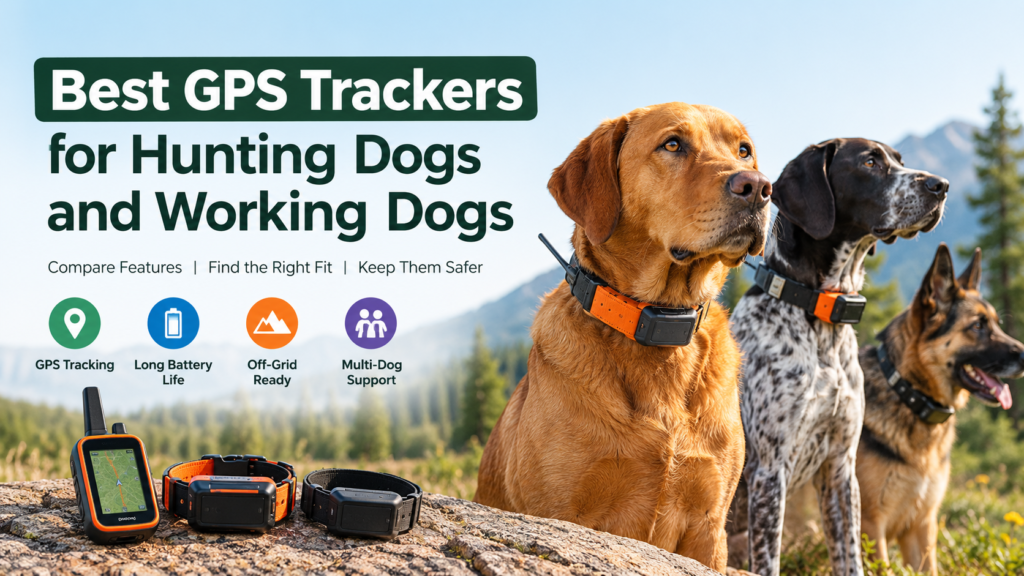
A dog that flushes birds from cover, disappears over a ridge on a cold trail, or works a search grid off-leash needs different tracking technology than a Labrador that naps in the backyard. Consumer pet trackers are built around Bluetooth or cellular signal in populated areas. Hunting and working dogs regularly operate miles from the truck, in canyons, timber, and farmland where cell towers are sparse or nonexistent — which is exactly where a basic pet tracker falls apart.
This guide focuses specifically on systems built for that reality: long-range radio and satellite-based trackers designed for bird dogs, hounds, search-and-rescue (SAR) dogs, ranch and farm dogs, herding dogs, K9 units, and any dog that works or roams off-leash in rural or backcountry terrain.
Quick Answer / Key Takeaways
- Cellular trackers (Tractive, Fi) work well for outdoor pets in populated areas but depend on carrier signal, so they can lose connection entirely in remote hunting or ranch country.
- Dedicated radio/GPS systems from Garmin, Dogtra, and SportDOG don’t rely on cell towers. The handheld or phone talks directly to the collar over its own radio frequency, which is why they’re the standard for hunters and working-dog handlers.
- Advertised range (9–10 miles) is a best-case, open-field number. Real-world range in hills, timber, or around buildings is typically a fraction of that.
- No system is “set it and forget it.” ID tags, a registered microchip, and backup power are still part of a responsible safety setup, regardless of which tracker you buy.
- Multi-dog capacity, battery life, and collar size for small or large dogs vary a lot between systems — the “best” tracker depends heavily on your specific use case, not just the biggest number on the box.
Best Trackers at a Glance
| Product | Tracking Technology | Advertised Range | Multi-Dog Capacity | Battery Life | Subscription | Training Features | Waterproofing | Best Use Case | Approx. Price |
|---|---|---|---|---|---|---|---|---|---|
| Garmin Alpha 300i | Dedicated handheld radio + GPS/Galileo; inReach satellite (SOS/messaging) | Up to 9 mi / 14.5 km (collar-dependent) | Up to 20 active, 250 stored | Handheld: up to 55 hrs (50 hrs with inReach on) | None for core tracking; inReach requires a satellite plan | Yes, 18 levels stim/tone/vibration (TT-series collars) | IPX7 | Serious hunters/pros needing satellite SOS in dead zones | ~$799–850 handheld only; collar sold separately |
| Garmin Alpha 200i | Dedicated handheld radio + GPS/Galileo; inReach satellite | Up to 9 mi | Up to 20 active, 250 stored | Handheld: up to 20 hrs (15 hrs with inReach) | Same as above | Yes, 18 levels | IPX7 | Budget-conscious hunters who still want inReach safety | ~$750 handheld only |
| Garmin Astro 430 | Dedicated handheld radio + GPS/GLONASS | Up to 9 mi | Up to 20 | Runs on 2 AA (swap in the field) or NiMH pack | None | Tracking only (no e-collar) | IPX7 | Handlers who want field-swappable battery power | ~$449 handheld only |
| Garmin Alpha 10 | Compact handheld radio + GPS/GLONASS; pairs with smartphone via Garmin Explore | Up to 9 mi | Up to 20 | Check current manufacturer specifications (sources vary, 40 hrs+) | None | Yes, with compatible TT-series collar | IPX7 | Lightweight backup or secondary handheld | ~$400 |
| Dogtra PATHFINDER2 | Free smartphone app + Bluetooth GPS connector; offline maps | Up to 9 mi (varies by surroundings) | Up to 21 | Roughly a full day average use per charge | No subscription | Yes, integrated e-collar, 0–100 levels | Fully waterproof | Hunters who prefer phone-based tracking without recurring fees | ~$430 (includes one collar) |
| Dogtra PATHFINDER2 MINI | Same app-based system, smaller collar | Up to 4 mi | Up to 21 | Similar to standard Pathfinder2 | No subscription | Yes | Fully waterproof | Smaller/lighter hunting breeds (e.g., beagles) | ~$430 |
| SportDOG TEK Series 2.0 | Dedicated handheld radio + GPS (HopTek) | Up to 10 mi | Up to 21 | Collar ~24 hrs; handheld ~12 hrs | None | Available in tracking-only or GPS + e-collar versions | DryTek, submersible to 25 ft | Handlers wanting the longest advertised range and a purpose-built handheld | ~$600–800 depending on version |
| SportDOG TEK Series 1.5 | Dedicated handheld radio + GPS | Up to 7 mi | Up to 12 | Similar to TEK 2.0 | None | Tracking-only or GPS + e-collar versions | DryTek | Budget entry into the SportDOG ecosystem | ~$450–550 |
Don’t see a spec you need for a specific configuration or bundle? Check current manufacturer specifications before buying, since collar pairings and firmware updates change ranges and compatibility over time.
If you want a broader look at trackers built for general outdoor and active dogs rather than dedicated hunting/working use, our guide to best GPS dog trackers for active and outdoor dogs covers that ground.
Garmin Alpha 300i
Best for: Serious hunters, guides, and working-dog professionals who need the fastest updates, longest battery life, and satellite SOS in areas with no cell service.

- Features a vivid sunlight-readable 3.5” capacitive touchscreen display and a button-operated, dog-focused design for qui…
- Easily set up and monitor up to 20 dogs with your compatible dog collars from up to 9 miles away (depending on your dog …
- With an Outdoor Maps+ subscription, you have access to a wide variety of premium mapping content that is regularly updat…
- Tracking technology: Dedicated handheld-to-collar radio using multi-GNSS (GPS, GLONASS, Galileo); the “i” model adds Garmin’s inReach satellite technology, offering two-way messaging and interactive SOS alerts via the global Iridium satellite network.
- Range: Up to 9 miles, depending on the dog collar used, with a 2.5-second location update rate.
- Battery: A user-replaceable lithium-ion battery provides up to 55 hours of battery life, or up to 50 hours with inReach satellite technology enabled.
- Dog capacity: Monitor up to 20 dogs with compatible collars, with storage for up to 250 dogs in the roster.
- Subscription: None required for core GPS tracking and training. A separate inReach satellite service plan is required to use SOS, two-way messaging, and live tracking features over the Iridium network.
- Training features: 18 levels of momentary and continuous stimulation, plus tone and vibration, when paired with a training-capable collar such as the TT25.
- Mapping: Preloaded TopoActive maps and downloadable BirdsEye satellite imagery at no extra cost; an optional Outdoor Maps+ subscription adds public land boundaries and landowner data.
- Waterproofing/durability: IPX7-rated, rubberized housing built for field use.
- Pros: Longest battery life in the Alpha lineup; fastest 2.5-second updates; satellite SOS for true backcountry safety; backward-compatible with many existing Garmin collars.
- Cons: Handheld and collar are sold separately, so total cost climbs quickly for multi-dog setups; inReach features require an ongoing subscription; touchscreen can be less durable long-term than a simple button interface.
- Who should buy it: Hunters and professional handlers who regularly work land with no cell coverage and want a true satellite safety net, not just GPS tracking.
- Who should avoid it: Casual owners who mostly work dogs close to home with cell service — a cellular or phone-app-based system may be simpler and cheaper.
Garmin Alpha 200i
Best for: Hunters who want Garmin’s core tracking, training, and inReach safety features at a lower price than the 300i.

- Features sunlight-readable 3.5” capacitive touchscreen display and a button-operated, dog-focused design for quick, mino…
- Easily set up and monitor up to 20 dogs from up to 9 miles away with a 2.5-second update rate by using multiple global n…
- Dog list and group management lets you keep inactive dogs in the system for easier setup
- Tracking technology: Same multi-GNSS handheld-to-collar radio system as the 300i, with inReach satellite communication.
- Range: A 9-mile range depending on your dog device, with 2.5-second location updates.
- Battery: Up to 20 hours, or up to 15 hours with inReach technology enabled — noticeably shorter than the 300i, which matters on multi-day hunts.
- Dog capacity: Up to 20 active dogs, 250 stored.
- Subscription: None for core tracking; inReach requires a satellite plan.
- Training features: 18 levels of stimulation, tone, and vibration with a compatible collar.
- Mapping: Preloaded TopoActive maps and downloadable BirdsEye satellite imagery.
- Waterproofing/durability: IPX7.
- Pros: Lower price than the 300i while keeping inReach; smaller and lighter; proven, well-established platform.
- Cons: Battery life is roughly a third of the 300i’s, so multi-day hunters will need to charge more often or carry a backup battery; some retailers list the base Alpha 200 as discontinued in favor of the 200i or 300.
- Who should buy it: Budget-conscious hunters who still want satellite SOS and don’t need maximum battery life.
- Who should avoid it: Anyone doing back-to-back, multi-day hunts without reliable charging access — read our full Garmin Alpha 200i review for a deeper look at real-world battery behavior before buying.
Also read Garmin Alpha 200i review here.
Garmin Astro 430
Best for: Handlers who want a proven, button-operated Garmin system and the option to swap AA batteries in the field instead of waiting on a recharge.

- Expanded dog capability – track up to 20 dogs from a range of up to 9 miles
- GPS/glonass – high-sensitivity GPS and glonass satellite reception has the ability to track in more challenging environm…
- Preloaded mapping – includes preloaded topo U.S. 100K mapping and a free 1-year birdseye satellite imagery subscription
- Tracking technology: Handheld-to-collar radio with GPS and GLONASS.
- Range: Tracks up to 9 miles and updates every 2.5 seconds, even in heavy cover or deep, narrow canyons according to the manufacturer trailspacetrailspace.
- Battery: Powered by 2 AA alkaline, in-unit NiMH, or lithium-ion batteries — a real advantage for hunters who want to carry spare AAs rather than depend entirely on a charger.
- Dog capacity: Up to 20 dogs.
- Subscription: None.
- Training features: Tracking only; the Astro 430 does not include e-collar stimulation controls.
- Mapping: Preloaded with Topo U.S. 100K mapping and a 1-year subscription to BirdsEye Satellite Imagery.
- Waterproofing/durability: Water-resistant to IPX7, bright orange case for easy recovery if dropped.
- Pros: Field-swappable AA batteries are genuinely useful on multi-day hunts far from power; simple, mature interface; lower price than the Alpha 300/200 line.
- Cons: No integrated e-collar training; smaller 2.6-inch screen; no satellite SOS option.
- Who should buy it: Tracking-only users who value battery flexibility over a touchscreen or training features.
- Who should avoid it: Anyone who wants combined tracking and e-collar training in one handheld.
Garmin Alpha 10
Best for: Handlers who want a compact, lightweight backup handheld or a lower-cost entry into the Garmin ecosystem.

- Compact design with at-a-glance multi-GNSS tracking and configurable training
- Pair with the T 5 and TT 15 dog devices to track up to 20 dogs with additional dog devices sold separately up to 9 miles…
- Customize training for each dog with 18 levels of continuous and momentary stimulation plus tone and vibe
- Tracking technology: Compact handheld radio with GPS/GLONASS; can also pair with a smartphone through the Garmin Explore app.
- Range: Up to 9 miles with a T5 or TT15 collar.
- Battery: Listings vary — some retailers cite up to 40 hours on a full charge, others describe a full week of typical use. Check current manufacturer specifications before relying on a specific figure.
- Dog capacity: Track up to 20 dogs with compatible collars.
- Subscription: None.
- Training features: Tone, vibration, and stimulation available with a compatible TT-series collar.
- Mapping: Pairs with the Garmin Explore app for mapping and hunt-data review rather than carrying onboard topo maps like the Astro or Alpha 200/300 series.
- Waterproofing/durability: Rugged, weather-resistant housing, IPX7 rated.
- Pros: Small, light, and less expensive than the touchscreen Alpha models; good as a spare or secondary unit.
- Cons: Battery-life claims are inconsistent across retailers; no built-in topo mapping or inReach.
- Who should buy it: Owners who want a lightweight, no-frills handheld or a backup to a primary system.
- Who should avoid it: Anyone who wants onboard topo maps, satellite messaging, or the longest possible battery runtime.
Check the Latest Amazon Price
Dogtra PATHFINDER2
Best for: Hunters who prefer running everything from their phone instead of carrying a separate handheld, and who want to avoid subscription fees entirely.

- CUT EM’ LOOSE: The PATHFINDER2 is a complete GPS tracking system with the enhanced Dogtra PATHFINDER2 real time tracking…
- E-COLLAR FUNCTION BUTTON: The new PATHFINDER2 GPS Connector allows for direct corrections for a quicker response. You ha…
- SMARTWATCH COMPATIBLE: Smart watch users can now track their dogs from their smartwatch with quick access to the extende…
- Tracking technology: A GPS tracking and training system with a free real-time tracking and training app that connects to a Bluetooth GPS connector clipped to your belt or vehicle. There’s no dedicated handheld screen — your phone is the map.
- Range: Tracks up to 21 dogs within a 9-mile range, though the manufacturer notes range may vary depending on the surroundings.
- Battery: Both the GPS collar and the handheld GPS connector are designed to last a full day on average usage, and battery life varies based on settings. A Rescue Mode can extend the collar’s runtime by several hours.
- Dog capacity: Up to 21 dogs and hunters on one system.
- Subscription: No monthly subscription required; offline maps are available for use without a signal.
- Training features: Integrated e-collar with 0 to 100 stimulation levels, nick and constant stimulation, non-stimulating pager vibration, and an LED locate light.
- Mapping: Free maps built into the app, downloadable for offline use.
- Waterproofing/durability: Fully waterproof receiver.
- Pros: No subscription, genuinely free offline maps, no separate handheld to buy or charge, and it’s expandable to a large number of dogs.
- Cons: Because it runs through your phone, tracking drains your phone’s battery too — Dogtra itself recommends carrying an external battery pack for long hunts. Requires a reasonably modern smartphone with Bluetooth 5.0.
- Who should buy it: Hunters comfortable relying on a smartphone in the field who want to avoid handheld cost and subscription fees.
- Who should avoid it: Anyone who wants a dedicated, rugged handheld that isn’t also their phone, or who hunts in conditions where phone battery drain is a serious concern.
Dogtra PATHFINDER2 MINI
Best for: Owners of smaller hunting breeds — beagles, small spaniels, and similar dogs — who need a lighter, smaller collar.

- LIVE TRACKING COMPASS & TRAINING: This set features a crisp 2″ LCD screen and built-in compass. Operating entirely separ…
- RUGGED REAL-TIME COMPASS: Get rapid 2-second GPS updates to instantly pinpoint your dog. The tactile handheld remote ope…
- CUSTOMIZED TRAINING STYLES: Match your style by assigning tactile buttons to functions or dedicating them per dog. Built…
- Tracking technology: Same app-based Bluetooth GPS system as the standard Pathfinder2, scaled down.
- Range: 4 miles, which may vary depending on surroundings — noticeably shorter than the standard Pathfinder2’s 9-mile range according to huntemup.
- Battery: Comparable to the standard Pathfinder2; varies with usage.
- Dog capacity: Up to 21 dogs on one system.
- Subscription: No monthly subscription required; offline maps are available without a signal.
- Training features: Same e-collar functions as the standard Pathfinder2 in a smaller housing.
- Mapping: Free, offline-capable app maps.
- Waterproofing/durability: Waterproof, built for the same field conditions as the standard model.
- Pros: Meaningfully smaller and lighter collar for dogs that can’t comfortably carry the full-size unit.
- Cons: Half the range of the standard Pathfinder2, which matters for big-running hounds or dogs that regularly work far from the handler.
- Who should buy it: Owners of smaller-bodied hunting or working dogs.
- Who should avoid it: Anyone whose dogs regularly range beyond 4 miles.
SportDOG TEK Series 2.0
Best for: Hunters who want the longest advertised range on the market and a dedicated, purpose-built handheld rather than a phone app.

- Wide Range GPS Tracking: The SportDOG TEK Series 2.0 GPS Tracking System allows you to accurately track up to 21 dogs in…
- Durable & Waterproof: Rugged, submersible collar and handheld device built for outdoor use with long-lasting rechargeabl…
- Compact & Expandable System: Lightweight smart setup with adjustable scale and multiple correction modes for flexible an…
- Tracking technology: Dedicated handheld-to-collar radio using SportDOG’s HopTek technology.
- Range: Up to 16 km (about 10 miles) using HopTek technology.
- Battery: The collar charges in 4 hours and lasts about 24 hours per charge; the handheld device charges in 8 hours and lasts about 12 hours per charge. The shorter handheld runtime is worth planning around on multi-day trips.
- Dog capacity: Expandable to track up to 21 collars/handhelds.
- Subscription: None.
- Training features: Available in a tracking-only version or a combined GPS + e-collar version with 99 continuous, momentary, and rising static stimulation levels, plus vibration or tone.
- Mapping: Preloaded topo maps with unlimited lifetime map updates.
- Waterproofing/durability: DryTek waterproof and submersible to 25 feet.
- Pros: Longest advertised range of the systems in this guide; combines tracking and training in one collar if you choose the e-collar version; submersible rating is a genuine plus for waterfowl dogs.
- Cons: Handheld battery life (about 12 hours) is shorter than Garmin’s higher-end handhelds, so you’ll want a backup power source on long days; collar minimum size (10.75″) rules it out for very small dogs.
- Who should buy it: Hunters prioritizing maximum range and rugged waterproofing, especially waterfowl and upland hunters.
- Who should avoid it: Owners of dogs under about 8 lbs, or anyone who needs more than 12 hours of handheld runtime without recharging.
Compare Current Options
SportDOG TEK Series 1.5
Best for: Owners who want the SportDOG ecosystem and reliability without paying for the 2.0’s longer range.

- Wide Range GPS Tracking: The SportDOG TEK Series 1.5 GPS Tracking System allows you to accurately track up to 12 dogs in…
- Durable & Waterproof: Rugged, submersible collar and handheld device built for outdoor use with long-lasting rechargeabl…
- Compact & Expandable System: Lightweight smart setup with adjustable scale and multiple correction modes for flexible an…
- Tracking technology: Same handheld-to-collar radio platform as TEK 2.0, at a shorter range.
- Range: 7-mile range.
- Battery: Comparable charge times and runtime to the TEK 2.0.
- Dog capacity: Track and train up to 12 dogs.
- Subscription: None.
- Training features: Available tracking-only or with 99 levels of continuous, momentary, and rising stimulation in the GPS + e-collar version.
- Mapping: Preloaded topo maps.
- Waterproofing/durability: DryTek waterproof construction.
- Pros: Lower price than the 2.0 while keeping SportDOG’s core tracking and training quality.
- Cons: Shorter range and lower multi-dog capacity than the 2.0.
- Who should buy it: Handlers who don’t need more than 7 miles of range or more than 12 dogs tracked.
- Who should avoid it: Big-running hound owners or anyone expecting to expand past 12 dogs.
See Current Availability
Hunting Dogs vs. Working Dogs: What Changes?
“Hunting dog” and “working dog” get lumped together in most articles, but the priorities genuinely differ by role.
- Hunters (bird dogs, hounds, waterfowl dogs): Prioritize range, update speed, and terrain performance, since these dogs can be out of sight in seconds. Multi-dog capacity matters for anyone running braces or packs.
- Ranch and farm dogs: Often need geofencing more than long range, since the goal is usually knowing when a dog has left a defined property boundary, not tracking it across miles of open country.
- Search-and-rescue (SAR) dogs: Need reliable tracking in the same rugged, often signal-dead terrain where the search itself is happening, plus accurate track logs for search documentation. Battery life across a multi-hour deployment is critical.
- K9/outdoor working dogs: Handlers often need fast, precise updates during active deployment more than maximum range, since the dog is usually working closer to the handler than a free-ranging hunting dog.
- Herding dogs: Typically stay within sight and closer range, so a geofence-capable or shorter-range system may be entirely sufficient, freeing up budget for other priorities.
- Sporting/field-trial dogs: Some competitions restrict which devices are allowed, so confirm event rules (UKC, AKC, PKC, etc.) before buying if you plan to compete.
Radio vs. Cellular vs. Satellite vs. Bluetooth GPS Trackers
| Technology | How it works | Works without cell service? | Typical range | Common use case |
|---|---|---|---|---|
| Dedicated radio/GPS (Garmin Alpha/Astro, Dogtra Pathfinder2, SportDOG TEK) | Collar and handheld/phone communicate directly over their own radio frequency | Yes | Several miles, terrain-dependent | Hunting, ranch/farm, SAR, backcountry work |
| Cellular (Tractive, Fi) | Collar has a built-in SIM and reports location over LTE, like a phone | No — requires connecting to AT&T, Verizon, or T-Mobile LTE, so coverage gaps mean tracking gaps | Effectively unlimited where coverage exists | Everyday outdoor pets, neighborhoods, escape alerts |
| Satellite (Garmin inReach, add-on to Alpha 300i/200i) | Messages route through the Iridium satellite network | Yes, globally | Global | Emergency SOS and messaging in true dead zones |
| Bluetooth (AirTag-style trackers) | Relies on nearby compatible devices to relay a location | No | Roughly 30–33 feet, or wherever another compatible device happens to be nearby | Short-range, indoor/urban “did I leave this behind” tracking, not off-leash field use |
The key distinction for hunters and working-dog handlers: a cellular tracker is only as good as the nearest tower. As the American Kennel Club notes when comparing tracker types, GPS-based trackers work globally using satellites and transmit data using LTE — the same technology that gives your cellphone signal — which is exactly why cellular systems struggle where cell signal doesn’t reach. A dedicated radio-based hunting GPS sidesteps that problem entirely because the collar and handheld talk to each other directly. If you’re trying to decide between the two approaches for a specific dog, our comparison of the Garmin Alpha 200i vs Tractive GPS walks through that tradeoff in more detail.
How Much Tracking Range Do You Really Need?
Manufacturers advertise range under ideal, open-line-of-sight conditions — typically flat, open terrain with no obstructions between collar and handheld. That number is a ceiling, not a guarantee.
Real-world range is reduced by:
- Terrain: Hills, canyons, and ridgelines block line-of-sight radio signal.
- Dense woods and heavy vegetation: Foliage absorbs and scatters radio signal, cutting range noticeably in thick cover.
- Buildings and structures: Metal barns, vehicles, and dense construction interfere with signal.
- Distance and obstructions combined: A dog that’s 3 miles away but behind a ridge may be harder to reach than one 5 miles away in open country.
A practical rule of thumb: treat the advertised “up to 9 miles” or “up to 10 miles” figures as what’s achievable in ideal open terrain, and expect meaningfully less in the woods, hills, or brush most hunters actually work. If you consistently hunt big, open country, the top of the advertised range is more attainable. If you hunt dense timber or steep terrain, prioritize update speed and terrain performance over the single biggest range number on the spec sheet.
Best Tracker for Different Hunting Styles
- Bird hunting (upland, pointing breeds): Fast update rates matter since these dogs can go on point and hold, then break and range quickly. A 2–2.5 second update rate (available across most systems in this guide) helps you close distance efficiently.
- Coon hunting: Multi-dog capacity and reliable performance in dense timber at night are priorities. Look at systems with strong terrain performance and easy nighttime visibility (locate lights, bright screens).
- Big-running hounds: Maximum range matters most here, since these dogs can legitimately run for miles. The SportDOG TEK 2.0’s advertised 10-mile range or Garmin’s 9-mile range with a strong-antenna collar are worth prioritizing.
- Waterfowl hunting: Waterproofing and submersibility matter more than almost anything else. SportDOG’s DryTek rating (submersible to 25 feet) and Dogtra’s fully waterproof receiver are both built with this in mind.
- Upland hunting: A balance of range, speed, and a lighter collar for all-day carrying (especially on smaller pointing breeds) tends to matter more than maximum range.
- Mountain/backcountry hunting: This is where satellite communication earns its keep. If you’re regularly hours from cell service and want a safety net for yourself as well as your dog, the Garmin Alpha 300i or 200i’s inReach capability is the clearest differentiator in this guide.
We don’t make unsupported claims about which specific dog breeds perform best with which system — range and durability needs come down to how and where you hunt, not breed alone.
Best Tracker for Different Working Dogs
- Search-and-rescue: Reliable performance in the same challenging terrain where a search is happening, plus long battery life across multi-hour deployments, are the priorities. A handheld with field-swappable batteries (like the Astro 430) can be a real advantage for extended operations.
- Ranch/farm: Geofencing and knowing when a dog leaves a defined area may matter more than raw range. A shorter-range, lower-cost system may be entirely adequate.
- Herding: Dogs typically stay close to the handler, so range requirements are usually modest.
- K9/outdoor work: Fast, accurate updates during active deployment and rugged durability matter more than maximum range.
- Field/service work: Requirements vary widely by role; match the system to how far the dog actually ranges from the handler in practice, not to the biggest number on a spec sheet.
Subscription vs. No Subscription
Garmin’s Alpha and Astro systems require no subscription for core GPS tracking and training — you only pay ongoing fees if you activate inReach satellite messaging. Dogtra’s Pathfinder2 line and SportDOG’s TEK series require no subscription at all for any tracking or training feature, which is a meaningful long-term cost difference if you don’t need satellite SOS. If avoiding recurring fees entirely is a priority, our roundup of GPS dog trackers without monthly subscription fees goes deeper on subscription-free options across categories.
Tracking-Only vs. GPS + E-Collar
Some systems (Garmin Astro 430, SportDOG TEK tracking-only versions, Dogtra’s TRX-series additional collars) offer GPS tracking without any e-collar stimulation function. Others integrate both in one collar. A tracking-only setup makes sense if you already have a separate training collar, train primarily with voice and whistle commands, or simply prefer not to combine the two functions. A combined system reduces the number of collars a dog wears and can simplify setup, but it’s worth confirming that the training features (stimulation levels, vibration, tone) actually meet your training approach before buying, since not every combined system offers the same range of settings.
Handheld vs. Smartphone Tracking
Dedicated handhelds (Garmin Alpha/Astro, SportDOG TEK) run on their own rugged hardware, independent of your phone’s battery, and typically offer sunlight-readable screens built for field use. The tradeoff is added cost, weight, and one more device to charge and carry.
Smartphone-based systems (Dogtra Pathfinder2) use an app on your existing phone instead of a separate handheld. This lowers cost and reduces what you’re carrying, but ties tracking to your phone’s battery and durability, and depends on your phone functioning normally (screen visible in bright sun, case protecting it from weather) throughout the hunt. Garmin’s own inReach devices are built specifically for global communication when phones and cell service fail, which is a meaningful consideration if you’re choosing based on backup-safety needs rather than tracking alone.
Battery Life for Long Hunts and Multi-Day Work
Battery life varies dramatically across this category — from roughly 12 hours (SportDOG TEK 2.0 handheld) to 55 hours (Garmin Alpha 300i handheld). For single-day hunts, most systems in this guide comfortably last the day. For multi-day trips or extended SAR deployments, consider:
- Charging access: Will you have a vehicle, generator, or solar charger available overnight?
- Field-swappable batteries: The Astro 430’s AA-battery option is a genuine advantage if you can’t reliably recharge.
- Rescue/power-saving modes: Several systems (Garmin, Dogtra) include a low-power mode that extends runtime by slowing update frequency when the battery gets low — useful as a backup, not a primary strategy.
- Phone battery drain: If you’re using a phone-based system like Pathfinder2, plan for extra phone battery drain and carry a portable charger on long days.
Waterproofing and Durability
Hunting and working dogs regularly go through water, mud, brush, and rough terrain, so waterproofing ratings matter more here than for a typical household pet tracker. IPX7 (rated for temporary submersion, roughly 1 meter for up to 30 minutes) is standard across most handhelds and collars in this guide. SportDOG’s DryTek rating goes further, with collars submersible to 25 feet — worth prioritizing specifically for waterfowl retrievers that dive and swim repeatedly. Beyond water resistance, look at overall housing construction (rubberized coatings, reinforced antennas) since drops, brush impacts, and temperature swings are routine for field use.
Collar Weight and Dog Size Suitability
Collar weight and minimum dog size vary meaningfully between systems:
- Dogtra’s Pathfinder2 standard collar weighs about 6.6 oz and fits dogs as small as 35 lbs; the Mini is about 22% smaller for beagles and similarly sized breeds, starting around 15 lbs.
- SportDOG TEK collars are built for dogs 8 lbs and larger with neck sizes 10.75″–23″.
- Garmin’s T5/T5X/TT-series collars vary by model, with the T5 Mini specifically built for smaller breeds.
Always check current collar specifications against your specific dog’s weight and neck size — a collar that’s too heavy or bulky for a small dog is both uncomfortable and can affect how well it sits for accurate tracking.
Maps, Offline Maps, Navigation and Geofencing
Garmin’s Alpha and Astro handhelds come preloaded with topo mapping and offer downloadable satellite imagery at no ongoing cost; premium map layers (like detailed public land boundaries) are available through an optional add-on subscription. SportDOG’s TEK handhelds ship with preloaded topo maps and free lifetime updates. Dogtra’s Pathfinder2 app uses free, downloadable offline maps with no subscription at all. Geofencing — an alert when a dog crosses a defined boundary — is available on Dogtra’s system (Geo-Fence, Mobile-Fence, and E-Fence modes) and is a useful feature specifically for ranch, farm, and property-boundary use cases, even if you don’t need it for open-country hunting.
Compatibility Between Handhelds and Collars
Not every collar works with every handheld, even within the same brand. Garmin’s Alpha 300i, for example, is compatible with TT25, TT15X, TT15, TT15 Mini, and TT10 collars, but not every older or newer collar automatically pairs with every handheld generation — always confirm compatibility for your specific handheld-and-collar combination before buying, especially if you’re adding a collar to an existing system or buying used equipment.
What Happens When There’s No Cell Service?
This is where the distinction between tracker types matters most. Cellular trackers like Tractive rely on connecting to a carrier’s LTE network — no signal means no location update, full stop. Dedicated radio-based systems (Garmin Alpha/Astro, Dogtra Pathfinder2, SportDOG TEK) don’t depend on cell towers at all; the collar and handheld/phone communicate over their own radio link, so they continue functioning normally in areas with zero cell coverage. For situations where you also need to communicate with people outside the field — not just track your dog — satellite communication like Garmin’s inReach is the option built specifically for that gap, since it uses the Iridium satellite network to send and receive custom and preset text messages regardless of cell coverage.
How to Choose the Right GPS Tracker
Work through these questions in order:
- Terrain: Open country favors longer advertised range; dense timber or mountains reduce real-world range regardless of the system.
- Cell coverage: No service where you hunt or work rules out cellular-only systems like Tractive or Fi for that use case.
- Number of dogs: Confirm the system’s multi-dog capacity matches your pack or string, not just what you own today.
- Range needed: Big-running hounds need more range than close-working pointing breeds or herding dogs.
- Dog size: Confirm collar weight and minimum neck/weight size fit your smallest dog.
- Training requirements: Decide if you want tracking-only or combined GPS + e-collar training.
- Battery needs: Multi-day trips favor longer battery life or field-swappable batteries.
- Budget: Factor in handheld + collar + any additional collars, not just the advertised starting price.
- Subscription preference: Decide whether avoiding recurring fees (Dogtra, SportDOG) matters more than satellite SOS capability (Garmin inReach).
1-Dog vs. Multi-Dog Tracking
If you only ever run one dog, almost any system in this guide will work — the differentiator becomes range, battery, and training features rather than capacity. If you run braces, packs, or multiple working dogs, confirm both the maximum simultaneous tracking number and the cost of additional collars, since adding dogs to a system (extra collars) is often the largest ongoing cost, more than the handheld itself.
Common Mistakes When Buying a Hunting Dog GPS Tracker
- Buying a cellular tracker for a no-service hunting area. Check actual coverage where you hunt, not just your home coverage.
- Looking only at advertised maximum range. Real-world range in your actual terrain matters more than the number on the box.
- Ignoring collar/handheld compatibility. Confirm your specific collar model works with your specific handheld before buying.
- Forgetting battery requirements for multi-day trips. A 12-hour handheld battery is fine for a day hunt and inadequate for a multi-day backcountry trip without a charging plan.
- Ignoring dog weight and collar size. A collar built for an 8-lb-minimum dog may not be appropriate — or comfortable — for a small breed.
- Assuming all GPS trackers work without a subscription. Some do (Dogtra, SportDOG); some require ongoing fees for satellite or premium map features (Garmin inReach, Outdoor Maps+).
- Choosing based only on price. The cheapest system that doesn’t meet your range, terrain, or dog-size needs isn’t actually the better value.
Safety Checklist
A GPS tracker is a powerful tool, but it shouldn’t be a dog’s only safety measure. Battery failures, signal gaps, and equipment malfunctions happen. Pair any GPS system with:
- A GPS tracker appropriate to your terrain and dog count
- A visible ID tag with current contact information
- A registered microchip. According to the AVMA, pets with microchips are up to 20 times more likely to be reunited with their owners if they become lost, and keeping registration information current is what makes that possible. avma
- A charged backup battery or power bank for handhelds and phones
- Offline maps downloaded in advance, in case of both cell and GPS-device issues
- A charged handheld or phone confirmed working before you leave the truck
- Emergency communication (satellite messenger, radio, or planned check-in times) where appropriate for the remoteness of the terrain
Is GPS Tracking Enough on Its Own?
No single device should be a dog’s only line of defense. GPS trackers can fail, lose charge, lose signal in extreme terrain, or simply not be on the dog if a collar comes off. Treating a GPS tracker as one layer in a broader safety plan — alongside ID tags, a microchip, training, and situational awareness of terrain and weather — gives a much more reliable safety net than relying on any single piece of technology.
FAQ
What is the best GPS tracker for hunting dogs?
There’s no single “best” — it depends on your terrain, number of dogs, and whether you need satellite SOS. Hunters covering big, open country and wanting the longest advertised range often look at SportDOG’s TEK 2.0 or Garmin’s Alpha 300i; hunters wanting to avoid subscriptions often prefer Dogtra’s Pathfinder2.
What is the best GPS tracker for working dogs?
This depends heavily on role. SAR and K9 handlers often prioritize reliability and battery life in the field; ranch and farm use cases often prioritize geofencing over maximum range. Match the system to the specific job rather than a general “best” label.
Do hunting dog GPS trackers work without cell service?
Dedicated radio-based systems (Garmin, Dogtra, SportDOG) do, since the collar and handheld/phone communicate directly rather than through a cell network. Cellular trackers like Tractive or Fi do not work without carrier signal.
What is better for hunting dogs, Garmin or Dogtra?
Both are well-established in this space. Garmin’s Alpha line offers longer battery life on higher-end models and optional satellite SOS via inReach, at a higher total cost including subscription. Dogtra’s Pathfinder2 avoids handheld cost and subscription fees entirely by running through a smartphone app. The right choice depends on whether you value a dedicated rugged handheld and satellite safety, or a lower-cost, subscription-free, phone-based system.
How far can a hunting dog GPS tracker reach?
Manufacturers advertise up to 9–10 miles under ideal open-terrain conditions. Real-world range in hills, woods, or near structures is typically shorter — treat advertised figures as a best case, not a guarantee.
Do GPS dog trackers require a monthly subscription?
Not always. Garmin’s Alpha and Astro systems require no subscription for core tracking; Dogtra and SportDOG systems in this guide require none at all. Subscriptions come into play specifically for Garmin’s optional inReach satellite features and premium map layers.
Can one GPS tracker system track multiple dogs?
Yes. Most systems in this guide support well over a dozen dogs simultaneously (up to 20–21 on most models), though additional collars are typically sold separately and add to total cost.
What is the difference between a hunting GPS collar and a regular pet GPS tracker?
Hunting and working-dog systems use dedicated radio communication between collar and handheld/phone, built for multi-mile range in remote terrain without cell service. Regular pet trackers typically rely on cellular or Bluetooth connectivity, which works well in populated areas but is unreliable or nonfunctional in remote, low-coverage terrain.
Are GPS trackers safe for working dogs?
Reputable GPS collars from established manufacturers are widely used by professional handlers, but any collar should be properly fitted, checked regularly for rubbing or overheating in warm weather, and paired with basic care — this isn’t a veterinary safety claim, just standard equipment practice. If you have specific health or fit concerns for your dog, consult your veterinarian.
What should I look for in a GPS tracker for a search-and-rescue dog?
Reliable performance in the same challenging terrain where searches occur, long battery life for extended deployments, accurate track logging, and ideally a backup power option, since SAR deployments can run far longer than a typical hunt.
Can I use a cellular GPS tracker for hunting?
You can, but its usefulness depends entirely on cell coverage in your specific hunting area. In terrain with reliable LTE signal, a cellular tracker can work; in remote or mountainous terrain without coverage, it will not provide location updates.
How long should a hunting dog GPS tracker battery last?
For a single-day hunt, most systems in this guide (12+ hours minimum) are sufficient. For multi-day trips, look specifically at battery life figures and charging logistics, or consider a system with field-swappable batteries.
Conclusion
There’s no universal “best” GPS tracker for hunting and working dogs — the right choice depends on your terrain, how many dogs you run, whether you need satellite communication as a personal safety net, and whether avoiding a subscription matters more to you than maximum battery life or range. Garmin’s Alpha line leads on battery life and offers satellite SOS through inReach, at a higher total cost. Dogtra’s Pathfinder2 removes subscription fees and handheld cost by running through your phone. SportDOG’s TEK series offers the longest advertised range and strong waterproofing for waterfowl work. Whichever system you choose, treat it as one part of a broader safety setup — paired with ID tags, a registered microchip, and backup power — rather than the only thing standing between your dog and getting lost.
Pingback: Best Premium GPS Dog Trackers for Hunting and Working Dogs in 2026 - PetTrackerHub – Pet GPS Tracker Reviews & Comparisons