
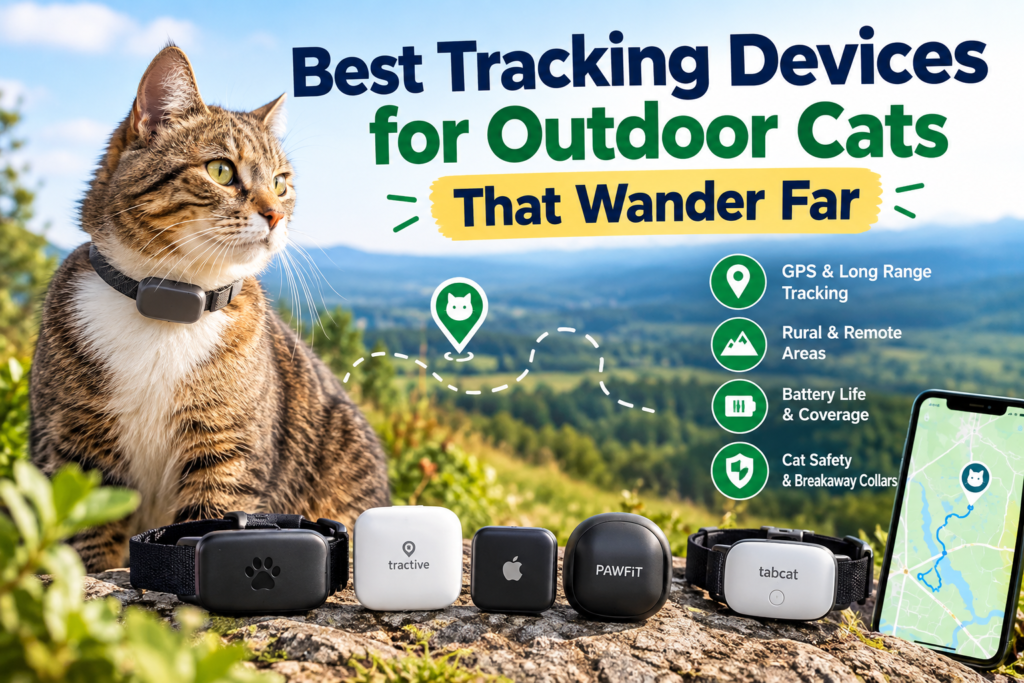
If your cat treats the neighborhood — or the back forty — like their own personal territory, a short-range tracker isn’t going to cut it. This guide is built specifically for cats that wander far: across properties, into woods, or out of sight for hours at a time.
Quick Answer: What Is the Best Tracker for a Cat That Wanders Far?
For a cat that regularly roams beyond your yard, you need cellular GPS, not Bluetooth or radio frequency (RF). The Tractive GPS CAT 6 Mini is the strongest all-around option: it uses LTE cellular coverage for effectively unlimited range, refreshes location every 2–3 seconds in Live mode, and is purpose-built for cats. If weight is your top concern, the Pawfit Lite is lighter. If your cat tends to hide nearby rather than roam for miles, a no-subscription Tabcat V2 or an Apple AirTag can work as a budget or backup option — but neither gives you a live map once your cat is genuinely far from home. There is no single “best” tracker for every cat; the right pick depends on how far your cat actually roams, and we’ll walk through exactly how to match the technology to that distance.
Best Tracking Devices for Outdoor Cats
| Tracker | Technology | Best For | Live GPS? | Practical Range | Weight | Battery Life | Subscription | Waterproofing | Cat Size | Main Limitation |
|---|---|---|---|---|---|---|---|---|---|---|
| Tractive CAT 6 Mini | Cellular GPS/LTE | Cats that roam miles from home | Yes | Unlimited with cellular coverage | 1.13 oz w/ collar | Up to 7 days (Power Saving Zones) / 4 days without | Required, ~$5–10/mo | Waterproof | 7–18 lbs | Needs cellular signal; mandatory subscription |
| Pawfit Lite | Cellular GPS/4G | Small or weight-sensitive cats | Yes | Unlimited with cellular coverage | ~0.62 oz (17.6g) | 3–5 days | Required, ~$5–7/mo | IP68 waterproof | 8.8 lbs+ | Shorter battery life than Tractive |
| Fi Mini | Cellular GPS/LTE-M | Small cats under 10 lbs | Yes | Unlimited with cellular coverage | 0.56 oz (16g) | ~3 weeks to ~2 months (varies by use) | Required, $129/yr bundled | IP68 waterproof | Under 10 lbs | Verizon network only; fewer cat-specific features |
| Apple AirTag (2nd gen) | Bluetooth + Find My network | Cats that stay near people/iPhones | No (crowd-sourced pings only) | Only as far as the nearest iPhone | 0.39 oz (11g), plus holder | Over 1 year | None | IP67 | Any size (needs holder) | Useless in areas with no nearby iPhones |
| Tabcat V2 | Radio Frequency (RF) | Nearby hiding spots, backup device | No (handheld directional only) | Up to ~500 ft, line of sight | 0.2 oz per tag | 3–12 months per tag | None | Water-resistant | Any size | No map, no live tracking, short range |
All figures above are manufacturer-published specifications as of this writing. Real-world range and battery life vary with terrain, tree cover, and cellular coverage.
Tractive GPS CAT 6 Mini

- REAL-TIME GPS TRACKING WITH UNLIMITED RANGE: Track your cat with live location updates every 2–3 seconds. Unlike others …
- HEALTH, SLEEP & ACTIVITY MONITORING: Stay on top of your cat’s wellness with daily insights into their sleep and activit…
- VIRTUAL FENCES AND LOCATION HISTORY: Set safe zones and get alerts if your cat leaves. See where they’ve been and activa…
Tractive’s newest cat tracker is a collar-integrated device built specifically around cellular GPS. According to Tractive’s own product page, the CAT 6 Mini weighs about 1.13 ounces including the collar, fits cats between 7 and 18 pounds, and connects to AT&T, Verizon, and T-Mobile LTE networks across the U.S. Because it transmits over cellular data rather than relying on Bluetooth proximity, there’s no practical distance cap — if your cat is somewhere with signal, you can see them on a map from anywhere with an internet connection.
How far it can realistically help: As far as cellular coverage reaches. This is the core advantage over AirTag or RF trackers for a cat that crosses several properties or disappears into a wooded area with signal.
Live tracking: Yes — Live mode refreshes position roughly every 2–3 seconds according to Tractive, though this setting drains the battery faster than passive tracking.
Battery: Tractive states up to 7 days with Power Saving Zones enabled (a geofence around home that reduces GPS polling), or up to 4 days without them. Independent reviewers have reported shorter real-world runtimes when Live mode is used heavily during an active search.
Collar and subscription: The tracker is built into a safety-release collar. A subscription with real-time GPS tracking is mandatory — Tractive’s cellular connectivity only works with an active plan, similar to its dog trackers.
Strengths: Purpose-built for cats, strong unlimited-range performance, mature app, breakaway collar included. Limitations: Ongoing subscription cost, and like all cellular trackers, it goes dark in true dead zones until your cat re-enters coverage. Ideal user: Owners of outdoor or semi-feral cats who need reliable, long-distance live tracking and don’t mind a subscription.
Check current price and availability directly through Tractive or major pet retailers before buying, since pricing and plan structures are updated periodically.
Pawfit Lite

- REAL-TIME GPS TRACKING & UNLIMITED RANGE: Connects to multiple satellite systems for accurate live location updates thro…
- SMART SAFETY ALERTS: Create virtual safe zones and receive instant escape notifications if your cat leaves a designated …
- LIGHTWEIGHT DESIGN & SAFETY COLLAR: Weighing less than 18g, Pawfit Lite is designed for comfortable everyday wear and in…
Pawfit Lite is the lightest dedicated cellular GPS cat tracker currently on the market at roughly 17.6 grams (about 0.62 oz), according to Pawfit’s own listings and third-party testing. It uses 4G connectivity for live location updates and includes a breakaway safety collar.
How far it can realistically help: Like Tractive, range is tied to cellular coverage rather than a fixed distance, so it works well for cats that wander far as long as they stay within network range.
Live tracking: Yes, with 5-second location refresh according to Pawfit’s cat product page.
Battery: Manufacturer and retailer listings put battery life at roughly 3–5 days under regular use, shorter than Tractive’s CAT 6 Mini — a real tradeoff for the lighter weight.
Strengths: Best-in-class weight, waterproof (IP68) construction, included breakaway collar. Limitations: Shorter battery life means more frequent charging, which is a real consideration for a cat that’s outside overnight. Ideal user: Owners of smaller or weight-sensitive cats who prioritize a barely-there feel over maximum battery life.
Fi Mini

- GPS THAT CLIPS ONTO THEIR OWN COLLAR: The Fi Mini attaches to the collar your cat already wears and shows their live loc…
- FIRST MONTH OF MEMBERSHIP INCLUDED: Unbox, clip on, pair with the Fi app, and live tracking works the same day. Membersh…
- ESCAPE ALERTS AND VIRTUAL FENCES: Set safe zones around home or the yard and get notified the instant your cat leaves on…
Fi, known for its dog collars, released the Fi Mini as its first cat-compatible tracker. It clips onto an existing collar or harness rather than replacing it, weighs about 0.56 oz, and runs on Verizon’s LTE-M network.
How far it can realistically help: Full cellular GPS range, similar to Tractive and Pawfit — a genuine option for a cat that wanders far, not just a Bluetooth proximity device.
Live tracking: Yes, plus a dedicated “Lost Mode” that increases update frequency during an active search.
Battery: Fi’s published figures for the Mini range from about three weeks up to roughly two months depending on settings and how often Safe Zone mode is used.
Strengths: Long battery life relative to other cellular cat trackers, clips onto any collar, IP68 waterproof. Limitations: Single-carrier (Verizon) coverage only, and the cat interface has fewer dedicated features (such as behavior tracking) than Fi’s dog products. Ideal user: Owners of small cats or multi-pet households already using Fi for a dog.
Apple AirTag for Cats

- Easy Setup No Subscription Required: This Apple Tag Works exclusively with Apple Find My (iOS only). Add the tracker to …
- Worldwide Network Tracking Beyond Bluetooth Range: When the Smart Tracking Tag are out of Bluetooth range, the Apple Fin…
- Sound Alerts for Nearby Items (Controlled in App): When Item Locator is nearby, tap “Play Sound” in the Find My app or a…
An AirTag is not a GPS tracker. Per Apple’s own description of the Find My network, the AirTag broadcasts a secure Bluetooth signal that nearby Apple devices detect and relay to iCloud — there’s no cellular chip and no independent GPS. Apple states the battery lasts over a year and the device carries an IP67 water and dust resistance rating.
How far it can realistically help: Only as far as there are other iPhones, iPads, or Macs nearby to relay a ping. In a dense neighborhood, this can work surprisingly well. In a rural area, on a large property, or overnight in the woods, it may not report a location at all for hours or days.
Live tracking: No. You get intermittent location updates whenever a nearby Apple device detects the tag — not a continuously refreshing live map.
Strengths: Very cheap, no subscription, tiny and light, long battery life. Limitations: Completely dependent on nearby Apple device density; not a real solution for a cat that wanders far from populated areas. Ideal user: Backup tag for an urban or suburban cat, or a second layer of protection alongside a true GPS tracker.
Tabcat V2

- TRACK YOUR CAT EASILY: Our RF technology allows you to easily track your cat or kitten, much more accurate than GPS; thi…
- EASY TO USE LOCATOR: The accurate handset holder guides you to your cat with with just 1 button; lights change in real t…
- LIGHTWEIGHT FOR CATS & KITTENS: At just 0.2 Oz, smaller & lighter than the original, our light tracking tag is one of th…
Tabcat uses radio frequency (RF), not GPS or Bluetooth. According to Tabcat’s official U.S. site, the V2 homing tags offer a guideline range of up to 500 feet outdoors with a clear line of sight (some listings cite figures up to 600 ft/182m), and locate a cat with a handheld receiver rather than a phone map.
How far it can realistically help: Not far. This is a “walk toward the beeping” tool for a cat that’s hiding nearby — under a porch, in a neighbor’s yard, up a tree — not a device for tracking a cat that’s genuinely several miles away.
Live tracking: No map at all. You walk with the handset and follow directional audio/visual cues as you get closer.
Battery and cost: No subscription, ever. Tags last roughly 3–12 months per Tabcat depending on use, and the one-time cost covers the device for years.
Strengths: Zero ongoing cost, works without a phone or cellular signal, very lightweight tags. Limitations: Short range, no history, no live map, not designed for a cat that wanders genuinely far. Ideal user: Owners whose cats mostly stay close but occasionally hide, or anyone wanting a subscription-free backup alongside a GPS tracker.
GPS vs AirTag vs RF: Which Technology Works Best for Far-Roaming Cats?
This is the single most important decision for an owner of a far-wandering cat, and it’s where most competing articles gloss over the details.
| Factor | Cellular GPS (Tractive, Pawfit, Fi) | Apple AirTag (Bluetooth/Find My) | RF (Tabcat) |
|---|---|---|---|
| Live tracking | Yes, continuous map updates | No — intermittent pings only | No — directional signal only |
| Works several miles away | Yes, if cellular coverage exists | Only if another Apple device is nearby | No |
| Needs cellular service | Yes | No (uses Bluetooth + Wi-Fi relay) | No |
| Needs nearby smartphones | No | Yes — depends on Find My network density | No |
| Subscription required | Yes | No | No |
| Works in dense forest/rural land | Depends on cellular signal | Very unreliable | Works, but only within ~500 ft |
| Best for | Cats that roam far, rural or suburban | Backup or supplemental tag | Nearby hiding spots |
The practical takeaway: cellular GPS is the only technology built to answer “where is my cat right now” from miles away. AirTag answers “has anyone with an iPhone walked near my cat recently” — which is a very different (and much less reliable) question once you’re outside a populated area. RF trackers like Tabcat don’t attempt long range at all; they trade range for pinpoint accuracy once you’re already close.
How Far Can a Cat GPS Tracker Really Track?
It helps to separate a few distinct technologies that get lumped together in marketing copy:
- GPS positioning is how the device calculates its own coordinates using satellites. This part works virtually anywhere with sky visibility, regardless of distance from you.
- Cellular transmission is how that GPS data actually gets to your phone. A “GPS tracker” like Tractive or Pawfit only reports your cat’s location where there’s LTE or similar cellular coverage — GPS positioning alone doesn’t transmit anything without it.
- Bluetooth (AirTag) has a direct range of roughly 30–100 feet on its own. Beyond that, an AirTag depends entirely on Apple’s crowd-sourced Find My network relaying a ping from someone else’s nearby device.
- RF (Tabcat) uses a dedicated handheld receiver communicating directly with the tag, capped at a few hundred feet.
- Crowd-sourced networks (used by AirTag and similar Bluetooth tags) only work where there’s device density — meaning they’re strong in cities and weak-to-nonexistent on rural properties, farmland, or deep in the woods.
In short: a true cellular GPS tracker can report your cat’s position from several miles away or across town, as long as there’s signal. AirTag and RF devices cannot — they were never designed to.
Best Trackers for Rural and Remote Outdoor Cats
Rural properties introduce two separate problems: weak or patchy cellular coverage, and very few nearby smartphones for a crowd-sourced network like Find My to rely on.
For a rural cat, a cellular GPS tracker (Tractive, Pawfit Lite, or Fi Mini) is still the strongest option, but it’s honest to say that no tracker is guaranteed to work in every location — a cat that ducks into a cellular dead zone on your own property will show only its last known position until it moves back into coverage. Before buying, check your carrier’s coverage map for the specific area your cat roams, since Tractive and similar devices connect through partner cellular networks rather than a proprietary satellite system.
An AirTag is the weakest option in rural areas specifically because it depends on nearby iPhone density — something farmland and forests simply don’t have. Tabcat can still help once you’re physically close (within a few hundred feet), which makes it a reasonable backup device for a rural cat even though it can’t help you locate one that’s genuinely far away.
Best Tracker for Cats That Wander Overnight
Overnight roaming stresses two things: battery life and how much you rely on Live mode. Continuous Live tracking (updating every few seconds) drains any cellular tracker’s battery far faster than passive check-ins every few minutes.
- If your cat is reliably home by morning, Tractive’s up to 4–7 day battery window (with Power Saving Zones) or Fi Mini’s multi-week battery gives comfortable overnight margin even with occasional Live-mode checks.
- Location history matters here too — Tractive keeps up to 365 days of location history, letting you see where your cat traveled overnight even if you weren’t watching live.
- Pawfit Lite’s shorter 3–5 day battery means an owner who checks in frequently overnight should charge it fully before an evening the cat is expected to be out late.
Cat Tracker Weight and Breakaway Collar Safety
This section matters more than most buying guides admit. Cats are not small dogs, and a tracker built for a dog collar is not automatically safe for a cat.
- Weight limits matter. Most cat-specific trackers weigh well under an ounce (16–42 grams). A tracker designed for dogs is typically heavier and bulkier, which can affect a cat’s balance, comfort, and willingness to keep it on.
- Breakaway collars are essential for outdoor cats. A cat’s flexible body means a snagged regular collar can trap a leg or jaw — a safety-release buckle pops open under pressure and prevents this. According to a veterinary blog from the Animal Medical Center of New York, breakaway collars are specifically recommended for cats because standard collars can catch on fences or branches, while a breakaway design releases with minimal force.
- Secure attachment matters as much as weight. A collar-integrated tracker like Tractive’s CAT 6 Mini avoids a separate bulky attachment, while clip-on designs like Fi Mini need to be mounted securely so they don’t swing or snag.
- Small vs. large cats: Check the manufacturer’s stated minimum weight (commonly 7–9 lbs for most cat GPS trackers) before fitting one to a small or young cat — an oversized or overly heavy tracker on a small cat is both uncomfortable and less accurate, since it may shift position on the collar.
- Never assume a dog tracker is fine for a cat. Beyond weight, breakaway mechanics differ: a breakaway collar that would be dangerous on a leashed dog (letting it slip free mid-walk) is exactly the safety feature a cat needs.
How to Choose a Tracker Based on Your Cat’s Roaming Distance
- Under 500 feet (stays close, occasional hiding): A Tabcat V2 or an AirTag is often enough, since your cat rarely leaves practical range.
- Around 1 mile (typical suburban roaming): A cellular GPS tracker like Pawfit Lite or Tractive is worth the subscription — Bluetooth and RF devices start to fail at this distance.
- Several miles (rural roaming, farm cats, woods-crossing cats): Cellular GPS is essentially required. Prioritize battery life and check cellular coverage for your specific property.
- Rural/remote with patchy signal: Choose the cellular GPS tracker with the longest realistic battery life (Fi Mini or Tractive with Power Saving Zones), and keep a Tabcat or AirTag as backup for once you’re physically close.
- Unknown roaming distance: Start with a cellular GPS tracker and review the location history after a few weeks — this tells you exactly how far your cat actually travels, which can inform whether you need the extra range at all.
What Happens If My Cat Loses Its Collar?
Every tracker on this list — GPS, RF, or Bluetooth — stops working the moment the collar comes off. This is the biggest blind spot in any tracker-only strategy. A breakaway collar is a safety feature, but it means the collar (and whatever’s attached to it) can and will come off under the right amount of pressure.
This is why permanent identification matters as a backup, not a replacement. According to the ASPCA’s official position on pet identification, microchipping paired with a collar and ID tag gives the best chance of a lost pet being reunited with its owner, since a microchip can’t fall off or get lost the way a collar can. A microchip alone doesn’t provide GPS location — it only helps once your cat is found and brought to a vet or shelter that can scan it — so it’s a complement to a tracker, not a substitute.
GPS Tracker vs AirTag for an Outdoor Cat
These solve different problems, and it’s worth being blunt about that instead of implying they’re interchangeable:
- A GPS tracker gives you an active, continuously updated map location anywhere there’s cellular coverage — the tool you want for a cat that’s genuinely missing or roaming far.
- An AirTag gives you occasional, passive pings whenever a nearby Apple device happens to detect it — useful in a city, unreliable in the country, and unhelpful the moment your cat is somewhere without nearby iPhones.
For a cat that occasionally slips into the backyard, an AirTag can be a low-cost safety net. For a cat that wanders far from home on a regular basis, it is not a substitute for real cellular GPS — treat it as a cheap backup at most, not your primary tracker.
How Much Does a Cat Tracker Cost Over 1–3 Years?
Subscription costs are where cellular trackers add up, so it’s worth comparing total ownership cost rather than sticker price alone.
- Tractive CAT 6 Mini: $49 tracker. Subscription plans (per Tractive’s published pricing) range from about $6–9/month depending on term length. Using the 1-year plan (~$108/yr), year one runs roughly $157; a 2-year prepaid plan brings the effective rate down to about $72/year. Over 3 years, expect roughly $300–$375 depending on which plan length you choose.
- Pawfit Lite: Roughly $45 tracker plus an estimated $5–7/month subscription. Year one runs approximately $105–$129; over 3 years, expect roughly $225–$300.
- Fi Mini: $129 for the first year, which bundles the hardware and membership together. Confirm renewal-year membership pricing directly with Fi, since it may differ from the launch bundle price.
- Apple AirTag: About $29 per tag, plus a breakaway mount or holder (roughly $10–15). No subscription at all — 3-year cost is essentially the one-time purchase, plus an occasional replacement battery.
- Tabcat V2: Roughly $100–110 for a starter bundle with two tags, and no subscription. Three-year cost is close to the purchase price, aside from periodic tag battery replacement.
These figures reflect currently published pricing and are subject to change — always confirm current price and subscription terms on the manufacturer’s site before buying.
How to Use a GPS Tracker to Find a Missing Outdoor Cat
- Open Live mode immediately. Switch from passive tracking to continuous live updates as soon as you realize your cat hasn’t come home.
- Check location history first. Before walking anywhere, review the past 24–48 hours of movement to identify a pattern — cats often return to the same hiding spots.
- Head toward the last confirmed signal, not a guess. If the tracker shows the last known position was near a tree line or a neighbor’s shed, start your physical search there rather than the general direction your cat usually goes.
- Watch the battery indicator. Heavy Live-mode use drains batteries faster — if the battery is critically low, consider switching back to standard updates to avoid losing the signal entirely during the search.
- Use the tracker’s sound or light feature if it has one. Several trackers, including Tractive and Pawfit, include a remote-triggered LED or alarm sound to help you pinpoint a cat that’s hiding nearby once you’re close.
- Accept the limits of cellular dead zones. If the map stops updating, your cat is likely somewhere without cellular signal — a culvert, dense structure, or true coverage gap. Keep checking periodically; the location will update again once your cat moves.
- Combine tools if you have them. If you also carry a Tabcat handset or your cat has an AirTag, switch to short-range tools once the GPS tracker has gotten you within a few hundred feet.
Frequently Asked Questions
What is the best tracker for a cat that roams far? A cellular GPS tracker built for cats — such as the Tractive CAT 6 Mini or Pawfit Lite — is the only technology designed to report location from several miles away, provided there’s cellular coverage.
Can GPS trackers track cats several miles away? Yes, as long as the tracker uses cellular (LTE) transmission and there’s coverage in that area. Range isn’t capped by distance the way Bluetooth or RF trackers are.
Does a cat GPS tracker work without Wi-Fi? Yes. Cellular GPS trackers use mobile networks, not home Wi-Fi, so they work anywhere there’s cell signal — including away from your house.
Does a GPS cat tracker need cellular service? Yes, for live tracking. Without cellular coverage, a GPS-and-cellular tracker can calculate its position but can’t transmit it to your phone until it re-enters coverage.
Is AirTag good for outdoor cats? It can work as a low-cost backup in a dense, iPhone-heavy neighborhood, but it isn’t reliable for a cat that wanders into rural areas or anywhere without nearby Apple devices.
What is better than AirTag for a cat that wanders? Any true cellular GPS tracker — Tractive, Pawfit Lite, or Fi Mini — since they provide live, continuously updated location rather than intermittent crowd-sourced pings.
Can Tabcat track a cat several miles away? No. Tabcat’s RF technology tops out at roughly 500 feet with a clear line of sight; it’s built for nearby hiding spots, not long-distance tracking.
How heavy should a cat tracker be? Most cat-specific trackers weigh well under an ounce (roughly 16–42 grams including the collar). Anything noticeably heavier, especially a device built for dogs, risks discomfort or an ill-fitting collar.
Do GPS cat trackers require subscriptions? Yes, generally. Because they rely on ongoing cellular data transmission, GPS/cellular trackers like Tractive, Pawfit, and Fi require a paid subscription. RF (Tabcat) and Bluetooth (AirTag) options do not.
What happens when the tracker battery dies? The device stops transmitting location entirely. You’ll see the last known position until the tracker is recharged and reconnects.
Can GPS trackers work in rural areas? Yes, but only where the tracker’s cellular partner network has coverage. Check your specific property against your carrier’s coverage map, since performance varies significantly by location.
Should an outdoor cat wear a breakaway collar? Yes. A breakaway or safety-release collar is strongly recommended for outdoor cats to prevent choking or entrapment if the collar snags on something.
This guide is based on manufacturer-published specifications and independent reviews current as of publication. Product prices, subscription plans, and availability change frequently — always verify current details on the manufacturer’s official site before purchasing. No tracker, regardless of technology, is guaranteed to provide a location in every possible situation or terrain.