
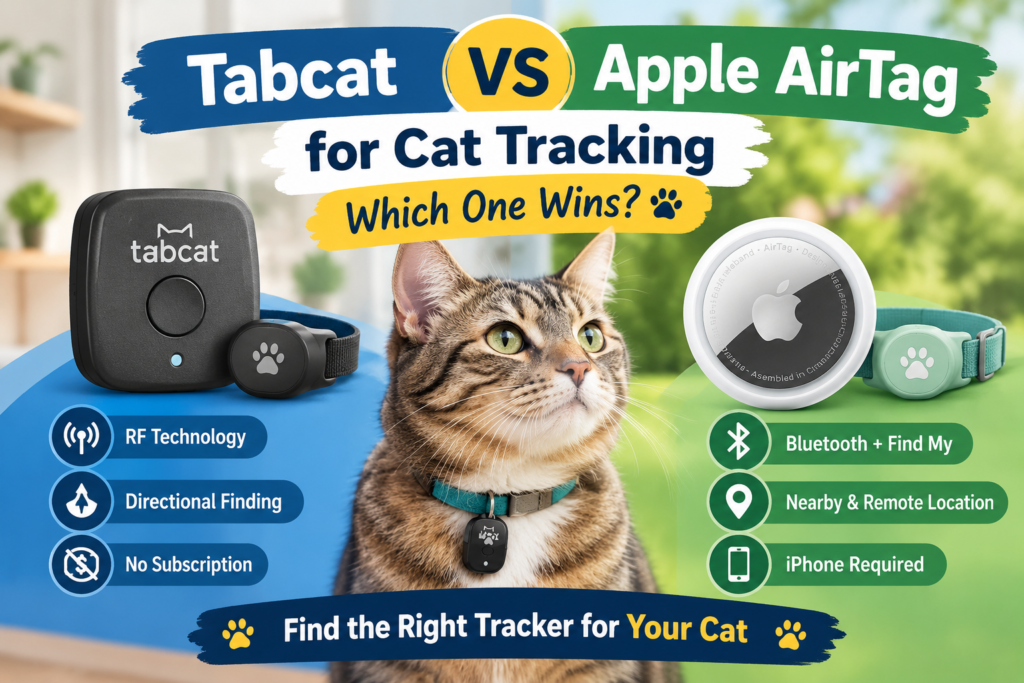
Losing sight of a cat for even twenty minutes can feel like an emergency. Both the Tabcat V2 and the Apple AirTag are popular answers to “where is my cat right now,” but they solve the problem in almost opposite ways, and neither one is a GPS tracker in the way most people assume. This guide breaks down exactly how each device behaves in the situations that matter most to cat owners — hiding cats, escaped cats, multi-cat homes, rural properties, and city apartments — so you can pick the right tool instead of guessing.
Affiliate Disclosure: PetTrackerHub may earn a commission when you purchase products through links on our site, at no extra cost to you. We only recommend products we believe may be useful to our readers.
Quick Answer
- Choose Tabcat if your cat tends to hide close to home (under a porch, in a crawlspace, in a neighbor’s yard) and you want a no-subscription, no-phone-required way to zero in on an exact hiding spot within a few hundred feet.
- Choose Apple AirTag if you’re an iPhone user who wants a low-cost, passive safety net for a cat that occasionally slips out and stays within a populated neighborhood, and you’re comfortable with location updates that depend on other Apple devices being nearby.
- Choose a cellular GPS pet tracker instead of either one if your cat roams widely outdoors, you need live location updates, or you want geofencing/escape alerts. Neither Tabcat nor AirTag was built for that job.

- TRACK YOUR CAT EASILY: Our RF technology allows you to easily track your cat or kitten, much more accurate than GPS; thi…
- EASY TO USE LOCATOR: The accurate handset holder guides you to your cat with with just 1 button; lights change in real t…
- LIGHTWEIGHT FOR CATS & KITTENS: At just 0.2 Oz, smaller & lighter than the original, our light tracking tag is one of th…
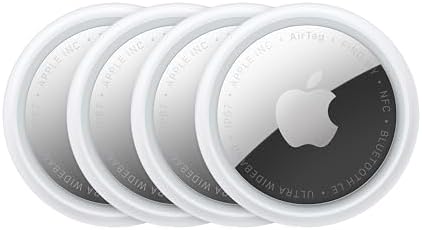
- FIND YOUR ITEMS ON FIND MY — AirTag (2nd generation) helps you keep track of what matters. Attach one to an item you wan…
- EXPANDED PRECISION FINDING ON IPHONE AND APPLE WATCH — Get step-by-step directions to your lost item on iPhone and, now,…
- ENHANCED SPEAKER — With a 50% louder speaker and a new, distinctive chime, it’s easier than ever to hear and find AirTag…
Tabcat vs AirTag at a Glance
| Feature | Tabcat V2 | Apple AirTag (2nd gen) |
|---|---|---|
| Core technology | Direct RF (radio frequency) signal between tag and handheld receiver | Bluetooth Low Energy + UWB, relayed through Apple’s Find My network |
| True GPS | No | No |
| Live/continuous tracking | No — on-demand directional search only | No — passive, intermittent location updates when an Apple device is nearby |
| Location updates | Real-time while actively searching with the handset | Irregular; depends on Find My network device density |
| Tracking range | Up to ~500 ft (152 m) in open air, per manufacturer guideline; less indoors or through walls | City-block to city-wide in dense Apple-device areas; effectively no range where no Apple devices pass by |
| Nearby (precision) finding | Yes, built-in directional handset, accurate to about 1 inch per manufacturer specs | Yes, via Precision Finding on compatible iPhones (UWB) |
| Remote/map finding | No | Yes, via the Find My app, when the network relays a location |
| Phone required | No | Yes |
| iPhone required | No (works with a standalone handset) | Yes (Find My is Apple-only; Android users cannot track an AirTag) |
| Subscription | None — one-time purchase | None for basic Find My use |
| Battery type | Tag: 2x SR1130/GP389 silver-oxide cells. Handset: CR2032 | User-replaceable CR2032 |
| Battery life | Manufacturer states 3–12 months depending on use | Roughly about a year under typical use, per Apple |
| Tracker weight | 0.21 oz (about 6 g) tag, plus a 0.25 oz silicone case | 0.42 oz (11.8 g) |
| Holder/collar requirement | Included silicone case slides onto a standard collar | No official holder included; needs a third-party keyring/collar mount |
| Multiple-cat support | One handset pairs with up to 4 tags | Unlimited AirTags per Apple Account, each shown separately in Find My |
| Indoor use | Strong — designed for pinpointing hiding spots | Weak to moderate — depends on other Apple devices being in Bluetooth range |
| Outdoor use | Good within a few hundred feet; requires you to search | Good passively in areas with iPhone traffic; poor in low-traffic areas |
| Rural use | Works, but you must physically walk the property with the handset | Weak — few nearby Apple devices to relay a location |
| Urban/suburban use | Works well for short-range hide-and-seek | Strong — dense iPhone traffic improves location relay frequency |
| Best use case | Cats that hide nearby and need to be physically located | iPhone-owning households wanting a low-cost passive safety net |
| Main limitation | Short range; you must search rather than track remotely | No live tracking; useless without nearby Apple devices; iPhone-only |
Specifications can change between hardware revisions and firmware updates, so always confirm current numbers on the manufacturer’s own product pages before buying.
How Tabcat Works for Cat Tracking
Tabcat, made by UK-based Loc8tor, uses direct radio-frequency (RF) communication between a small tag on your cat’s collar and a handheld receiver you carry. There’s no app, no internet connection, and no third party involved — the receiver talks directly to the tag, the same basic principle used in walkie-talkies or older wildlife telemetry collars. According to Tabcat’s official product page, the handset guides you toward the tag using color-coded lights and beeping tones, and the company states the system can pinpoint a cat’s location to within about one inch once you’re in range.
The practical tradeoff is range. Tabcat’s manufacturer lists a guideline range of up to 500 feet in open air, but that number drops noticeably indoors or through walls, fences, and dense vegetation. In other words, Tabcat doesn’t tell you where your cat is across town — it tells you, very precisely, where your cat is within a few hundred feet of you right now.
- TRACK YOUR CAT EASILY: Our RF technology allows you to easily track your cat or kitten, much more accurate than GPS; thi…
- EASY TO USE LOCATOR: The accurate handset holder guides you to your cat with with just 1 button; lights change in real t…
- LIGHTWEIGHT FOR CATS & KITTENS: At just 0.2 Oz, smaller & lighter than the original, our light tracking tag is one of th…
How Apple AirTag Works for Cat Tracking
The AirTag is not a pet tracker at all — it’s a general-purpose item finder that people also attach to collars. According to Apple’s official tech specs page, the second-generation AirTag uses Bluetooth for proximity finding plus an Apple-designed ultra-wideband (UWB) chip for close-range Precision Finding, and it weighs 0.42 ounces (11.8 grams).
The AirTag doesn’t transmit its own location to you directly over long distances. Instead, it relies on Apple’s Find My network, described in Apple’s Find My privacy documentation as a system in which nearby Apple devices detect a Bluetooth signal from the AirTag and relay an approximate, encrypted location back to the owner. If your cat and the AirTag wander into an area with few iPhones, iPads, or Macs passing by, the AirTag effectively goes dark until an Apple device comes within Bluetooth range again.
- FIND YOUR ITEMS ON FIND MY — AirTag (2nd generation) helps you keep track of what matters. Attach one to an item you wan…
- EXPANDED PRECISION FINDING ON IPHONE AND APPLE WATCH — Get step-by-step directions to your lost item on iPhone and, now,…
- ENHANCED SPEAKER — With a 50% louder speaker and a new, distinctive chime, it’s easier than ever to hear and find AirTag…
Tabcat vs AirTag: Key Differences
The single most important distinction is this: Tabcat is a direct-connection RF finder, and AirTag is a passive, network-dependent Bluetooth finder. Neither is GPS.
- Tabcat needs no other devices, no internet, and no phone. It needs you, physically, within a few hundred feet with the handset in hand.
- AirTag needs nothing from you at the moment of searching, but it needs other people’s Apple devices to be nearby to report a location. In a truly empty area, an AirTag can’t tell you anything new.
- Tabcat gives real-time directional guidance the instant you activate the handset. AirTag gives you the last relayed location, which could be minutes or hours old depending on foot traffic.
- Tabcat works on any phone ecosystem (it doesn’t use a phone at all). AirTag is locked to Apple’s Find My app, so Android-only households cannot use it to track a cat.
Range and Real-World Tracking
Tabcat’s 500-foot open-air range (per manufacturer specification) is best understood as “close-range recovery,” not tracking. If your cat is two streets over, you’ll need to walk the neighborhood with the handset until you pick up a signal — the device won’t tell you which direction to start walking until you’re already somewhat close.
AirTag’s effective range is really the range of Apple’s crowdsourced network, not the AirTag itself. In a dense city block, dozens of iPhones may pass by every hour, so a lost AirTag can get “found” fairly often. On a rural property or in a quiet exurb, an AirTag can sit silent for a long time simply because no compatible device came within Bluetooth range to relay its position.
Indoor Cat vs Outdoor Cat
Indoor cats that hide inside the house: Tabcat is purpose-built for this. Under a bed, behind a dryer, in a closet — the handset’s inch-level directional accuracy (per manufacturer claims) is genuinely useful here. AirTag can technically work indoors too, but it depends on your own iPhone (or a household member’s) being close enough to trigger Precision Finding; it isn’t designed as a “search the house” tool the way Tabcat is.
Indoor cats that escape into the neighborhood: This is where the two devices diverge sharply. Tabcat requires you to search on foot within its few-hundred-foot range. AirTag can potentially surface a rough location automatically if a neighbor’s iPhone passes near your cat, without you doing anything — but only if the neighborhood has enough iPhone density, and only with a delay.
Outdoor roaming cats: Neither device is designed for a cat that regularly ranges far beyond the yard. See the dedicated section below on when you need a real GPS tracker instead.
What Happens If Your Cat Runs Away?
Realistic scenarios help clarify which technology actually helps:
- Cat hiding under a bed or in a closet: Tabcat’s directional handset excels here; AirTag can work if your phone is in the room but isn’t designed for this kind of close-quarters search.
- Cat hiding in a garage or crawlspace: Same story — Tabcat’s RF signal passes through some structures better than expected, though thick walls and metal will reduce range on both devices.
- Cat hiding under a porch or deck: Tabcat’s handheld search usually works well here since you’re within a few dozen feet.
- Cat leaving the yard into the immediate neighborhood: Tabcat requires you to walk the block with the receiver. AirTag may relay a location automatically if a neighbor’s Apple device passes by, but there’s no guarantee of timing.
- Cat traveling beyond the immediate neighborhood: Both devices become unreliable. Tabcat is out of range entirely. AirTag depends entirely on Apple-device traffic in whatever area the cat ends up in.
- Cat moving through an area with many iPhones (dense urban core): AirTag has the best odds of relaying a location here, because Find My depends on device density.
- Cat moving through a low-density or rural area: AirTag may go quiet for long stretches. Tabcat still works, but only once you’re physically close enough to search with the handset.
If your cat’s typical range includes any of the wider-area scenarios above, a dedicated real-time GPS tracker built for pets is worth comparing before you buy either of these devices — see the “neither is a true GPS tracker” section below.
Accuracy and Location Updates
Tabcat’s manufacturer states its handset can pinpoint a tag to within about one inch once you’re in range, which is a meaningful advantage for close-quarters searching. But that accuracy only applies within the RF range — there’s no accuracy to speak of beyond a few hundred feet, because the device simply can’t see that far.
AirTag’s location updates are irregular and depend on Find My network relays. When another Apple device is nearby, Precision Finding (on compatible iPhones) can guide you to within roughly a meter or better, according to independent technical explainers of Apple’s Find My Bluetooth network. Between relays, though, you’re looking at a “last known location,” not a live position.
Weight and Collar Safety Considerations
Weight is one of the most-discussed specs in cat tracker reviews, but total wearable weight matters more than the tag alone.
- Tabcat tag: 0.21 oz (about 6 g), per the manufacturer, plus a roughly 0.25 oz silicone case that’s included with every purchase. Combined, that’s still lighter than a single AirTag.
- AirTag: 0.42 oz (11.8 g) for the tag alone, per Apple’s tech specs. Apple doesn’t include a holder or collar clip in the box, so you’ll need a separate silicone or nylon mount, which adds further weight and bulk.
For kittens and small adult cats, every fraction of an ounce on the collar matters more, both for comfort and for the risk of a collar riding unevenly. Neither manufacturer publishes cat-specific weight-safety thresholds, so this is a case where common-sense guidance from veterinary and animal-welfare sources is more useful than marketing claims. The ASPCA’s general cat care guidance recommends that any outdoor cat wear a breakaway safety collar with an elastic or quick-release panel so the cat can free itself if the collar snags on something — a rule that applies regardless of which tracker brand is attached.
A few practical points, distinguishing manufacturer claims from general independent observation:
- Tabcat’s own marketing states its tag is lighter than “any other cat tracking device” — that’s a manufacturer claim, not an independently verified comparison across every tracker on the market.
- Both devices should be attached to a breakaway collar rather than a solid buckle collar for outdoor cats, per standard pet-safety advice — not because either manufacturer says so, but because breakaway design is a general safety recommendation for any collar-worn accessory on a cat that goes outside.
- Never substitute a tracker’s strap or lanyard hole for a full collar attachment; use the manufacturer’s case or a purpose-built holder.
We’re not veterinarians, and neither device’s manufacturer publishes formal veterinary safety certifications, so if you have a very small kitten or a cat with a health condition that makes collar-wearing risky, talk to your vet before adding any collar accessory.
Battery Life
- Tabcat: The manufacturer states 3–12 months per tag depending on how often you search, using two SR1130 (or GP389-equivalent) silver-oxide batteries. The handheld receiver uses a CR2032. No charging cables, no removing the collar weekly.
- AirTag: Apple states roughly a year of typical battery life on a single user-replaceable CR2032 cell, though actual results vary with usage and environmental conditions per Apple’s own testing notes.
Both are meaningfully better than most rechargeable cellular GPS collars, which commonly need recharging every few days to a couple of weeks — a real advantage of RF and Bluetooth designs over GPS in terms of low-maintenance ownership.
Subscription and Long-Term Cost
Neither Tabcat nor AirTag requires a monthly subscription for basic tracking, which is a major selling point versus most cellular GPS trackers. Still, total cost of ownership differs.
One cat, one year (approximate, verify current pricing before purchase):
- Tabcat: about $110 upfront (2-cat pack from the manufacturer) plus a few dollars for replacement batteries — no ongoing fees.
- AirTag: about $29 for a single tag, plus a separate holder/collar mount (commonly $5–$15), plus an iPhone is required if you don’t already own one.
Two cats, one year:
- Tabcat: one handset pairs with up to four tags, so a single ~$110 pack (which already includes two tags) covers two cats with no extra device cost.
- AirTag: roughly $58 for two individual AirTags, or about $99 for the four-pack if you want spares — plus two holders.
Two-year outlook: Because neither device carries a subscription, the main added cost over time is batteries (both) and possibly a holder replacement (AirTag). Tabcat’s higher upfront price is partly offset by including a full multi-cat kit out of the box; AirTag’s lower per-unit price is offset by needing separate holders and, for many households, no existing iPhone to run Find My.
If your household has already ruled out subscriptions entirely, our roundup of tracking devices without monthly subscription fees covers more no-subscription options worth comparing.
Tabcat vs AirTag for Small Cats and Kittens
For very small cats and kittens, Tabcat’s lighter total tag weight (about 6 g plus a thin silicone case) is generally easier to carry comfortably than an AirTag (11.8 g plus a separate holder). That said, kittens grow quickly, and any collar — with or without a tracker — needs to be checked and refitted often. Both companies expect the tracker to be attached to an appropriately sized, well-fitted collar rather than worn directly against the skin.
Tabcat vs AirTag for Multiple Cats
Tabcat is arguably the more purpose-built option for multi-cat households: one handset pairs with up to four tags, and the base two-cat pack already includes two tags at one purchase price. AirTag scales differently — each AirTag is tracked individually in the Find My app under one Apple Account, so a four-cat household would typically need four separate AirTags (a four-pack runs about $99) plus four separate holders, but you gain the ability to see all four last-known locations on a map simultaneously, which Tabcat’s handset cannot do.
Which Works Better in Urban Areas?
In dense urban and suburban settings, AirTag has a structural advantage: more iPhones means more frequent Find My relays, so a lost AirTag is more likely to surface a recent location. Tabcat still works fine in cities, but its usefulness is capped by its few-hundred-foot range regardless of population density — it’s built for “search nearby,” not “track across the city.”
Which Works Better in Rural Areas?
Rural areas flip the advantage. With little to no Apple-device foot traffic, an AirTag can sit without a location update for long stretches. Tabcat doesn’t care how many other devices are around — its direct RF connection to the handset works the same in a city or on a farm — but you still have to physically be within roughly a few hundred feet and walk the property to search.
Do You Need an iPhone?
Yes, for AirTag. Find My is an Apple-only ecosystem; there’s no functional Android app for actively tracking an AirTag the way an iPhone owner can. Tabcat, by contrast, needs no smartphone of any kind — it comes with its own dedicated handheld receiver, making it the more accessible option for Android households or anyone who doesn’t want tracking tied to a phone at all.
What Happens If Neither Tracker Is Enough?
This is the section most comparison articles skip, and it matters. If your cat:
- Roams widely and unpredictably outdoors,
- Lives somewhere with sparse Apple-device traffic,
- Needs live, continuously updating location rather than an on-demand search or a passive relay,
- Or needs geofencing/escape alerts that notify you the moment the cat leaves a set area,
…then both Tabcat and AirTag fall short, and you should be looking at a dedicated cellular GPS pet tracker instead. These devices use actual satellite GPS plus a cellular data connection (similar to a phone) to report live location on a map, typically with a monthly or annual subscription. Our comparison of AirTag vs Tractive GPS goes deeper into how a true cellular GPS tracker differs from a Bluetooth item finder, and ourroundup of GPS trackers under $100 is a useful starting point if budget is the main obstacle to going the subscription-GPS route. It’s also worth reading our full AirTag review for a closer look at where Bluetooth-based tracking hits its limits with pets specifically.
Tabcat vs AirTag: Pros and Cons
Tabcat
- Pros: No subscription, no phone required, purpose-built for cats, lightweight tag, long battery life, precise close-range directional search, multi-cat handset support.
- Cons: Short range (a few hundred feet), requires you to physically search, no remote/map view, higher upfront cost per tag, no continuous tracking.
- TRACK YOUR CAT EASILY: Our RF technology allows you to easily track your cat or kitten, much more accurate than GPS; thi…
- EASY TO USE LOCATOR: The accurate handset holder guides you to your cat with with just 1 button; lights change in real t…
- LIGHTWEIGHT FOR CATS & KITTENS: At just 0.2 Oz, smaller & lighter than the original, our light tracking tag is one of th…
Apple AirTag
- Pros: Low upfront cost, works passively without you doing anything, benefits from a massive crowdsourced network in populated areas, map view in the Find My app, useful in dense cities.
- Cons: iPhone required, no true live tracking, unreliable in low-traffic areas, heavier than Tabcat, no included collar holder, not designed specifically for pets.
- FIND YOUR ITEMS ON FIND MY — AirTag (2nd generation) helps you keep track of what matters. Attach one to an item you wan…
- EXPANDED PRECISION FINDING ON IPHONE AND APPLE WATCH — Get step-by-step directions to your lost item on iPhone and, now,…
- ENHANCED SPEAKER — With a 50% louder speaker and a new, distinctive chime, it’s easier than ever to hear and find AirTag…
Tabcat vs AirTag: Which Should You Choose?
- Choose Tabcat when your cat tends to hide nearby rather than roam far, you want zero reliance on any phone or app, you don’t want a subscription of any kind, and you’re comfortable doing the searching yourself with a handheld device.
- Choose AirTag when you’re already in the Apple ecosystem, your cat mostly stays within a populated neighborhood, you want the option of a passive map-based check without actively searching, and you accept that updates won’t be continuous or guaranteed.
- Consider a cellular GPS tracker when your cat roams widely, lives somewhere with low Apple-device traffic, or you specifically need live tracking or geofencing — needs that neither Tabcat nor AirTag was designed to meet.
FAQ
Is Tabcat better than AirTag for cats? It depends on the scenario. Tabcat is generally better for precisely locating a cat that’s hiding nearby, since it doesn’t depend on other devices being around. AirTag can be more convenient for passive, low-effort monitoring in a populated area, but it isn’t as reliable for close-range searching indoors.
Can Tabcat track a cat from far away? No. Tabcat’s manufacturer lists a guideline range of up to 500 feet in open air, and less indoors or through obstacles. It’s designed for close-range recovery, not long-distance tracking.
Does Tabcat use GPS? No. Tabcat uses direct radio-frequency (RF) communication between the tag and a handheld receiver — not GPS, cellular, or Bluetooth.
Does AirTag use GPS? No. AirTag uses Bluetooth Low Energy and ultra-wideband technology, and it depends on Apple’s crowdsourced Find My network to relay location data. It contains no GPS chip.
Can AirTag track a cat without an iPhone nearby? Not usefully. The AirTag itself has no GPS or cellular connection, so it needs some nearby Apple device (not necessarily yours) to detect its Bluetooth signal and relay a location to Apple’s servers.
Does Tabcat require a subscription? No. Tabcat is a one-time purchase with no monthly or annual fees.
Does AirTag require a monthly fee? No. Basic Find My tracking is included at no extra cost with an Apple Account.
Which is better for an indoor cat? Tabcat is generally the stronger fit for indoor hide-and-seek, since its handset gives real-time directional guidance to within about an inch, per the manufacturer, without needing another device nearby.
Which is better for an outdoor cat? Neither is ideal for a cat that roams widely. For a cat that mostly stays close to home, Tabcat offers more reliable close-range search; for a cat that stays within a populated neighborhood, AirTag can offer passive coverage. For cats that roam far, a cellular GPS tracker is the more appropriate tool.
Is AirTag too heavy for a small cat? At 11.8 grams plus a separate holder, an AirTag is heavier than Tabcat’s roughly 6-gram tag. Whether it’s “too heavy” depends on the individual cat’s size; for kittens or very small adult cats, the lighter Tabcat tag is generally the more comfortable option, though neither manufacturer publishes a formal maximum-weight-for-cat-size guideline.
Can you use Tabcat for multiple cats? Yes. One Tabcat handset can pair with up to four tags, so it’s well suited to multi-cat households.
What is better than AirTag for tracking a roaming cat? A dedicated cellular GPS pet tracker with live location updates and geofencing is the more appropriate tool for a cat that roams widely outdoors, since neither AirTag nor Tabcat offers continuous, guaranteed location tracking.
Final Takeaway
Tabcat and AirTag solve different problems that both happen to fall under “cat tracker.” Tabcat is a precision, no-subscription hide-and-seek tool with a short range that you control yourself. AirTag is a passive, low-cost safety net that piggybacks on Apple’s enormous device network, with no guarantee of when — or whether — a location update will arrive. If your cat’s habits and your phone ecosystem line up with one device’s strengths, that’s the one to buy. If your cat roams far beyond the yard, skip both and look at a cellular GPS tracker instead — it’s the only category of device actually built for that job.
Prices, specifications, and battery-life estimates reflect information available in 2026 and are subject to change. Always confirm current pricing and specs directly with Apple and Tabcat before purchasing.