
Introduction
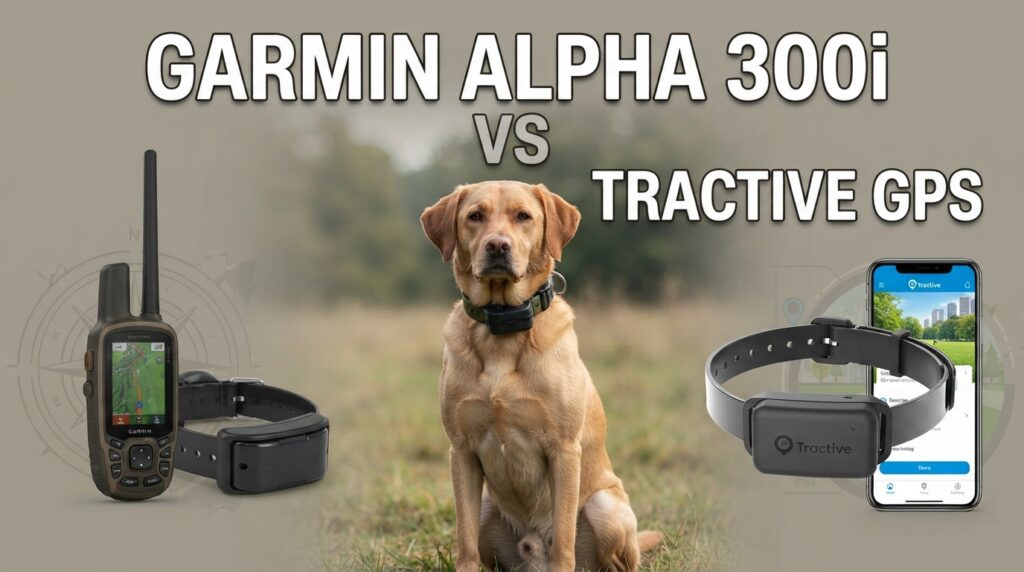
A Garmin Alpha 300i and a Tractive GPS tracker both promise to tell you where your dog is. That’s about where the similarity ends.
The Alpha 300i is a handheld GPS/VHF radio unit built to pair with a separate Garmin dog collar — a system designed for hunters and handlers who need to track and sometimes train dogs across open country, often where there’s no cell signal at all. Tractive is a compact, collar-mounted tracker that uses your phone and a cellular connection to show a dog’s location on a map, almost anywhere cell towers reach.
Which one actually fits your situation depends on a handful of practical questions: Does your dog work in areas with spotty or no cellular coverage? Are you managing one pet or a pack of hunting dogs? Do you want a dedicated handheld device, or is your phone enough? Are you comfortable with an ongoing subscription, or trying to avoid one? Do you care about health and sleep monitoring, or about training range and battery life in the field? This guide walks through the real differences so you can match the technology to your dog, not the other way around.
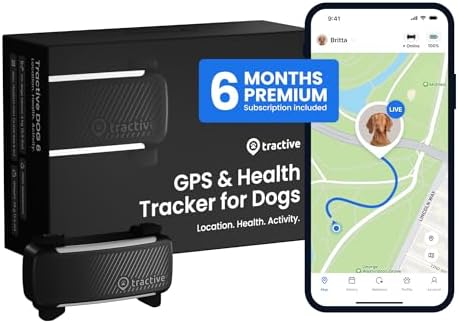
- REAL-TIME GPS TRACKING WITH UNLIMITED RANGE: Track your dog’s live location nationwide with updates every 2-3 seconds—up…
- VIRTUAL FENCES & LOCATION HISTORY: Set up safe zones and receive alerts when your dog leaves the area. Activate live tra…
- HEALTH & ACTIVITY MONITORING: Monitor your dog’s daily health, sleep patterns, and activity levels through the Tractive …

- Features a vivid sunlight-readable 3.5” capacitive touchscreen display and a button-operated, dog-focused design for qui…
- Easily set up and monitor up to 20 dogs with your compatible dog collars from up to 9 miles away (depending on your dog …
- With an Outdoor Maps+ subscription, you have access to a wide variety of premium mapping content that is regularly updat…
If you’re coming from an older Garmin model, it’s also worth knowing how this compares to the previous generation — see our Garmin Alpha 200i review for that context.
Quick Answer
The Garmin Alpha 300i is built for hunters, field trialers, and working-dog handlers who need reliable tracking and often training capability in remote areas, regardless of cell coverage. It requires a dedicated handheld and a separate compatible collar.
The Tractive GPS (currently the DOG 6 / DOG 6 XL lineup) is built for everyday dog owners who want phone-based live tracking, escape alerts, and health/activity monitoring, using cellular data rather than radio. It needs a cellular connection and an active subscription to function.
Neither is objectively “better” — they’re solving different problems with different technology.
Garmin Alpha 300i vs Tractive GPS: Quick Comparison
| Feature | Garmin Alpha 300i | Tractive GPS (DOG 6 / DOG 6 XL) |
|---|---|---|
| Tracking technology | GPS + VHF radio | GPS + cellular (LTE-M/2G) |
| Communication method | Direct radio link, handheld-to-collar | Cellular network to phone app |
| Range | Up to 14.5 km (9 mi.) VHF range under suitable conditions | Effectively unlimited anywhere supported cellular coverage exists |
| Cellular requirement | Not required for core tracking | Required |
| Subscription requirement | Optional (only for inReach satellite messaging/Outdoor Maps+) | Required for any location tracking |
| Handheld requirement | Yes, dedicated Garmin handheld | No — smartphone app only |
| Phone app | Companion app (Garmin Explore) for review/setup | Primary interface (Tractive app) |
| Live tracking | Via handheld screen | Via app, real time |
| Escape alerts | Not a core feature | Yes, virtual fence alerts |
| Geofencing | Limited | Yes (“Virtual Fences”) |
| Training features | Yes, with compatible TT-series collars | No, tracking/monitoring only |
| Health monitoring | Not a focus | Resting heart rate, respiratory rate, activity, sleep, scratch monitoring |
| Activity tracking | Basic hunt metrics (distance, speed, time) | Detailed activity tracking |
| Sleep tracking | No | Yes |
| Satellite/SOS capabilities | Optional inReach two-way satellite messaging and SOS | Not available |
| Multi-dog tracking | Up to 20 dogs on one handheld | Each dog needs its own tracker and subscription |
| Battery | Handheld: up to 55 hr; Collar: up to 68 hr, up to 136 hr with extended battery | DOG 6: up to 14 days (Power Saving Zones); DOG 6 XL: up to 6 weeks |
| Water resistance | Handheld: IPX7; Collar: 1 ATM (10 m submersible) | IP68, fully submersible |
| Weight | Handheld roughly 10 oz; collar varies by model | DOG 6: 1.4 oz; DOG 6 XL: 2.5–3.5 oz |
| Setup | Pair handheld with collar(s), configure channels | Download app, activate SIM, choose subscription |
| Best use case | Hunting, field work, remote/off-grid dogs | Everyday pets, escape-prone dogs, travel |
| Typical ownership cost | High upfront hardware cost, low/no recurring fee unless using inReach | Lower upfront cost, mandatory recurring subscription |
Pricing and exact figures change over time — always confirm current numbers before buying, and see the comparison to Garmin’s prior generation in our Garmin Alpha 200i vs Tractive GPS guide for additional context.
How Garmin Alpha 300i Tracking Works
The Alpha 300i system has two separate physical components: the handheld (the device you carry) and a compatible collar worn by the dog, such as the TT25 or T5 series. They are sold separately or as a bundle, and understanding that distinction matters — the “Alpha 300i” by itself is not something you strap to a dog.
The collar uses GPS to determine its own position, then transmits that data directly to the handheld using VHF (very high frequency) radio, not cellular data. The handheld receives that signal and plots the dog’s position on its built-in maps. Because this is a direct radio link rather than a connection routed through cell towers, it can work in places with no cellular coverage at all — deep forest, remote public land, or backcountry where a phone would show “No Service.”
Terrain still matters, though. Hills, dense timber, and other obstructions can reduce the effective radio range, since VHF signals travel best with a relatively clear line of sight. This is one reason the system is particularly relevant to hunting and working-dog handlers: it’s designed around exactly the kind of unpredictable, off-grid terrain those dogs work in. For a broader look at what this category of device is built for, see our guide to GPS trackers for hunting dogs and working dogs.
- REAL-TIME GPS TRACKING WITH UNLIMITED RANGE: Track your dog’s live location nationwide with updates every 2-3 seconds—up…
- VIRTUAL FENCES & LOCATION HISTORY: Set up safe zones and receive alerts when your dog leaves the area. Activate live tra…
- HEALTH & ACTIVITY MONITORING: Monitor your dog’s daily health, sleep patterns, and activity levels through the Tractive …
- Features a vivid sunlight-readable 3.5” capacitive touchscreen display and a button-operated, dog-focused design for qui…
- Easily set up and monitor up to 20 dogs with your compatible dog collars from up to 9 miles away (depending on your dog …
- With an Outdoor Maps+ subscription, you have access to a wide variety of premium mapping content that is regularly updat…
How Tractive GPS Tracking Works
Tractive’s DOG 6 devices clip onto a standard collar and use GPS to determine location, then send that data over a cellular network — the same basic principle as how your phone gets a signal. The device contains its own built-in SIM and connects to whichever partner network has coverage in your area.
That data flows to the Tractive smartphone app, which is the primary interface for the whole system. From the app you get live tracking, virtual fence (“escape alert”) notifications when your dog leaves a set area, and location history you can review later.
Because this depends on cellular coverage, Tractive can lose connectivity in true dead zones — deep wilderness, some rural properties, or areas without a strong signal from any of its network partners. Where coverage exists, though, it can track a dog over very large distances, even across borders, without the range limitations of a radio-based system. This entire approach requires an ongoing subscription, since the built-in SIM’s data costs are bundled into the plan rather than charged separately like a phone bill. Our full Tractive GPS Dog Tracker review covers the app experience in more depth.
Range: Garmin Alpha 300i vs Tractive
This is one of the most misunderstood parts of the comparison, so it’s worth being precise.
Garmin’s Alpha 300i system has a rated VHF communication range of up to 14.5 km (9 mi.) between the handheld and the collar under suitable conditions, and the collar itself carries the same up to 14.48 km (9 mi.) radio range rating. That figure assumes relatively open terrain. Hills, dense vegetation, buildings, and other obstructions can noticeably shorten the practical range, because VHF radio performance depends heavily on line of sight between the two devices.
Tractive doesn’t have a comparable fixed range figure, because it isn’t a point-to-point radio link — it’s cellular. As long as your dog’s tracker and a nearby cell tower can connect to one of Tractive’s network partners, the app can show a location update, whether your dog is down the block or on another continent. The tradeoff is that Tractive’s connection depends entirely on cellular infrastructure being present. In a true dead zone — dense wilderness, some mountain terrain, or remote rural land with no carrier coverage — Tractive can lose connectivity completely, at which point it can’t provide a live position until coverage returns.
So neither system has “unlimited” range in a meaningful, always-on sense. Garmin’s range is capped by radio physics and terrain; Tractive’s is capped by where cellular infrastructure exists.
Battery Life
Battery expectations differ substantially between the two systems, largely because they’re built around different use cases.
Garmin Alpha 300i handheld: up to 55 hours per charge, via USB-C.
Compatible Garmin collar (e.g., TT25): up to 68 hours on the standard battery, up to 136 hours with the optional extended battery box accessory.
Tractive DOG 6: up to roughly two weeks with Power Saving Zones enabled, and closer to six days in typical everyday use without them.
Tractive DOG 6 XL / XL Adventure: up to about six weeks with Power Saving Zones enabled, or roughly 20 days without them — a meaningfully longer runtime than the standard DOG 6, largely due to a larger battery in the bigger housing.
For hunters, the practical implication is that a full day or multi-day hunt is well within range of a single charge on either the handheld or collar, and the extended battery box can stretch a Garmin collar across a long weekend without recharging. For everyday Tractive owners, “Power Saving Zones” — which reduce update frequency near home Wi-Fi — are the main lever for getting the longest battery life; leaving live tracking on constantly will drain the battery considerably faster than the marketed figures suggest.
Subscription and Long-Term Cost
This is where the two systems diverge the most.
Garmin Alpha 300i: The core hardware cost is the main expense — the handheld and a compatible collar are purchased once. Street pricing for the Alpha 300i handheld alone commonly runs in the $800–$900 range from authorized dealers, with a handheld-and-collar bundle (such as Alpha 300i + TT25) frequently priced around $1,150–$1,200, though exact pricing varies by retailer and changes over time — always confirm current pricing before buying. There is no subscription required for the core GPS/VHF tracking function. The only recurring cost applies if you activate the optional inReach satellite messaging and SOS feature, which requires a separate Garmin inReach subscription; Garmin currently structures these as monthly plans (from a low-cost “Enabled” tier up to higher tiers with more messages and tracking features), and some plans include an activation fee. If you never use inReach, you can own and use the Alpha 300i system indefinitely with no monthly bill. If you want to avoid subscriptions entirely, our guide to dog trackers without monthly subscription fees covers other no-subscription options as well.
Tractive GPS: The tracker hardware itself is far cheaper up front — typically in the roughly $50–$120 range depending on the model — but the device does nothing without an active subscription, since the cellular data plan is bundled into that fee rather than billed separately. Tractive’s published plans for the DOG 6 line up around $9/month on a 1-year commitment (about $108 billed annually) or roughly $6/month on a 2-year commitment (about $144 every two years); the DOG 6 XL runs slightly higher, with a 1-year plan around $10/month, a 2-year plan around $7/month, and a 5-year plan around $5/month. Multiply by however many pets you’re tracking, since each device needs its own subscription.
Over a 1-year horizon, Garmin’s system usually costs more upfront but nothing ongoing (unless inReach is added). Over a 3-year horizon, Tractive’s lower hardware cost is offset by continuous subscription payments, while a Garmin system’s total cost stays essentially flat after the initial purchase. Which is “cheaper” depends heavily on how many years you keep the device and whether you use inReach.
Tracking Accuracy and Reliability
Both systems rely on standard GPS chips to determine position, so baseline location accuracy is broadly comparable and subject to the same general GPS limitations — dense tree canopy, canyon walls, and tall buildings can all degrade GPS accuracy for any consumer device, not just these two.
Where they differ is in how that position gets relayed back to you. Garmin’s VHF radio link is a direct connection that doesn’t depend on outside infrastructure, but its reliability is sensitive to terrain and line-of-sight obstructions between handheld and collar — thick woods and hilly ground can weaken the signal well before the rated 9-mile maximum. Tractive’s reliability instead depends on cellular network strength in that specific location; in cities and most suburban or rural areas with good carrier coverage, updates are frequent and reliable, but in genuine dead zones — some mountainous, heavily wooded, or very remote rural areas — the app simply can’t get a fix until coverage resumes. Neither company claims laboratory-level positional precision, and independent, real-world testing is the best way to judge how either system performs in your specific terrain.
Health and Activity Monitoring
Tractive’s DOG 6 lineup includes a fairly substantial health-monitoring suite: resting heart rate and respiratory rate (collected while a dog is sleeping or resting), activity tracking, sleep tracking, and a newer scratch-monitoring feature that flags changes in scratching behavior that could point to skin irritation or allergies. Tractive explicitly states that these features are not diagnostic — the company describes them as a way to flag changes worth discussing with a veterinarian, not a substitute for one.
Garmin’s Alpha ecosystem isn’t built around this kind of pet health monitoring. Its “activity” data is oriented toward field performance — distance covered, speed, and time in the field during a hunt — rather than resting vitals, sleep quality, or long-term wellness trends. If ongoing health and wellness insight is a priority, that’s a meaningful point in Tractive’s favor; if you mainly need field performance data during a hunt, Garmin’s metrics are more directly useful for that purpose.
Training Features
Garmin’s Alpha 300i, when paired with training-capable collars in the TT series, supports remote training functions including multiple stimulation levels along with tone and vibration cues, controlled directly from the handheld. This makes the system dual-purpose for handlers who want both tracking and training in one setup — useful for working with young or in-training hunting dogs.
Tractive is not built as a remote training platform. It’s a tracking and monitoring system; it has no stimulation, tone, or vibration training functions. If remote training capability matters to you, that need is served by Garmin’s training-enabled collar options, not by Tractive.
Hunting and Working Dogs
The Alpha 300i’s combination of VHF range, cellular independence, and optional multi-dog capability (tracking up to 20 dogs from a single handheld) is why it shows up repeatedly in gear recommendations for hunters, field trialers, and handlers working hounds, pointers, or retrievers across large or remote tracts of land. Handlers managing several dogs at once particularly benefit from the group-management features built into the handheld.
None of this makes it “universally better” — for a dog that never leaves a fenced backyard or a neighborhood with strong cell coverage, this level of hardware and capability is simply unnecessary. It’s purpose-built for situations where cellular coverage can’t be assumed and where training functionality adds real value.
Everyday Family Dogs
For a typical suburban or urban pet, Tractive’s phone-based approach tends to fit daily life more naturally. Owners who want to know if a dog has escaped a yard, who travel with their pet, or who simply want a general sense of daily activity and sleep patterns get most of what they need through a smartphone app they already carry, without a separate handheld device to manage. Escape-prone dogs in particular benefit from Tractive’s virtual fence alerts, which notify you the moment a dog leaves a defined safe zone.
This is also the more approachable option for owners who are less interested in a dedicated GPS gadget and more interested in a straightforward safety and wellness tool that lives on their phone.
Which Is Easier to Use?
Initial setup differs meaningfully between the two. Garmin’s system requires pairing the handheld with one or more collars, configuring channels to avoid interference with nearby users’ devices, and learning a dedicated handheld interface with physical buttons and a touchscreen. There’s a real learning curve, particularly for training functions.
Tractive’s setup is closer to setting up any consumer smartphone accessory: download the app, activate the tracker’s SIM, and select a subscription plan. Daily use happens entirely within the app most owners are already comfortable navigating.
For someone who wants minimal learning curve and doesn’t mind a subscription, Tractive is generally the simpler day-to-day experience. For someone comfortable with dedicated outdoor electronics — and who wants the extra capability that comes with it — the Garmin handheld’s learning curve is a reasonable tradeoff for its off-grid reliability and training features.
Which Is Better for Different Scenarios?
| Scenario | Better-suited option |
|---|---|
| Hunting | Garmin Alpha 300i |
| Remote hiking | Garmin Alpha 300i |
| Rural property with good cell coverage | Either, depending on training needs |
| Working dogs | Garmin Alpha 300i |
| Multiple dogs | Garmin Alpha 300i (single handheld, multiple collars) |
| Suburban pet | Tractive GPS |
| Urban dog | Tractive GPS |
| Escape artist | Tractive GPS (virtual fence alerts) |
| Frequent traveler | Tractive GPS (works wherever cellular coverage exists) |
| Health/activity monitoring priority | Tractive GPS |
| No-cell-service areas | Garmin Alpha 300i |
| Owner who prefers smartphone-only tracking | Tractive GPS |
For more on trackers built specifically around active outdoor lifestyles rather than hunting, see our best GPS trackers for active and outdoor dogs.
Garmin Alpha 300i Pros and Cons
Pros:
- Works without cellular coverage, using direct VHF radio
- Long handheld battery life (up to 55 hours) and long collar battery life (up to 68–136 hours)
- Supports multi-dog tracking (up to 20 dogs) from one handheld
- Optional training capability with compatible collars
- Optional inReach satellite messaging and SOS for true backcountry safety
- No mandatory monthly subscription for core tracking
Cons:
- High upfront hardware cost, especially for a full handheld-plus-collar bundle
- Requires carrying a separate dedicated device
- Learning curve for setup and use
- VHF range is affected by terrain and obstructions
- inReach features, if used, add a recurring cost
Tractive GPS Pros and Cons
Pros:
- Simple smartphone-app setup and daily use
- Works over very large distances anywhere supported cellular coverage exists
- Strong health, sleep, and activity monitoring features
- Virtual fence escape alerts
- Lower upfront hardware cost
Cons:
- Mandatory ongoing subscription — the device is nonfunctional without one
- Depends entirely on cellular coverage; unreliable or unavailable in true dead zones
- No training capability
- Multi-dog households need a separate device and subscription per pet
Who Should Consider Garmin Alpha 300i?
Hunters, field trial competitors, and handlers of working dogs who regularly operate in areas with unreliable or absent cell coverage are the clearest fit. It’s also a strong option for anyone managing multiple dogs who wants training and tracking combined in a single handheld system, or who wants the added safety net of satellite SOS in genuinely remote terrain.
Who Should Consider Tractive GPS?
Everyday pet owners — particularly those in suburban or urban environments with reliable cell coverage — who want simple phone-based tracking, escape alerts, and ongoing health insight are the best fit. It also suits owners who travel with their dog and want continuous tracking without carrying separate hardware.
- REAL-TIME GPS TRACKING WITH UNLIMITED RANGE: Track your dog’s live location nationwide with updates every 2-3 seconds—up…
- VIRTUAL FENCES & LOCATION HISTORY: Set up safe zones and receive alerts when your dog leaves the area. Activate live tra…
- HEALTH & ACTIVITY MONITORING: Monitor your dog’s daily health, sleep patterns, and activity levels through the Tractive …
- Features a vivid sunlight-readable 3.5” capacitive touchscreen display and a button-operated, dog-focused design for qui…
- Easily set up and monitor up to 20 dogs with your compatible dog collars from up to 9 miles away (depending on your dog …
- With an Outdoor Maps+ subscription, you have access to a wide variety of premium mapping content that is regularly updat…
Who Should NOT Choose Either?
Tractive isn’t a good match for anyone who spends significant time in areas without cellular coverage, since the tracker simply can’t report a location there. It also isn’t ideal for owners who want to avoid recurring subscriptions altogether, since Tractive requires one to function at all.
Garmin’s dedicated hardware, meanwhile, is likely overkill for a normal household pet that stays within a fenced yard or well-covered neighborhood — the cost and complexity outweigh the benefit for that use case. It’s also not a fit for owners who don’t want to carry or learn a separate handheld device, or for very small dogs where the collar hardware may be disproportionately bulky; always check a collar’s weight and sizing against your dog’s size before buying either system.
Final Decision Framework
Choose Garmin Alpha 300i if your priority is reliable tracking (and optionally training) in areas where cell service can’t be guaranteed.
Consider Tractive if your priority is simple, phone-based tracking with health and activity insight for everyday life.
If your dog spends most of its time in remote fields, forests, or public hunting land, investigate the Alpha 300i and a compatible training or tracking-only collar.
If you frequently operate where cellular coverage is strong and consistent — most cities, suburbs, and many rural areas — consider Tractive for its simpler setup and lower upfront cost.
Frequently Asked Questions
Is Garmin Alpha 300i better than Tractive?
Neither is universally better — they use different technology for different situations. Garmin is generally better for off-grid, hunting, and working-dog use; Tractive is generally better for everyday pets in areas with cellular coverage.
Does Garmin Alpha 300i work without cell service?
Yes. The core tracking connection between the handheld and collar uses VHF radio, not cellular data, so it functions in areas with no cell signal. The optional inReach satellite feature also works independently of cellular networks.
Does Tractive GPS work without a subscription?
No. Tractive’s tracking function depends on an active subscription, since the device’s built-in cellular data is billed through that plan.
Which has longer range?
Garmin’s VHF radio link has a rated maximum of up to 9 miles (14.5 km) under suitable conditions. Tractive has no comparable fixed range — it can track over very large distances anywhere it has cellular coverage, but loses connectivity entirely in dead zones.
Which has better battery life?
It depends on the component. Garmin’s handheld lasts up to 55 hours and its collar up to 68–136 hours between charges. Tractive’s DOG 6 lasts up to about two weeks, and the DOG 6 XL up to about six weeks, with Power Saving Zones enabled.
Is Garmin Alpha 300i good for hunting dogs?
Yes — this is its core intended use case, particularly for handlers working dogs across remote or unpredictable terrain.
Is Tractive good for escape artists?
Yes. Virtual fence alerts notify you as soon as a dog leaves a defined safe area, which is one of Tractive’s more useful features for escape-prone dogs.
Can Garmin Alpha 300i track multiple dogs?
Yes, a single handheld can track and manage up to 20 dogs with compatible collars.
Does Tractive monitor dog health?
Yes — resting heart rate, respiratory rate, activity, sleep, and scratch monitoring are all included, though Tractive is explicit that these features flag changes rather than diagnose medical conditions.
Which dog tracker is better for rural areas?
It depends on cellular coverage in that specific area. Rural areas with strong carrier coverage work well with Tractive; rural or remote areas with weak or no cell service favor Garmin’s radio-based system.