
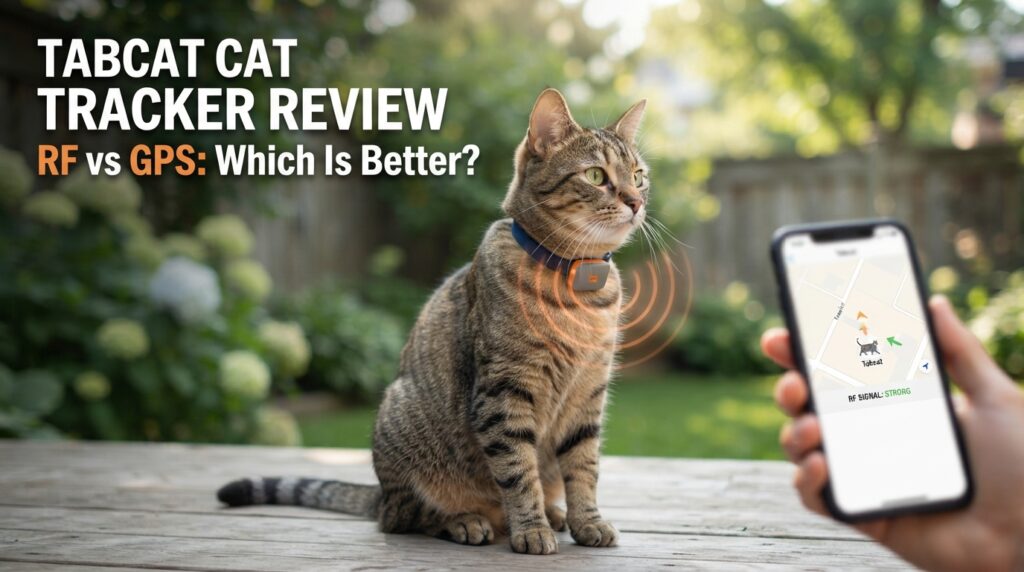
If you’ve searched for a Tabcat cat tracker review, you’ve probably also seen it compared to GPS cat collars — and the comparison isn’t as simple as “which one is better.” Tabcat and GPS trackers are built to solve two different problems, and picking the wrong one means paying for guidance your cat’s lifestyle doesn’t actually need.

- TRACK YOUR CAT EASILY: Our RF technology allows you to easily track your cat or kitten, much more accurate than GPS; thi…
- EASY TO USE LOCATOR: The accurate handset holder guides you to your cat with with just 1 button; lights change in real t…
- LIGHTWEIGHT FOR CATS & KITTENS: At just 0.2 Oz, smaller & lighter than the original, our light tracking tag is one of th…
This guide is based on Tabcat’s official specifications and publicly available GPS tracker documentation — not a hands-on lab test. Where a claim comes from the manufacturer rather than independent verification, we say so. Our goal is to help you match the right technology to your cat, not to push you toward one product.
Quick Verdict
Tabcat is a radio-frequency (RF) locator, not a GPS tracker. It doesn’t show your cat on a map, and it can’t tell you where your cat is from across town. What it does well is guide you, step by step, to a cat that’s hiding or has wandered a few hundred feet from home — through walls, under decks, behind sheds — with no subscription and no app.
If your cat is an indoor cat that occasionally bolts out the door, or an indoor/outdoor cat that stays in the neighborhood, Tabcat is often the more practical and affordable choice. If your cat roams blocks away, crosses streets, or you need to know its location while you’re at work or traveling, a cellular GPS tracker is the better tool. The rest of this Tabcat cat tracker review breaks down exactly why.
What Is Tabcat?
Tabcat (made by UK-based Loc8tor) is a directional radio-frequency locator built specifically for finding cats and kittens that are hiding or nearby. The system has two parts: a small handheld receiver and one or more lightweight tags that clip onto your cat’s existing collar. According to Tabcat’s own product documentation, the current model ships as a two-tag starter kit priced at $99.99, with a one-handset system that can track up to four tags — useful for multi-cat households.
There’s an important naming wrinkle worth flagging for accuracy: Tabcat’s US site currently markets the tracker as “Tabcat V6,” but the hardware itself is the “v2” tag-and-handset platform introduced in 2022, which is not cross-compatible with the original pre-2021 version. If you already own an older Tabcat handset, double-check compatibility before buying new tags — v1 and v2 tags and handsets don’t work together.
How Does Tabcat Work?
Tabcat uses radio-frequency (RF) signals, not satellites. The handset sends out a signal, the tag on your cat’s collar responds, and the handset translates the strength and direction of that response into audio beeps and flashing lights. As you get closer, the beeping speeds up and the lights fill in, guiding you toward your cat with — according to the manufacturer — precision down to about 1 inch once you’re close.
There’s no map, no GPS coordinates, and no phone required. You walk around with the handset, following the signal like a directional compass, until you physically locate your cat.
- TRACK YOUR CAT EASILY: Our RF technology allows you to easily track your cat or kitten, much more accurate than GPS; thi…
- EASY TO USE LOCATOR: The accurate handset holder guides you to your cat with with just 1 button; lights change in real t…
- LIGHTWEIGHT FOR CATS & KITTENS: At just 0.2 Oz, smaller & lighter than the original, our light tracking tag is one of th…
Is Tabcat Really a GPS Tracker?
No — and this is the single most misunderstood part of shopping for one. Despite showing up in searches for “GPS cat tracker,” Tabcat does not use GPS satellites, does not require cellular data, and does not produce a location on a map. It’s a short-range RF homing device. This distinction matters because it defines exactly what the product can and can’t do for your cat, which we’ll cover in detail below.
Tabcat RF vs. GPS vs. Bluetooth
Understanding the underlying technology explains why these three tracker types behave so differently in real-world use.
RF (radio-frequency) tracking, which Tabcat uses, works by direct signal exchange between a handheld receiver and a tag. It requires no internet, no app, and no ongoing service, but the tradeoff is a limited effective range and the need for you to actively search with the receiver in hand.
GPS tracking (the technology behind trackers like Tractive GPS) uses satellite positioning combined with a built-in cellular chip. The tracker calculates its coordinates from GPS satellites, then transmits that data over a cellular network to an app on your phone, giving you a live map location from virtually anywhere with coverage. This is why GPS trackers carry a monthly or annual subscription fee — you’re paying for the cellular data connection, not just the hardware.
Bluetooth tracking, used by AirTag-style devices, relies on short-range Bluetooth signals combined with a network of other people’s phones. The tag itself has no cellular or GPS chip; it simply broadcasts a signal that any nearby compatible phone can anonymously relay back to you. This makes it subscription-free like RF, but its ability to locate a moving pet depends entirely on how many compatible phones happen to be nearby.
| Feature | RF (Tabcat) | GPS + Cellular | Bluetooth (AirTag-style) |
|---|---|---|---|
| Live map | No | Yes | Only if crowd network detects it |
| Typical range | Up to ~500 ft, line-of-sight | Unlimited (cellular coverage) | ~15–30 ft direct; crowd-dependent beyond that |
| Indoor finding | Strong (works through walls) | Weak (GPS needs open sky) | Moderate, only very close range |
| Remote tracking | No | Yes | Limited, network-dependent |
| Subscription | None | Monthly or annual fee | None, but needs a compatible phone |
| Escape/geofence alerts | No | Yes | No |
| Location history | No | Yes, on most plans | No |
| Battery life | 3–12 months (replaceable) | Days, needs recharging | Months (replaceable) |
| Best use case | Hiding or nearby cats | Roaming, outdoor cats | Casual nearby-item finding |
Tabcat Key Features
- Directional audio and visual guidance, accurate to roughly 1 inch at close range, according to the manufacturer
- Works through doors, walls, and furniture for indoor searches
- One handset tracks up to 4 tags — useful for multi-cat homes
- No subscription, app, Wi-Fi, or cellular signal required
- Replaceable batteries rather than a rechargeable pack
- Compact, lightweight tag designed to sit comfortably on a cat’s collar
Tabcat Range: How Far Can It Really Track?
Tabcat’s own FAQ quotes a guideline range of 150 meters (500 feet), and is upfront that this is a best-case figure, not a guaranteed radius. In practice, real-world range depends on several factors:
- Walls, doors, and buildings reduce range, since RF signals weaken as they pass through solid materials
- Furniture and clutter inside a home can shorten effective range further
- Vegetation and terrain (dense bushes, hills, fences) absorb or block signal outdoors
- Line of sight dramatically increases range — Tabcat notes that a cat stuck up a tree with clear sightlines can be found at longer distances than the quoted figure
- Interference from other RF devices can occasionally affect performance
The takeaway: treat the 500-foot figure as a “best case with nothing in the way” number, not a circle you can draw on a map and trust. Indoors, expect meaningfully less; outdoors with a clear line of sight, you may get more.
For context on why this matters less than it might seem: peer-reviewed GPS tracking research on pet cat movement — including a multi-country study of nearly 1,000 cats — found that most cats spend the overwhelming majority of their outdoor time within about 330 feet of home. For a cat with typical roaming habits, that falls within Tabcat’s realistic working range. For an outlier cat that regularly wanders farther, it won’t.
- TRACK YOUR CAT EASILY: Our RF technology allows you to easily track your cat or kitten, much more accurate than GPS; thi…
- EASY TO USE LOCATOR: The accurate handset holder guides you to your cat with with just 1 button; lights change in real t…
- LIGHTWEIGHT FOR CATS & KITTENS: At just 0.2 Oz, smaller & lighter than the original, our light tracking tag is one of th…
Battery Life
Tabcat uses replaceable batteries rather than a rechargeable lithium pack: the handset takes a single CR2032 coin cell, and each tag uses two SR1130 (or GP389) button batteries. Tabcat’s manufacturer specifications state tag battery life of 3 to 12 months depending on how often you activate a search, and some third-party retailers recommend replacing tag batteries every 4 to 6 months as a safety margin so you’re never caught with a dead tag during an actual search.
The advantage of replaceable batteries is that you never have to remove the tag from your cat’s collar to recharge it — a real practical difference from most GPS collars, which need to come off weekly (or every few days with heavy use) for charging. The tradeoff is a small ongoing cost for replacement batteries and the need to remember to check them periodically. Compare that to typical GPS trackers, where battery life is commonly measured in days rather than months, because the tracker is constantly powering GPS positioning and a cellular radio.
Size and Weight for Cats
Tabcat’s tag is one of its strongest selling points for cat comfort. Manufacturer listings put the tag at roughly 0.18–0.21 ounces (about 5–6 grams) and around 1.18 x 0.79 x 0.35 inches — small enough that Tabcat markets it as suitable for kittens as well as adult cats. Lighter tags matter because a bulky or heavy accessory can cause discomfort, irritation, or behavior changes in small or nervous cats, and GPS trackers — which need a battery large enough to power satellite and cellular radios — typically weigh noticeably more (often 1 to 1.5 ounces or more).
The tag attaches to your cat’s existing collar rather than replacing it, so it can be used with a breakaway collar. That matters for safety: veterinary and animal-welfare organizations, including the BC SPCA, recommend breakaway (quick-release) collars for cats specifically because they release if snagged on a fence, branch, or furniture, reducing the risk of choking or entanglement injuries — even for cats that mostly stay indoors. Never use a non-breakaway collar to mount any tracker, no matter how light it is.
Indoor vs. Outdoor Use
Tabcat is purpose-built for close-range, obstacle-heavy searching, which makes it particularly effective for:
- Indoor cats hiding under beds, in closets, or behind furniture
- Cats that duck into a garage, basement, or crawlspace
- A cat hiding under a deck or porch
- A backyard escape where the cat is still on the property or next door
Outdoors, its usefulness drops off with distance and terrain. It’s genuinely effective in a yard or immediate neighborhood, less reliable across open fields, wooded areas, or busy multi-block searches — situations where a live GPS map is far more useful.
Compare GPS tracker technology and how it handles outdoor tracking →
Tabcat vs. GPS Cat Trackers
This is the real decision most shoppers are trying to make, so it’s worth laying it out plainly.
Tabcat tends to be the better choice when:
- Your cat is primarily indoors and might slip out occasionally
- Your cat roams but typically stays in the yard or immediate neighborhood
- You don’t want a monthly subscription
- You want the lightest possible tag
- You live somewhere with poor cellular coverage
- You’d rather have months of battery life than a rechargeable device
GPS is the better choice when:
- Your cat regularly roams several blocks or crosses streets
- Your cat is a full-time outdoor or barn cat
- You want to see a live map location, not just a directional signal
- You need geofence/escape alerts sent to your phone
- You want location history to understand your cat’s patterns
- You travel and want to check your cat’s location remotely
Neither is a universal upgrade over the other — they’re solving different problems, and plenty of multi-cat households end up using both: Tabcat for quick, everyday hide-and-seek, and a GPS tracker (like the options covered in our GPS trackers for active outdoor pets guide) for a cat that genuinely roams.
- TRACK YOUR CAT EASILY: Our RF technology allows you to easily track your cat or kitten, much more accurate than GPS; thi…
- EASY TO USE LOCATOR: The accurate handset holder guides you to your cat with with just 1 button; lights change in real t…
- LIGHTWEIGHT FOR CATS & KITTENS: At just 0.2 Oz, smaller & lighter than the original, our light tracking tag is one of th…
Tabcat vs. GPS Comparison Table
| Tabcat (RF) | Typical Cellular GPS Cat Tracker | |
|---|---|---|
| Technology | Radio-frequency (RF) | GPS + cellular (LTE) |
| Location method | Directional signal strength | Satellite coordinates via app map |
| Live map | No | Yes |
| Range | Up to ~500 ft, line-of-sight | Effectively unlimited with coverage |
| Subscription | None | Monthly or annual (commonly $5–$13/mo or ~$96–$130/yr) |
| Battery | 3–12 months, replaceable | Roughly 5–7 days typical, up to ~14 days in power-saving mode; rechargeable |
| Tag weight | ~0.18–0.21 oz | Roughly 0.9–1.5 oz depending on model |
| Escape/geofence alerts | No | Yes |
| Location history | No | Yes, on most plans |
| Indoor tracking | Strong (through walls) | Weak (GPS needs sky visibility) |
| Cellular requirement | No | Yes |
| Best for | Hiders, indoor/near-home cats | Roamers, outdoor/adventure cats |
Specifications shown for a representative modern cat GPS tracker; exact figures vary by brand and model, so check current GPS tracker specifications before buying.
Tabcat vs. AirTag
Apple’s AirTag is a different animal from both RF and GPS trackers, and it’s worth a dedicated comparison since it’s frequently suggested as a cheap cat-tracking option.
AirTag uses Bluetooth Low Energy along with an Ultra Wideband chip for what Apple calls Precision Finding. According to Apple’s own support documentation, Precision Finding guides you to a nearby item using your iPhone’s camera, motion sensors, and Ultra Wideband radio — but this only works at close Bluetooth range, roughly 15 to 30 feet, and only with compatible iPhone models.
Beyond that direct range, AirTag relies on Apple’s Find My network: any nearby iPhone or iPad, from any owner, can anonymously detect a lost AirTag and relay its approximate location back to you. This “crowd-assisted finding” is clever for stationary lost items like keys, but for a moving cat it’s inherently unreliable — it only works if another Apple device happens to be nearby at the right moment, and Apple designed the product around finding personal items, not tracking a living, moving animal.
| Tabcat | AirTag | |
|---|---|---|
| Technology | RF, dedicated handheld receiver | Bluetooth + Ultra Wideband |
| Direct finding | Up to ~500 ft, any phone/device | ~15–30 ft, compatible iPhone only |
| Beyond direct range | No coverage | Depends on nearby Apple devices |
| Subscription | None | None |
| Smartphone required | No | Yes (iPhone for full features) |
| Battery | 3–12 months (tag) | About a year, replaceable CR2032 |
| Best use case | Actively searching for a hiding/nearby cat | Passive backup, dense Apple-device areas |
If you’re weighing this option seriously, our AirTag and GPS comparison goes deeper into how Bluetooth crowd-finding stacks up against true GPS tracking for pets.
Who Should Buy Tabcat?
- Owners of primarily indoor cats who occasionally slip outside
- Multi-cat households wanting a low-cost, subscription-free way to track several cats with one handset
- Owners whose cats tend to hide rather than roam far
- Anyone who wants the lightest possible tag for a small cat or kitten
- Shoppers who specifically want a no-subscription cat tracker and don’t need remote/live tracking
- People in rural areas with unreliable cell coverage, where a cellular GPS tracker would struggle anyway
Who Should NOT Buy Tabcat?
- Owners of cats that regularly roam several blocks or more
- Full-time outdoor or barn cats with a large territory
- Anyone who needs a live map view of their cat’s location
- Owners who want automatic alerts when a cat leaves a set boundary
- Anyone who wants to review where their cat has been over time
- Frequent travelers who need to check on their cat’s location remotely
If any of those describe your situation, a GPS tracker — despite the subscription cost — will do a job Tabcat simply isn’t designed for.
Waterproofing and Weather Resistance
Tabcat’s tags are described by the manufacturer as splash-resistant and suitable for rain and damp grass, but Tabcat does not publish a formal IP (ingress protection) rating, and the tag is not marketed as waterproof. That’s an important distinction: splash-resistant means it can handle light rain or morning dew, not submersion in a pond, bath, or puddle. If your cat swims, wades regularly, or spends significant time in wet conditions, a tracker with a certified waterproof rating (many GPS collars carry an IP67 or similar rating) is the safer choice.
Pricing and Long-Term Value
Here’s where the “no subscription” pitch actually plays out in dollars. Tabcat’s US starter kit (handset plus two tags) currently lists at $99.99 — a one-time purchase covering up to two cats, with the option to add up to two more tags for larger households. There’s no recurring fee after that.
A GPS tracker, by contrast, typically costs less upfront for the hardware (commonly $40–$50) but adds a recurring subscription, often running roughly $5–$13 per month or somewhere around $96–$130 if paid annually, depending on the plan and provider. Over a single year, that subscription alone can approach or exceed Tabcat’s full one-time price — and it continues year after year, and again for each additional cat if you’re not on a multi-pet plan.
The math favors Tabcat for pure long-term cost, especially in multi-cat households — but that comparison only makes sense if Tabcat’s short-range capabilities actually meet your needs. Paying less for a tool that can’t do what you need it to do isn’t good value. Verify current pricing directly with the retailer before purchase, since both categories adjust prices and promotions regularly.
Check the current Tabcat price → · Compare no-subscription pet trackers →
- TRACK YOUR CAT EASILY: Our RF technology allows you to easily track your cat or kitten, much more accurate than GPS; thi…
- EASY TO USE LOCATOR: The accurate handset holder guides you to your cat with with just 1 button; lights change in real t…
- LIGHTWEIGHT FOR CATS & KITTENS: At just 0.2 Oz, smaller & lighter than the original, our light tracking tag is one of th…
What Tabcat Cannot Do
To be clear and avoid overselling the product, Tabcat does not provide:
- GPS coordinates or satellite-based positioning
- A live map view on your smartphone
- Remote tracking from another city, or while you’re away from your cat’s general area
- Geofence or escape alerts
- Travel or route history
- Cellular connectivity of any kind
- Continuous, passive location updates — it only works when you’re actively searching with the handset in hand
If any of those capabilities are must-haves for your situation, no amount of range or battery life will make Tabcat the right fit — you need GPS.
Realistic Cat Scenarios: Which Tool Wins?
| Scenario | Better Tool | Why |
|---|---|---|
| Cat hiding under furniture | Tabcat | RF works through walls at close range; GPS can’t see indoors |
| Cat hiding in the garage | Tabcat | Same close-range, indoor-capable advantage |
| Cat hiding under a deck | Tabcat | Short-range, obstacle-heavy search suits RF guidance |
| Cat escapes into the backyard | Tabcat | Well within typical RF range |
| Cat disappears into nearby bushes | Tabcat, usually | Works if within a few hundred feet; GPS if the search expands |
| Indoor cat accidentally escapes | Tabcat, first response | Most escaped indoor cats stay close; RF search is often enough |
| Outdoor cat roaming several blocks | GPS | Exceeds Tabcat’s effective range |
| Apartment cat | Tabcat | Small space, mostly indoor, minimal roaming |
| Rural cat with large territory | GPS | Wide-open space favors satellite range over RF |
Pros and Cons
| Pros | Cons |
|---|---|
| No subscription, ever | Short effective range (a few hundred feet at best) |
| Very lightweight tag, good for kittens | No live map or app |
| Long battery life (months, not days) | No escape alerts or geofencing |
| Works well through walls and indoors | No location history |
| Simple, no-app operation | Requires active searching, not passive tracking |
| Tracks up to 4 cats on one handset | Not a true waterproof rating |
| One-time cost, good long-term value for close-range use | Useless once a cat is beyond signal range |
Is Tabcat Worth It?
For the right cat, yes. If your cat’s “getting lost” usually means hiding somewhere in or around the house rather than genuinely roaming, Tabcat solves that problem well, cheaply, and permanently — no monthly bill, no app to maintain, no battery to charge weekly. For a cat with a wider territory, though, the low price and long battery life don’t offset the hard ceiling on range: past a few hundred feet, Tabcat simply has nothing to tell you.
Final Verdict: Is Tabcat Better Than GPS for Cats?
There’s no universal answer — it depends entirely on your cat.
Tabcat can be better than GPS for a cat that’s likely hiding nearby, because it’s lightweight, subscription-free, and purpose-built for close-range, directional finding through the exact obstacles — walls, furniture, sheds — where hiding cats end up. For that use case, a live map is arguably overkill; you need a “warmer/colder” signal, and that’s exactly what Tabcat delivers.
GPS is substantially better for cats that roam farther, because it provides remote location, mapping, and coverage well beyond what any RF device can reach — at the cost of an ongoing subscription and shorter battery life between charges.
The right call comes down to matching the tool to your cat’s actual behavior, not to which product markets itself more aggressively as “better.” If you’re still unsure which category fits, our Tractive GPS guide and outdoor GPS tracker roundup can help you compare specific GPS options against what you’ve read here.
FAQs
Is Tabcat actually GPS? No. Tabcat uses radio-frequency (RF) technology, not GPS satellites. It provides directional guidance to a nearby tag rather than map coordinates.
How far can Tabcat track a cat? Tabcat’s manufacturer quotes a guideline range of up to 150 meters (500 feet) in clear line-of-sight conditions. Walls, buildings, and vegetation reduce that range indoors or in obstructed areas.
Does Tabcat require a monthly subscription? No. Tabcat is a one-time purchase with no subscription, app fees, or data plan required.
Does Tabcat work indoors? Yes, and it’s one of Tabcat’s strongest use cases — the RF signal can pass through doors, walls, and furniture, which GPS cannot do reliably.
Is Tabcat better than GPS for indoor cats? For most indoor cats that occasionally escape or hide, yes — the combination of indoor signal penetration, no subscription, and lightweight tag makes Tabcat a practical first choice.
Can Tabcat find a cat that is miles away? No. Tabcat’s effective range tops out at roughly 500 feet under ideal conditions. A cat that’s genuinely miles from home requires a cellular GPS tracker or other search methods.
How long does the Tabcat battery last? The manufacturer states 3 to 12 months per tag depending on usage, with a CR2032 battery in the handset. Some retailers recommend replacing tag batteries every 4 to 6 months as a precaution.
Is Tabcat waterproof? No. Tabcat tags are splash-resistant, not waterproof, and are not submersion-rated. Avoid full water exposure.
Tabcat vs. AirTag: which is better? They solve different problems. Tabcat offers longer, more reliable direct-search range using a dedicated receiver; AirTag relies on Apple’s crowd-sourced Find My network beyond its short Bluetooth range, which is less predictable for a moving pet.
Tabcat vs. GPS: which should cat owners choose? Choose Tabcat for indoor or close-roaming cats and a subscription-free setup. Choose GPS for cats that roam widely, or if you need live maps, escape alerts, and location history.
Pricing, specifications, and battery figures reflect manufacturer-published information at the time of writing and are subject to change. Always verify current specs and pricing directly with the retailer before purchasing.