
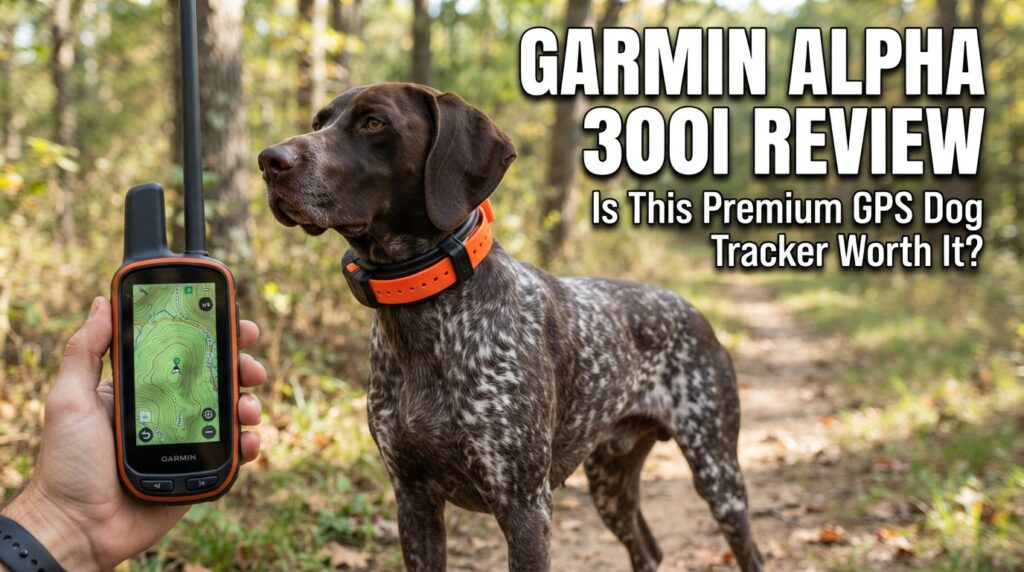
The Garmin Alpha 300i is a $849.99 handheld GPS unit built to track and train hunting and working dogs at ranges of up to 9 miles, with built-in inReach satellite messaging for areas that have no cell coverage at all. It is not a smartphone-based pet tracker — it’s a dedicated radio-and-GPS system that requires a compatible tracking collar (like the TT25) and, if you want satellite messaging, a separate monthly subscription. It costs significantly more than a Tractive or Fi collar because it’s solving a different problem: staying connected to dogs and to other people in places where cellular networks simply don’t reach.

- Features a vivid sunlight-readable 3.5” capacitive touchscreen display and a button-operated, dog-focused design for qui…
- Easily set up and monitor up to 20 dogs with your compatible dog collars from up to 9 miles away (depending on your dog …
- With an Outdoor Maps+ subscription, you have access to a wide variety of premium mapping content that is regularly updat…
Whether that’s worth it to you depends almost entirely on where you use your dog and what you’re using it for. This review breaks down the real specs, the real costs, and who actually needs this level of hardware — and who doesn’t.
Quick Verdict
| Best for | Hunting dog owners, working dog handlers, and rural/off-grid users who regularly lose cell service |
| Tracking technology | GPS/GNSS positioning + dedicated VHF radio link between handheld and collar (up to 9 mi.) |
| Cellular service required for dog tracking? | No — dog-to-handheld tracking works entirely off-grid |
| inReach subscription required? | Only if you want satellite messaging/SOS; not required for basic dog tracking |
| Battery (handheld) | Up to 55 hours; up to 50 hours with inReach enabled |
| Display | 3.5″ transflective color touchscreen, 282 x 470 resolution |
| Waterproof rating | IPX7 |
| Multi-dog capability | Tracks up to 20 dogs/devices simultaneously; stores up to 250 dog profiles |
| Compatible collars | TT25, T20, TT15X, TT15, TT15 Mini, T5, T5X, T5 Mini (sold separately) |
| Main advantage | Reliable dog tracking with zero dependence on cell towers, plus satellite SOS as a safety net |
| Main drawback | High total cost once you add a collar and, if you want it, an inReach plan |
Garmin Alpha 300i Key Specifications
All specifications below are drawn from Garmin’s official Alpha 300i owner’s manual and product listing.
| Spec | Detail |
|---|---|
| Dimensions (handheld) | 2.7 x 6.4 x 1.3 in. (6.8 x 16.2 x 3.4 cm), excluding antenna |
| Weight | 9.9 oz (280 g) with standard antenna and battery |
| Display | 3.5 in. diagonal, transflective color TFT touchscreen, 282 x 470 px |
| Battery | Rechargeable lithium-ion; up to 55 hrs, up to 50 hrs with inReach enabled |
| Water rating | IPX7 |
| Internal storage | 16 GB, plus microSD card slot |
| Connectivity | Wi-Fi, Bluetooth LE, ANT+ |
| VHF/radio range (collar-to-handheld) | Up to 14.5 km (9 mi.) |
| Maps | Preloaded TOPOActive; downloadable satellite imagery (no subscription required); optional Outdoor Maps+ |
| Dog tracking capacity | Up to 20 dogs/devices simultaneously; up to 250 stored dog profiles |
| Compatible collars | TT25, T20, TT15X, TT15, TT15 Mini, T5, T5X, T5 Mini |
| inReach | Built-in; separate satellite subscription required for messaging/SOS |
| Price (handheld only) | $849.99 |
- Features a vivid sunlight-readable 3.5” capacitive touchscreen display and a button-operated, dog-focused design for qui…
- Easily set up and monitor up to 20 dogs with your compatible dog collars from up to 9 miles away (depending on your dog …
- With an Outdoor Maps+ subscription, you have access to a wide variety of premium mapping content that is regularly updat…
What Is the Garmin Alpha 300i?
The Alpha 300i is a handheld GPS device built specifically for tracking and training dogs that work out of sight — hunting dogs, field trial dogs, and working breeds that range far from their handler. It’s not a stand-alone tracker: the system requires three pieces working together.
- The Alpha 300i handheld, which you carry and use to view your dog’s location, send training commands, and (optionally) send satellite messages.
- A compatible tracking collar, such as the TT25, which goes on the dog and reports its GPS position back to the handheld.
- The dog.
The handheld itself doesn’t do anything useful for dog tracking on its own — you need a compatible collar sold separately, which is a major line item most buyers overlook when comparing sticker prices to consumer pet trackers. If you’re weighing this against Garmin’s own Alpha 200i, the same rule applies there too.
How Garmin Alpha 300i Tracks Dogs
The Alpha 300i uses two distinct technologies that are easy to conflate but work very differently.
First, the collar itself determines the dog’s exact position using GPS and Galileo satellite signals, the same global positioning system used by phones and cars. That part of the equation has effectively unlimited range, because GPS satellites cover the entire globe.
The limitation isn’t the GPS — it’s how that location data gets from the collar to your handheld. The collar transmits its position over a dedicated VHF radio link, and that link is rated for a maximum range of up to 9 miles under ideal, open, line-of-sight conditions. This radio connection is what breaks down in real-world terrain, not the GPS positioning itself.
This is the core difference between the Alpha 300i and a cellular GPS tracker: a cellular device (like Tractive) relays position data through a phone network, so its practical range depends on cell tower coverage. The Alpha 300i relays it through a direct radio link between two devices you own, so it works with zero cell towers in range — but its range depends on terrain and line of sight instead.
Garmin Alpha 300i Battery Life
Garmin rates the Alpha 300i handheld at up to 55 hours on a charge, dropping to up to 50 hours if you have inReach satellite technology enabled. That’s roughly triple the runtime of the older Alpha 200i, which is rated for 20 hours (15 with inReach on).
A few things affect real-world battery life:
- Screen use. Leaving the touchscreen on and actively navigating maps drains the battery faster than using the top hot-buttons in “touchscreen-free” mode.
- Temperature. Lithium-ion batteries lose capacity in cold weather, which matters for late-season hunts.
- inReach activity. Sending frequent satellite messages or using short tracking intervals uses more power than leaving inReach idle.
- Backlight and Wi-Fi. Both draw additional power when active.
The collar side has its own separate battery. The TT25’s standard battery is rated up to 68 hours on the dynamic update rate, dropping to about 25 hours if you force a constant 2.5-second update rate, or extending to roughly 84 hours on a slower 2-minute update rate. An optional extended battery pack roughly doubles that runtime for multi-day trips. Garmin’s manufacturer figures assume optimal conditions; expect real-world battery life to run somewhat shorter, particularly in cold weather or with heavy screen use. Carrying a portable USB-C power bank is a practical way to extend a multi-day hunt without needing to swap hardware.
Garmin Alpha 300i Range
Garmin’s official spec is a VHF wireless range of up to 9 miles (14.5 km) between the collar and handheld. That number is achievable, but only under close to ideal conditions — flat, open terrain with a clear line of sight between you and your dog.
In practice, range drops noticeably with:
- Hills and ridgelines that physically block the radio signal
- Dense vegetation and hardwoods, which absorb and scatter VHF signals
- Valleys and low ground, where the dog and handheld lose line of sight to each other
- Other radio interference in congested hunting areas, though the Alpha 300i includes channel monitoring to help you pick a less congested frequency
If you hunt mostly in open prairie or sagebrush country, you can expect tracking that holds up reasonably close to the rated range. If you hunt thick timber or steep terrain, plan for meaningfully less — this is a real limitation of any VHF-based system, not a defect specific to this device. Garmin does not publish a guaranteed real-world range figure, and no manufacturer honestly could, since terrain varies too much from one hunt to the next.
Garmin Alpha 300i inReach
This is the section most buyers get confused about, so it’s worth being precise: inReach is a completely separate system from dog tracking.
Dog-to-handheld tracking uses the VHF radio link described above and needs no subscription of any kind. inReach, on the other hand, is Garmin’s satellite communication service, using the Iridium satellite network to let you:
- Send and receive text messages with anyone, anywhere on earth, even with zero cell signal
- Trigger an interactive SOS to Garmin’s 24/7 emergency response coordination center
- Check basic, premium, or marine weather forecasts from the field
- Share your live location with people back home via Garmin’s MapShare
inReach requires an active satellite subscription to function — without one, the SOS button, messaging, and satellite tracking-sharing features are inactive. You can absolutely use the Alpha 300i purely for dog tracking without ever activating inReach; you’ll just lose the safety-net messaging and SOS functionality that sets the “i” models apart from the base Alpha 300.
Does Garmin Alpha 300i Require a Subscription?
No — not for its core function. Here’s how the costs actually break down:
- Basic dog tracking (collar-to-handheld): No subscription required, ever. This works over the built-in VHF radio link at no ongoing cost.
- inReach satellite messaging/SOS: Optional, but requires an active plan if you want it. As of 2026, Garmin’s consumer inReach plans are:
| Plan | Monthly Price | Texts/Weather | Photo/Voice | Live Tracking |
|---|---|---|---|---|
| Enabled | $7.99 | Pay-per-use ($0.50/text) | Pay-per-use | $0.10/point |
| Essential | $14.99 | 50 included | 10 included | $0.10/point (10-min+) |
| Standard | $29.99 | 150 included | 25 included | Unlimited (10-min+) |
| Premium | $49.99 | Unlimited | 50 included | Unlimited (2-min+) |
All plans carry a one-time $39.99 activation fee, are billed month-to-month with a 30-day minimum commitment, and can be suspended when you’re not using the device. Pricing is set by Garmin and can change, so confirm current rates on Garmin’s inReach plan page before buying.
- Optional mapping: Garmin’s Outdoor Maps+ service, compatible with the Alpha 300 series, is a $49.99/year add-on for premium satellite imagery, elevation shading, and land ownership data beyond what’s preloaded. The base TOPOActive maps and direct-to-device satellite imagery download come included at no extra cost.
- Other services: None required for the device to function as a dog tracker.
If your priority is simply knowing where your dog is, you can buy the Alpha 300i, pair it with a collar, and never pay Garmin another dime. If you also want the safety net of satellite SOS and messaging, budget for one of the inReach plans above.
Garmin Alpha 300i + TT25 Collar
The handheld is only half the system — you need a compatible collar to actually track a dog, and the TT25 is Garmin’s current flagship collar for this purpose.
- Tracking: Reports position back to the handheld at up to a 2.5-second update rate, out to the same 9-mile radio range.
- Pairing: Pairs directly with the Alpha 300i (and other Alpha-series and Pro 550 Plus handhelds); setup is a guided, menu-driven process.
- Battery: Up to 68 hours on the standard battery at the dynamic update rate; an extended battery pack roughly doubles that for multi-day trips.
- Durability: Rugged, waterproof housing with a replaceable flex band designed to fit a wide range of breed sizes.
- Training functionality: The TT25 includes 18 levels of momentary and continuous stimulation, plus tone and vibration, controllable from the handheld.
At $349.99, the collar roughly doubles the real cost of getting started, which is the single biggest thing shoppers miss when they see “$849.99” and assume that’s the full price of a working system. If you’re comparing bundle pricing, Garmin and its retailers sell an Alpha 300i + TT25 bundle for around $1,199.98, which is close to buying both separately.
For a broader look at collar options beyond the TT25, PetTrackerHub’s guide to GPS trackers for hunting and working dogs covers the wider Garmin lineup and its price points.
[Check the current Garmin Alpha 300i + TT25 bundle price and availability →]
- Features a vivid sunlight-readable 3.5” capacitive touchscreen display and a button-operated, dog-focused design for qui…
- Easily set up and monitor up to 20 dogs with your compatible dog collars from up to 9 miles away (depending on your dog …
- With an Outdoor Maps+ subscription, you have access to a wide variety of premium mapping content that is regularly updat…
Garmin Alpha 300i Tracking & Mapping
The 3.5-inch touchscreen shows dog positions, track history, distance, and speed for each collared dog, updating as fast as every 2.5 seconds. TOPOActive maps come preloaded at no extra cost, and you can download satellite imagery directly to the device without a subscription — a genuine step up from older Garmin handhelds that gated imagery behind a paid plan.
For hunters, the most valuable features are dog status indicators (on point, treed, running), group management for switching between multiple hunting parties, and the ability to review a full track log after the hunt. For a non-hunting owner, most of this — hunt-specific status flags, multi-party group switching, training command menus — simply goes unused. That’s a meaningful part of why this device is overkill for a typical suburban dog owner; you’re paying for a feature set built around a use case you may never touch.
Garmin Alpha 300i Training Features
When paired with a training-capable collar like the TT25, the Alpha 300i can issue tone, vibration, or 18 levels of momentary/continuous electrical stimulation from the handheld. These are standard e-collar training tools used widely in gun dog and field trial training.
We won’t tell you whether stimulation-based training is right for your dog — that’s a personal and often contentious decision. What we will say is that this hardware is a tool, not a training method. If you’re new to e-collar training, work with a qualified trainer or reputable, humane training resource before relying on stimulation as your primary correction method, and always start at the lowest effective level.
Garmin Alpha 300i Multiple-Dog Tracking
The Alpha 300i can track up to 20 dogs or devices simultaneously and store profiles for up to 250 dogs, with dog list and group management tools that let you switch between hunting parties without re-entering every dog each time. For anyone running a kennel, guiding hunts, or regularly hunting with a group, this is a genuine practical advantage over single-dog consumer trackers — you’re not paying for and managing a separate app or subscription per dog.
Garmin Alpha 300i vs Garmin Alpha 300
| Alpha 300 | Alpha 300i | |
|---|---|---|
| Dog tracking | Yes, up to 9 mi. | Yes, up to 9 mi. |
| inReach satellite messaging/SOS | No | Yes (subscription required to activate) |
| Battery | Up to 55 hrs | Up to 55 hrs; 50 hrs with inReach enabled |
| Display | 3.5″ touchscreen | 3.5″ touchscreen |
| Maps | TOPOActive preloaded, satellite imagery, Outdoor Maps+ compatible | Same |
| Price (handheld only) | $799.99 | $849.99 |
The two devices are functionally identical for dog tracking, training, and mapping. The entire difference is the built-in inReach satellite radio. If you hunt in areas with reasonable cell coverage or you’re always hunting with a group nearby, the base Alpha 300 saves you $50 up front and the ongoing cost of a subscription you’d never use. If you regularly hunt remote country where a phone is useless and a satellite SOS could matter, the $50 premium for the 300i is easy to justify — assuming you’re also willing to pay for an inReach plan when you need it.
Garmin Alpha 300i vs Garmin Alpha 200i
| Alpha 200i | Alpha 300i | |
|---|---|---|
| Released | 2020 | Current generation |
| Battery | Up to 20 hrs; 15 hrs with inReach | Up to 55 hrs; 50 hrs with inReach |
| Display | 3.5″ touchscreen, same resolution | 3.5″ touchscreen, same resolution |
| USB | Micro-USB | USB-C |
| inReach | Built-in, subscription required to activate | Built-in, subscription required to activate |
| Usability | 6-button + touchscreen | 6-button + touchscreen, with expanded touchscreen-free control options |
| Price (handheld only) | $749.99 | $849.99 |
Should Alpha 200i owners upgrade? It depends on how you use the device. The headline improvement is battery life — nearly triple the runtime — which matters a great deal if you’re regularly out for multi-day hunts or find yourself hunting for extra charge time in the field. If your current 200i’s battery comfortably gets you through your typical hunting day and you’re not bothered by micro-USB charging, there’s a reasonable case for skipping this generation. If short battery life has been a recurring frustration, or your 200i is aging and due for replacement anyway, the 300i is a meaningful upgrade rather than an incremental one.
For a closer side-by-side on the 200i specifically, see PetTrackerHub’s Garmin Alpha 200i review.
[See current Garmin Alpha 300i handheld and bundle pricing →]
- Features a vivid sunlight-readable 3.5” capacitive touchscreen display and a button-operated, dog-focused design for qui…
- Easily set up and monitor up to 20 dogs with your compatible dog collars from up to 9 miles away (depending on your dog …
- With an Outdoor Maps+ subscription, you have access to a wide variety of premium mapping content that is regularly updat…
Garmin Alpha 300i vs Tractive GPS
This is the comparison that matters most if you’re deciding between “premium off-grid system” and “affordable everyday tracker,” so it’s worth being explicit about what each product is actually built for.
| Garmin Alpha 300i | Tractive GPS | |
|---|---|---|
| Tracking technology | GPS/GNSS + dedicated VHF radio link | GPS + cellular (LTE/2G) network |
| Network dependence | None for dog tracking | Requires active cell coverage |
| Tracking range | Up to 9 mi. (line of sight, VHF) | Effectively unlimited, anywhere with cell signal |
| Subscription | Optional (only for inReach features) | Required for any functionality |
| Battery (tracker) | Up to 68 hrs (TT25 collar) | Roughly 7 days typical |
| Smartphone requirement | No — dedicated handheld | Yes — app is the primary interface |
| Dedicated handheld | Yes | No |
| Multiple dogs | Up to 20 simultaneously | One subscription per tracker |
| Maps | Preloaded topo maps, downloadable satellite imagery | Standard mobile map view |
| Training/e-collar functions | Yes, with compatible collar | No |
| Off-grid capability | Full — works with zero cell coverage | None — needs cellular network |
| Emergency communication | inReach satellite SOS (subscription required) | None beyond app alerts |
| Price (device) | $849.99 handheld + ~$349.99 collar | Roughly $35–$70 |
| Best use case | Hunting/working dogs in remote or off-grid terrain | Everyday pets in areas with cell coverage |
The Alpha 300i is designed around off-grid, radio-based tracking for dogs that work out of sight in places cell towers don’t reach. Tractive is designed around cellular GPS tracking relayed through a smartphone app, which makes it far cheaper and simpler for everyday use, but useless the moment you’re outside cell coverage.
Neither is universally better. A suburban dog owner who mainly wants to know if their dog slips out of the yard is almost always better served by a low-cost cellular tracker like Tractive. A bird hunter running dogs through hardwoods with no cell service two counties over needs the Alpha 300i’s radio link, because Tractive simply won’t function there. For active dogs that split time between town and trail, PetTrackerHub’s roundup of GPS trackers for active and outdoor dogs covers options in between these two extremes.
Pros and Cons
Pros:
- Works with zero cell service — tracking doesn’t depend on network coverage at all
- Long battery life (up to 55 hours) relative to older Alpha models
- Dedicated handheld with a real screen, rather than relying on a phone
- Preloaded topo maps and free satellite imagery downloads
- Tracks up to 20 dogs simultaneously
- Rugged, IPX7-rated outdoor design
- Optional inReach satellite messaging and SOS for genuine off-grid safety
- Advanced hunting-specific features (dog status, group management, channel monitoring)
Cons:
- High upfront cost, especially once a collar is added
- Requires a separate, compatible tracking collar sold at additional cost
- Real learning curve for anyone unfamiliar with Garmin’s handheld ecosystem
- inReach features require an additional recurring subscription
- Outdoor Maps+ premium mapping is a further optional cost
- VHF radio range degrades meaningfully in hills, valleys, and dense woods
- Significant overkill for the average pet owner who just wants basic location tracking
Real-World Limitations
No review of this device is complete without a clear look at where it falls short, because these are genuine trade-offs rather than nitpicks:
- Line-of-sight dependence. The 9-mile range figure assumes open, flat terrain. Hills, ridges, and valleys physically block VHF radio waves, and real-world range can drop substantially in broken terrain.
- Dense vegetation. Thick hardwoods and heavy brush absorb and scatter radio signals, shrinking effective range compared to open prairie or field conditions.
- Radio interference. In areas with many hunters running similar devices, channel congestion can be a factor, though the Alpha 300i’s channel-monitoring feature helps mitigate this.
- Battery reality vs. rated spec. Manufacturer battery figures assume optimal conditions; cold weather, heavy touchscreen use, and active inReach messaging will reduce real-world runtime below the rated maximum.
- Learning curve. First-time Garmin users should expect to spend real time learning the menu structure, button layout, and setup process before the device feels intuitive in the field.
- Size and weight. At 9.9 oz plus a separate collar unit, this is bulkier gear than a small consumer pet tracker, which matters if you’re weight-conscious about field gear.
- Total cost. Between the handheld, collar, and optional subscriptions, the full system easily runs well over $1,000 before any accessories.
Who Should Buy Garmin Alpha 300i?
Excellent fit:
- Hunting dog owners (bird dogs, hounds, retrievers) who need reliable range in the field
- Working dog handlers managing dogs on job sites or large properties
- Rural or off-grid users who regularly operate with zero cell service
- Owners who consistently lose cellular coverage where they exercise or hunt their dogs
- Multi-dog households or kennels tracking several dogs at once
Possible fit:
- Serious outdoor adventurers who want a dedicated GPS handheld alongside dog tracking
- Large-property owners covering acreage beyond typical suburban lots
- Users who specifically want dedicated handheld navigation, not just dog tracking
Poor fit:
- Average urban or suburban pet owners with reliable cell coverage
- Owners who only need basic “did my dog escape the yard” alerts
- Buyers who want a lightweight, phone-based tracking app rather than separate hardware
- Anyone on a limited budget who won’t use the hunting- and terrain-specific features
Is Garmin Alpha 300i Worth It?
Worth considering if:
- You regularly work dogs in terrain with no reliable cell service
- You need the safety net of satellite SOS when you’re genuinely off-grid
- You run multiple dogs and want one system to manage all of them
- The training and hunting-specific features (dog status, group management) will actually get used
Probably unnecessary if:
- You mainly need to know if your dog wandered off in a neighborhood or park with cell coverage
- Your budget is a primary constraint and a $35–$70 cellular tracker would cover your actual needs
- You don’t hunt or work dogs in remote terrain where VHF range and off-grid safety matter
The premium price of the Alpha 300i buys a specific capability: dog tracking that works with zero dependence on cell infrastructure, backed by an optional satellite safety net. If that capability solves a real problem for how and where you use your dog, the cost is justified by what it does. If it doesn’t — if you’re always within cell range anyway — you’re paying for range and off-grid features you’ll never actually need.
Alternatives
- Garmin Alpha 300: Same tracking and training hardware without built-in inReach, at a $50 lower price — the better choice if you don’t need satellite messaging.
- Garmin Alpha 200i: The previous generation, still sold new in some channels; a lower-cost entry point into the Alpha ecosystem with meaningfully shorter battery life.
- Tractive GPS: A cellular, app-based tracker built for everyday pets in areas with cell coverage, at a fraction of the cost and with no dedicated handheld required. See PetTrackerHub’s Alpha 200i vs Tractive comparison for a deeper look at how the two philosophies compare.
- Other Garmin tracking collars: T20, TT15X, TT15 Mini, T5, T5X, and T5 Mini all pair with the Alpha 300i for owners who don’t need the TT25’s full training feature set.
For a wider view of real-time tracking options across price points, see PetTrackerHub’s guide to GPS trackers for dogs with real-time location tracking.
- Features a vivid sunlight-readable 3.5” capacitive touchscreen display and a button-operated, dog-focused design for qui…
- Easily set up and monitor up to 20 dogs with your compatible dog collars from up to 9 miles away (depending on your dog …
- With an Outdoor Maps+ subscription, you have access to a wide variety of premium mapping content that is regularly updat…
FAQ
Is Garmin Alpha 300i worth it? It’s worth it for hunting and working dog owners who regularly operate without cell service and want a dedicated, long-battery-life handheld with an optional satellite safety net. It’s generally not worth it for owners who mainly need basic tracking in areas with reliable cell coverage.
Does Garmin Alpha 300i require a monthly subscription? No, not for basic dog tracking. A subscription is only required if you want to activate inReach satellite messaging and SOS, which uses separate Garmin plans starting at $7.99/month.
How far can Garmin Alpha 300i track a dog? Up to 9 miles (14.5 km) under ideal, open, line-of-sight conditions. Real-world range is typically shorter in hills, valleys, or dense vegetation.
Does Alpha 300i work without cell service? Yes. Dog tracking uses a dedicated VHF radio link between the collar and handheld, not a cellular connection, so it works regardless of cell coverage.
What collar works with Garmin Alpha 300i? The TT25, T20, TT15X, TT15, TT15 Mini, T5, T5X, and T5 Mini are all compatible collars, sold separately from the handheld.
How long does Alpha 300i battery last? Up to 55 hours on the handheld, or up to 50 hours with inReach satellite technology enabled, per Garmin’s official specifications.
Is Alpha 300i better than Tractive? Neither is universally better — they solve different problems. The Alpha 300i is built for off-grid, radio-based tracking in remote terrain; Tractive is built for affordable, app-based cellular tracking in areas with cell coverage.
What is the difference between Alpha 300 and 300i? The 300i adds built-in inReach satellite messaging and SOS capability. Tracking, training, battery, and mapping features are otherwise identical between the two.
Is Alpha 300i good for hunting dogs? Yes — it’s specifically designed for hunting and field applications, with dog-status tracking, group management, and training functions built around that use case.
Can Alpha 300i track multiple dogs? Yes, up to 20 dogs or devices simultaneously, with up to 250 stored dog profiles for group management.
Is Garmin Alpha 300i waterproof? It carries an IPX7 rating, meaning it can withstand incidental exposure to water up to 1 meter deep for up to 30 minutes. It is water-resistant, not designed for submersion.
Should I upgrade from Alpha 200i? If your 200i’s shorter battery life has been a genuine limitation in the field, the 300i’s nearly tripled runtime is a meaningful upgrade. If your current battery life is sufficient for how you use the device, upgrading is optional rather than necessary.
Pricing, subscription plans, and specifications are current as of 2026 but are set by Garmin and subject to change. Always confirm current pricing and availability on Garmin’s official product page before purchasing.