
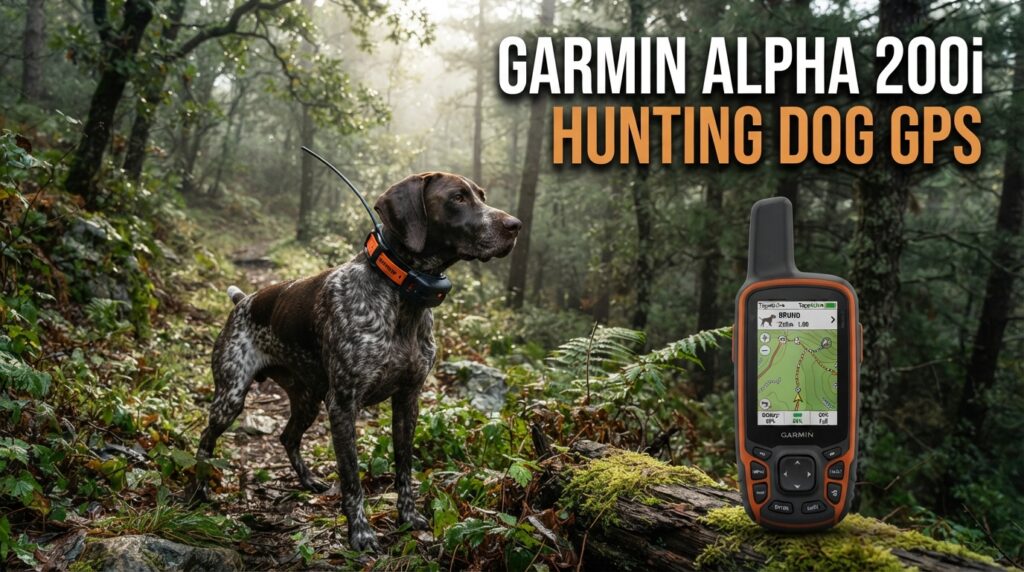
If you’ve searched for GPS trackers for dogs, you’ve probably run into the Garmin Alpha 200i and assumed it’s just a bigger, pricier version of a Tractive or a Fi collar. It isn’t. The Alpha 200i is a handheld GPS dog tracking and training system built for hunters and working-dog owners who need to know exactly where a dog is — including dogs that are a mile away, out of sight, and out of cell range. It communicates directly with a compatible Garmin dog collar over its own signal, not through a cellphone network, and it pairs that tracking with training controls, topographic mapping, and (on the “i” model) built-in satellite messaging and SOS.

- Features sunlight-readable 3.5” capacitive touchscreen display and a button-operated, dog-focused design for quick, mino…
- Easily set up and monitor up to 20 dogs from up to 9 miles away with a 2.5-second update rate by using multiple global n…
- Dog list and group management lets you keep inactive dogs in the system for easier setup
This review breaks down what the Alpha 200i actually is, how it performs in real hunting conditions, what it costs to own over time, and who should — and shouldn’t — buy it in 2026.
This article contains affiliate links. PetTrackerHub may earn a commission on qualifying purchases at no extra cost to you. See our affiliate disclosure policy for details.
Quick Verdict
The Garmin Alpha 200i is built to do one job extremely well: keep a handler connected to multiple hunting dogs across large, often roadless terrain, with training control layered on top. Its strengths are long real-world tracking range compared to cellular trackers, multi-dog support, rugged glove-friendly hardware, and inReach satellite messaging/SOS that works with zero cell signal. Its limitations are a real one: you need a dedicated handheld, a compatible collar sold separately, and — if you want the satellite features — an ongoing inReach subscription. It is not a lightweight everyday pet tracker, and it’s overkill (and overpriced) for someone who just wants to know if their dog left the backyard.
It’s the right tool for upland bird hunters, houndsmen, retriever owners, and anyone running dogs off-leash in big country. It’s the wrong tool for apartment dogs, urban walkers, or anyone who wants “set it and forget it” tracking through a phone app alone.
Garmin Alpha 200i Key Specifications
Specifications below are drawn from Garmin’s official product and support documentation. Prices, subscription costs, and exact collar bundle availability change regularly — always confirm current figures before buying.
| Spec | Details |
|---|---|
| Display | 3.5″ diagonal transflective color TFT touchscreen, sunlight-readable, 282 x 470 resolution; usable with gloves |
| Weight (handheld) | About 9.9 oz (280 g) with battery and antenna |
| Dimensions | Approx. 2.7″ x 6.4″ x 1.3″ |
| Handheld battery | Up to 20 hours (standard use); up to ~15 hours with inReach features and frequent update intervals active |
| Waterproof rating | IPX7 (submersion to 1 meter for 30 minutes) |
| Tracking capacity | Up to 20 dogs tracked simultaneously; additional dogs/contacts can be stored and enabled/disabled |
| Compatible collars | TT15, TT15 Mini, TT15X, T5, T5 Mini, T5X, T20, TT25, TT25 Mini (verify exact SKU compatibility with Garmin before purchase) |
| Tracking range | Up to 9 miles under open, line-of-sight conditions; real-world range is typically shorter |
| Tracking update interval | As fast as 2.5 seconds, adjustable to conserve battery |
| Navigation | Preloaded TopoActive maps, 3-axis compass, barometric altimeter, multi-GNSS (GPS + Galileo) |
| Satellite imagery | BirdsEye Satellite Imagery, direct-to-device download |
| Training controls | Up to 18 levels of momentary/continuous stimulation, tone, and vibration (on “TT”-series training collars) |
| inReach capability | Two-way satellite messaging, interactive SOS, weather requests via the Iridium network (Alpha 200i only; active subscription required) |
| Connectivity | Wi-Fi (for map/firmware updates), USB, ANT+, Bluetooth (for phone pairing via Garmin Explore app) |
| Internal storage | 16 GB, plus microSD expansion |
| Price (handheld only) | MSRP has been listed around $749.99; street pricing and bundle pricing vary — check the current price before buying |
What Is the Garmin Alpha 200i?
Think of the Alpha 200i as two connected pieces: a handheld unit that looks a bit like a rugged handheld GPS (because it is one), and a compatible collar worn by the dog. The two talk to each other directly using their own dedicated signal — not Wi-Fi, not Bluetooth, and not a cell network. That handheld shows you a live map with an icon for every dog wearing a paired collar, how far away each one is, which direction, and whether the collar’s sensors think the dog is stationary and pointed (“on point”), treed, or moving.
The “i” in Alpha 200i specifically means the unit has inReach satellite communication built in. Garmin also sells a non-“i” Alpha 200 without satellite messaging, at a lower price, for handlers who don’t need off-grid texting and SOS.
Because the handheld is the brain of the system, you’re buying more than a tracker — you’re buying a piece of GPS navigation hardware that happens to be purpose-built around dog tracking and e-collar training.
How Garmin Alpha 200i Dog Tracking Works
The handheld and the collar exchange location data over a dedicated radio link, independent of cell towers and independent of your home Wi-Fi. Each collar has its own GPS receiver (using GPS and Galileo satellites for positioning) and reports its position back to the handheld at whatever update interval you’ve set — as frequently as every 2.5 seconds. The handheld plots that position on its onboard TopoActive map or downloaded BirdsEye satellite imagery.
Because this is a direct device-to-device link rather than a network relay, there’s no dependency on carrier coverage. That’s the entire point for hunters: you can be five miles from the nearest cell tower and still see exactly where your dog is on the handheld’s screen, as long as the collar is within range and there’s a reasonable line of sight.
Garmin Alpha 200i for Hunting Dogs
This is where the Alpha 200i is designed to shine, and its feature set reflects specific hunting styles:
- Upland bird hunting (pheasant, grouse, quail): Pointing breeds that range out and go on point benefit from the Alpha 200i’s “on point” status alert, letting a handler know a dog has stopped and locked up even if it’s out of sight in tall cover.
- Hound hunting: Multi-dog tracking and “treed” detection (on supported collars) are aimed squarely at houndsmen running dogs in terrain where dogs may be out of visual contact for long stretches.
- Retrievers: Distance and direction readouts help handlers keep tabs on a dog working a blind retrieve or ranging through heavy cover near water.
- Dense woods and mountains: Topographic contours and elevation data help handlers understand terrain they can’t see, which matters when a dog’s collar icon shows it several hundred feet up a ridge.
- Open fields: In open terrain with clear line of sight, tracking tends to be most reliable and can approach the advertised range.
- Features sunlight-readable 3.5” capacitive touchscreen display and a button-operated, dog-focused design for quick, mino…
- Easily set up and monitor up to 20 dogs from up to 9 miles away with a 2.5-second update rate by using multiple global n…
- Dog list and group management lets you keep inactive dogs in the system for easier setup
Tracking Range: How Far Does the Alpha 200i Really Work?
Garmin’s official spec lists a tracking range of up to 9 miles, but that figure assumes close to ideal, open, line-of-sight conditions — similar to how a walkie-talkie’s advertised range assumes flat, unobstructed terrain. In real hunting conditions, several factors shrink that number:
- Terrain: Hills, ridgelines, and valleys block or degrade the signal between handheld and collar.
- Vegetation: Dense timber, brush, and heavy foliage reduce effective range compared to open fields.
- Elevation and line of sight: The more direct, unobstructed sight line between handheld and collar, the closer real-world performance gets to the advertised maximum.
- Collar model: Different collars in the Alpha ecosystem have different antenna designs and transmit power, which can affect achievable range.
- Tracking/update interval: Faster update intervals (like 2.5 seconds) draw more battery and, on some setups, can affect practical range versus slower, battery-saving intervals.
Do not treat “up to 9 miles” as a guarantee. Independent field testing from hunting publications generally describes real-world performance as strong in open country and meaningfully reduced in thick cover or mountainous terrain — consistent with how RF-based tracking systems behave in general, not a flaw unique to Garmin.
How Many Dogs Can the Alpha 200i Track?
The Alpha 200i can actively track and monitor up to 20 dogs at once, with the ability to store additional dogs or contacts in the system and toggle them active or inactive rather than deleting and re-adding profiles every hunt — useful for kennels or guide operations that rotate dogs. The practical limiting factor for most owners isn’t the handheld’s capacity, though — it’s cost. Each additional dog needs its own compatible collar, and collars are sold separately from the handheld, so tracking a large string of dogs multiplies the total investment quickly. If you’re comparing this to simpler GPS dog trackers for outdoor dogs that use one collar per subscription, the Alpha system’s real cost driver is collar count, not software limits.
Compatible Garmin Dog Collars
The Alpha 200i works with several collars across Garmin’s “T” (track-only) and “TT” (track and train) lines. Naming and availability shift over time as Garmin updates its lineup, so treat this as a starting point and confirm exact compatibility on Garmin’s site before ordering.
| Collar | Track only or Track & Train | Notes |
|---|---|---|
| T5 / T5 Mini | Track only | No stimulation training; good for handlers who only want location |
| T5X | Track only | Extended-range/battery variant of the T5 line |
| T20 | Track only | Newer track-only collar in Garmin’s current lineup |
| TT15 / TT15 Mini | Track & Train | 18 levels of stimulation, tone, and vibration |
| TT15X | Track & Train | Extended-battery version of the TT15 |
| TT25 / TT25 Mini | Track & Train | Newer generation collar with interchangeable standard/extended batteries |
A practical note: Garmin’s collar lineup has changed generation to generation (some older Mini collars have been discontinued, newer T20/TT25 collars introduced), and not every collar generation is guaranteed to pair with every Alpha handheld generation. Before buying a collar separately from a handheld, check Garmin’s current compatibility documentation or ask the retailer directly.
- Features sunlight-readable 3.5” capacitive touchscreen display and a button-operated, dog-focused design for quick, mino…
- Easily set up and monitor up to 20 dogs from up to 9 miles away with a 2.5-second update rate by using multiple global n…
- Dog list and group management lets you keep inactive dogs in the system for easier setup
GPS Tracking Performance
In day-to-day use, the handheld’s map view updates dog position markers based on the tracking interval you’ve selected, shows direction and distance to each dog, and keeps a track log you can review after the hunt. In open terrain with a clean line of sight, location updates are generally described as prompt and reliable in published field tests. In dense cover — the exact conditions upland hunters are often working in — expect intermittent lag between updates and, occasionally, a temporarily “frozen” position until signal reacquires. This is a known characteristic of RF-based tracking generally, not something specific to a bad unit.
Maps and Navigation
The Alpha 200i comes preloaded with TopoActive mapping, showing terrain contours, elevation, water features, and points of interest, and supports BirdsEye Satellite Imagery downloaded directly to the device over Wi-Fi (rather than requiring a phone connection in the field). It also supports waypoints, saved tracks, and — depending on map data available — optional display of public and private land boundaries, which matters for hunters working land access lines. Because maps and imagery are stored on the device, navigation functions work without cell service, which is consistent with the system’s off-grid design philosophy.
Training Features
On “TT”-series collars, the Alpha 200i offers up to 18 levels of momentary or continuous stimulation, plus separate tone and vibration commands, controlled from dedicated hardware buttons on the handheld so a handler doesn’t need to look at the screen to issue a correction. “T”-series collars (T5, T5X, T20) are tracking-only and don’t include stimulation training at all.
It’s worth being direct here: stimulation training is a tool, not a requirement, and it isn’t appropriate for every dog or every handler’s approach. Responsible use generally means starting at the lowest effective level, understanding a dog’s individual temperament, and — for handlers new to e-collar training — working with an experienced trainer rather than guessing at settings. If you’re not planning to use stimulation training at all, a track-only collar is both simpler and less expensive.
inReach Satellite Communication and SOS
This is the feature that separates the “i” model from the standard Alpha 200. Built-in inReach technology connects to the Iridium satellite network — which provides global coverage, including remote areas with no cell service — for:
- Two-way text messaging with contacts, independent of cell signal
- Interactive SOS, which alerts Garmin’s 24/7 emergency response coordination center and allows two-way communication during an emergency
- Weather requests for your current location or a waypoint
None of this works without an active inReach subscription, which is separate from the cost of the hardware. Garmin’s inReach consumer plans are generally tiered — a lower-cost Safety plan aimed at basic SOS and limited messaging, a mid-tier Recreation plan with unlimited messaging and more frequent tracking, and a higher-cost Expedition plan that adds features like in-device weather forecasts. Monthly Freedom-style plans (which can be paused) and annual plans are both typically available, and published pricing has ranged from roughly the mid-teens per month for entry-level Safety plans up to the $60s per month for Expedition-tier plans. Subscription pricing changes, and plan names and tiers are occasionally updated by Garmin — verify current inReach subscription plans and pricing directly with Garmin before budgeting.
For hunters working public land, backcountry, or areas with no cell coverage, this is a meaningful safety feature beyond dog tracking — it’s a personal emergency communicator that happens to live in the same handheld as your dog tracker.
Battery Life
Battery performance depends heavily on configuration, and Garmin’s “up to” figures reflect specific test conditions rather than guaranteed real-world runtime:
- Handheld: Up to about 20 hours in standard use; closer to 15 hours when inReach features and frequent tracking updates are both active.
- Collars: Varies significantly by model. Newer TT25-family collars, for example, have published runtimes around 25 hours at a fast 2.5-second update interval with the standard battery, extending well beyond that with a slower “dynamic” tracking mode, and roughly double that runtime with the optional extended battery.
- Tracking interval: Faster updates (every 2.5 seconds) draw noticeably more power than slower or adaptive intervals. If you’re planning an all-day hunt, dialing back the update frequency — or carrying a spare battery/charging option — is worth planning for.
- inReach usage: Leaving satellite messaging and SOS features active continuously will reduce handheld runtime compared to leaving them off until needed.
Practically, this means a single all-day hunt is usually well within battery range for the handheld, but multi-day trips will likely require charging or spare batteries for both the handheld and the collars.
- Features sunlight-readable 3.5” capacitive touchscreen display and a button-operated, dog-focused design for quick, mino…
- Easily set up and monitor up to 20 dogs from up to 9 miles away with a 2.5-second update rate by using multiple global n…
- Dog list and group management lets you keep inactive dogs in the system for easier setup
Setup and Ease of Use
Setting up the Alpha 200i system generally follows this sequence:
- Charge both devices — the handheld and each collar — fully before first use.
- Update firmware on the handheld (and collars, where applicable) via Wi-Fi or a computer connection, since units often ship with outdated software.
- Pair each collar to the handheld following Garmin’s pairing sequence, which typically involves powering on the collar near the handheld and confirming the connection on-screen.
- Configure a dog profile for each animal — name, collar assignment, and any group it belongs to.
- Configure tracking settings, including update interval and any alerts (like geofence-style boundary alerts where supported).
- Download maps or imagery for the specific hunting area if you want offline BirdsEye satellite detail beyond the preloaded TopoActive base map.
- Set training levels conservatively on TT-series collars, testing responsiveness before relying on it in the field.
- Test the full system — tracking range, training response, and messaging if using inReach — in a controlled setting before your first real hunt.
Most of the friction owners report isn’t with daily use (the button-first design is deliberately glove-friendly and doesn’t require precise touchscreen taps for core functions) but with initial setup and firmware updates, which can take longer than expected the first time.
Glove Usability, Screen, and Durability
The touchscreen is usable with gloves, but Garmin also built physical buttons for the functions hunters need most — power, training corrections, and screen lock — specifically so gloved hands and wet conditions don’t require precise touch input. The transflective display is designed to stay readable in direct sunlight, which matters for a device you’ll be glancing at throughout a hunt rather than shading with your hand. The IPX7 waterproof rating means it’s built to handle rain, wet brush, and brief submersion, though it isn’t designed for extended underwater use.
Charging
The handheld charges via USB, and charging-port design has varied slightly across hardware revisions and collar generations — some older units use micro-USB while newer collar generations have moved toward more modern charging connections. If you’re buying collars separately or buying used/refurbished units, confirm the charging cable and port type match what you already own, since cables aren’t always interchangeable across every Alpha-compatible collar generation.
Garmin Alpha 200i Pros and Cons
Pros:
- Real off-grid tracking that doesn’t depend on cell coverage
- Tracks up to 20 dogs simultaneously, with support for storing more
- Training controls (on TT-series collars) integrated into the same handheld as tracking
- Built-in inReach two-way messaging and SOS for remote safety, not just dog location
- Preloaded topo maps and direct-to-device satellite imagery
- Rugged, glove-friendly hardware with physical buttons for key functions
Cons:
- Significant upfront cost, and collars are sold separately from the handheld
- Requires a paid inReach subscription to use satellite messaging/SOS features
- Real-world tracking range is meaningfully shorter than advertised in dense cover or mountainous terrain
- Bulkier and heavier than a simple collar-mounted pet tracker
- Setup and firmware updates can be a learning curve for first-time users
- Multiple similarly named collar generations make compatibility easy to get wrong without checking first
Garmin Alpha 200i vs Cellular GPS Dog Trackers
Cellular GPS trackers — like Tractive, Fi, and Pawfit — solve a different problem than the Alpha 200i. They’re built to answer “where is my dog right now, anywhere there’s cell signal,” typically through a smartphone app, without a separate handheld device.
| Criteria | Garmin Alpha 200i | Cellular GPS Trackers (Tractive, Fi, Pawfit, etc.) |
|---|---|---|
| Tracking technology | Direct handheld-to-collar radio link | GPS + cellular network + app |
| Cellular dependency | None for core tracking | Required for live location |
| Subscription | Only needed for inReach satellite features | Usually required for live tracking/history |
| Best hunting suitability | Purpose-built for hunting/working dogs | Not designed for off-grid hunting use |
| Multi-dog tracking | Up to 20 dogs on one handheld | Typically one device per dog, one app per account |
| Mapping | Preloaded topo + downloadable satellite imagery | Standard consumer mapping (e.g., Google/Apple Maps base) |
| Training controls | Yes, on TT-series collars | No |
| Satellite SOS/messaging | Yes (Alpha 200i only, subscription required) | Generally no |
| Smartphone dependence | Optional (via Garmin Explore app) | Required |
| Handheld required | Yes | No |
| Best use case | Hunting, working dogs, off-grid ranges | Everyday pet safety, escape alerts, urban/suburban use |
Neither category is universally “better.” A suburban dog owner who mainly worries about an open gate is almost always better served by a lightweight cellular tracker — see our guide to the best GPS trackers for dogs for options in that category, including our full Pawfit 3 GPS tracker review. A hunter running pointers or hounds through cell-dead country is almost always better served by the Alpha system.
Garmin Alpha 200i vs AirTag
An Apple AirTag is a Bluetooth item tracker, not a live GPS tracking system. It relies on nearby Apple devices in Apple’s “Find My” network to relay its approximate location, has no independent GPS chip of its own, and has no training or hunting-specific features at all. It’s inexpensive and fine for keeping tabs on a dog around a neighborhood with plenty of iPhones nearby, but it isn’t built for — and shouldn’t be relied on for — tracking a dog in the field. The Alpha 200i, by contrast, uses genuine GPS positioning transmitted directly between handheld and collar, works without relying on strangers’ phones being nearby, and is purpose-built for exactly the scenario an AirTag can’t handle: a working dog ranging far from the handler in remote terrain.
Who Should Buy the Garmin Alpha 200i?
The Alpha 200i makes sense for:
- Upland bird hunters running pointing breeds that range out of sight
- Houndsmen tracking multiple dogs in big country
- Retriever owners who want distance/direction data during blind work
- Hunters who regularly work land with no cell coverage and want satellite SOS as a safety net
- Anyone managing multiple working dogs who needs one system to track and train them all
- Buyers comparing options for GPS trackers for large breed dogs who specifically need off-grid, multi-dog capability rather than a single-collar consumer tracker
- Features sunlight-readable 3.5” capacitive touchscreen display and a button-operated, dog-focused design for quick, mino…
- Easily set up and monitor up to 20 dogs from up to 9 miles away with a 2.5-second update rate by using multiple global n…
- Dog list and group management lets you keep inactive dogs in the system for easier setup
Who Should Consider Something Else?
The Alpha 200i is the wrong purchase for owners who mainly want:
- Inexpensive everyday pet tracking — a cellular tracker with a monthly plan is cheaper upfront and simpler to use.
- Lightweight, smartphone-only tracking with no separate handheld to carry or charge.
- Health and activity monitoring, which most Garmin Alpha collars don’t offer but many cellular pet trackers do.
- Long battery life with minimal charging, closer to days or weeks rather than hours.
- Simple urban escape alerts — a geofence notification on a phone, not a handheld GPS unit.
If any of those describe your situation more than “off-grid hunting dog,” a cellular tracker is likely the better fit — our comparison of Pawfit 3 vs Tractive XL is a reasonable starting point for that category, and our roundup of GPS trackers for outdoor dogs covers options between the two extremes.
Garmin Alpha 200i vs Other Garmin Alternatives
Garmin also sells the Alpha 200 (without inReach, at a lower price, for hunters who don’t need satellite messaging) and the newer, higher-end Alpha 300/300i line, which generally offers a longer-lasting battery, a different display technology, and broader collar compatibility with Garmin’s newest collar generations, at a higher price point. If satellite SOS matters to you but budget is tight, the standard Alpha 200 is worth comparing. If you want the longest possible battery life and don’t mind paying more, the Alpha 300i is worth researching directly on Garmin’s site before deciding between them.
Common Questions / FAQ
Does the Garmin Alpha 200i require cellular service? No. Core dog tracking works over a direct radio link between the handheld and collar, independent of cell towers. Only the inReach satellite features use a separate network (Iridium satellite, not cellular).
Does the Alpha 200i require a subscription? Not for basic GPS dog tracking and training. A subscription is only required to use the built-in inReach satellite messaging and SOS features.
Does the Alpha 200i work without cell service? Yes — that’s the core use case. Tracking, training, and mapping all function without cell coverage, and inReach messaging works via satellite rather than cell towers.
How far can the Alpha 200i track a dog? Garmin lists up to 9 miles under open, line-of-sight conditions. Real-world range is typically shorter in dense woods, mountainous terrain, or heavy vegetation.
How many dogs can the Alpha 200i track? Up to 20 dogs simultaneously, with the ability to store additional dogs/contacts and toggle them active or inactive.
What collars work with the Alpha 200i? Garmin’s T (track-only) and TT (track-and-train) collar lines, including models like the T5, T5X, T20, TT15, TT15X, and TT25 families, though exact generation-to-generation compatibility should be confirmed with Garmin before purchase.
Can the Alpha 200i track dogs in dense woods? Yes, but expect reduced range and occasional lag in position updates compared to open terrain, which is typical of RF-based tracking systems generally.
Does the Alpha 200i have SOS? Yes, via built-in inReach satellite technology, which requires an active subscription and routes to Garmin’s emergency response coordination center.
How long does the battery last? Up to about 20 hours on the handheld in standard use, less with frequent inReach use and fast tracking intervals. Collar battery life varies significantly by collar model and tracking interval, generally ranging from roughly a full hunting day to multiple days depending on the collar and settings.
Is the Alpha 200i waterproof? It carries an IPX7 rating, meaning it’s built to withstand rain and brief submersion, though it isn’t designed for extended underwater use.
Is the Alpha 200i good for hunting dogs? Yes — it’s specifically designed for this use case, unlike general-purpose pet trackers, and is a common choice among upland and hound hunters based on published field testing and retailer/user feedback.
Is the Alpha 200i worth considering in 2026? For hunters and working-dog owners who need off-grid, multi-dog tracking with training controls, yes. For owners who just want basic pet location tracking, a cellular tracker is usually a better value.
Final Buying Considerations
The Garmin Alpha 200i isn’t a “better AirTag” or a premium version of a cellular pet tracker — it’s a different category of product built for a different job: keeping a handler connected to working dogs across real hunting terrain, without depending on cell towers, while layering in training control and off-grid emergency communication. That focus is exactly why it’s the wrong choice for someone who just wants to know if the dog got out of the yard, and exactly why it’s a strong option for someone running bird dogs or hounds through country with no cell service.
Before buying, total up the real cost of ownership: the handheld, a collar per dog, and — if satellite messaging matters to you — an ongoing inReach subscription. Compare current pricing on Amazon or check the latest Garmin package options directly with Garmin before deciding which bundle fits your setup, since collar bundles and promotional pricing change throughout the year.
Pingback: Garmin Alpha 200i vs Tractive GPS: Which Is Better for Outdoor Adventures?
Pingback: Best GPS Trackers for Hunting Dogs and Working Dogs in 2026 - PetTrackerHub – Pet GPS Tracker Reviews & Comparisons
Pingback: Garmin Alpha 300i Review: Is This Premium GPS Dog Tracker Worth It? - PetTrackerHub – Pet GPS Tracker Reviews & Comparisons
Pingback: Garmin Alpha 300i vs Tractive GPS: Which Dog Tracker Is Right for You? - PetTrackerHub – Pet GPS Tracker Reviews & Comparisons